how do I know "How big I can go?", until.....

Re: how do I know \"How big I can go?\", until.....

Cranes will go a long way in helping the climber understand weights involved. Good point, I was going to mention it but this discussion had sort of devolved by that point.

Tom
 
Re: how do I know \"How big I can go?\", until.....

"One thing that gets me is watching videos of people rigging, think the rope, the pulley and the groundy will control it.

Yet there is no principle of the:

'Its only as strong as the weakest link'

so that in mind, I see old alloy 24kn carabiners, a stem ready to split, rope with a poor knot, potential rope friction on the swing, the list goes on...... "

What is the weakest link ? The tree the Ground guy ? You ? My list goes on too ! Sounds like you see a lot of homeowner stuff . In my my world we do control it , and the weakest link was known , before the deal . Your only as strong as your weakest post . Not you. T
the tree tool , keep your charts handy , don't know what you do with out those hands ! Kiddn , Banjo will tell me , big hands big feet big mistake , I mean , small rope , small limb , big crotch , wait , umm, Size matters ! That's what I was trying to say ! Listen , whoever posted this , you are with the wrong people . quit , work for some else . Take the log chart to the head with you , but go work with someone , just not someone with their first name and than thetreeman after it , move on . Dangerous game your playing .

 
Re: how do I know \"How big I can go?\", until.....

the weakest link is whatever.

I have broken steel carabiners at 500kgs, and bend a few alloys at 300kgs.

I make sure my lowering rope is the weakest link, and add more rigging points, slings, carabiners and pulleys to make up for a potential fail.
 
Re: how do I know \"How big I can go?\", until.....

Get your advice/training from a reliable source. Not everyone on the "Buzz" is reliable, although they talk a good game.
Rope is a tool. Your life and the lives of others depend on this tool. Stay within the 'Safe Working Loads' of all tools. Learn the ABS (average breaking strength) of the ropes you use and don't exceed the loads by more than 20% of the ABS, including the shock loads. Bigger logs, bigger rope.
I find the "green log weight" charts to be very helpful. I just did 4 days of rigging training and that was 1 of the handouts. Send me a PM if you want one.

Stay safe. Go home to your family everyday.
 
Re: how do I know \"How big I can go?\", until.....

I've never looked at a green log chart in my life because I worked as a groundie for 2 years before I learned to climb. In those 2 years I learned the weight of different tree species/sizes of timber/branches etc.

Rigging is about so much more than green log charts which to me are, and will always be - a total waste of time. I would actually discourage their use. If you're craning out and need to use a green log chart you shouldn't be working on crane removals. If you're rigging from the tree you shouldn't need a green log chart.

Here's some thoughts/ideas on rigging -

1. you can't know the working load limit of any part of a tree. Assume it's the weakest part of your system. Even if you have a good awareness and understanding of Visual Tree Assessment/the body language of trees (being able to identifiy obvious structural weaknesses), there will still be hidden weak spots inside the tree. This should always be at the forefront of your mind when choosing how your going to set up your rigging. Are there any obvious structural defects in the tree? if so, how will you work around this issue? Do we need to use rigging at all? use a bucket truck? crane? fell the tree in one go from ground level?

2. be aware of current industry best practices, think about your rigging setup/equipment and base it around recommended safety factors.....

3. choose ropes and rigging equipment that are very strong for the forces and loads that you expect to create....safety factors, working load limit etc.

4. what is the objective of the rigging? to avoid damage to structures etc? but will it fit in with the space around the base of the tree/landing zone? how much space have you got to rig the timber/branches into? this will help guide you on the sizes of branches/timber you rig.

5. What rigging equipment do we have available? what's the condition of the rigging equipment? how much use has that rigging line had? was it badly shockloaded at the last job? has the rigging equipment been in constant daily use on big jobs? does any of it need replaced? do we need to take smaller lighter pieces/branches? do we need to replace the rigging line before we start this job?

6. whose working today and what level are they at in relation to rigging experience? how many people on the ground?

7. where will I position the block(s) to achieve the best results? think about the angles and forces being created, will it swing far enough away from the house? where will I set my tie in point for my climbing line?

8. what is the estimated weight of the branches/timber? should I start off rigging small so that I and the groundie can get a feel for the weight before we go bigger?

9. What species of tree are we working on? fibrous wood, brittle wood? how will this affect control of hinges, what type of cuts will I use?

10. The client has paid for a professional job, how do we avoid damaging buildings, walls, pots, garden furniture etc? can we move things out of the way/landing zone? plywood the roof of the conservatory/glasshouse?

11. what is your acceptable level of risk when making decisions in the tree? take big pieces? will the rigging point in tree take the heavy loads? go small? how will this affect the time on the job? ie choose the optimum size of timber/branches that your comfortable with and your experience dictates.

12. are there any underground utilities that have the potential to get damaged during the rigging? are you letting heavy pieces run through the rigging all the way to the ground etc.

14. weather conditions? too windy? too wet? will the weather interfere with the rigging to a point where the job has to be stopped temporarily?

.
 
Re: how do I know \"How big I can go?\", until.....

Reply to tuttle -"the weakest link is whatever.

I have broken steel carabiners at 500kgs, and bend a few alloys at 300kgs.

I make sure my lowering rope is the weakest link, and add more rigging points, slings, carabiners and pulleys to make up for a potential fail.

--------------------
splicing and ropes available to order - email for details"
Whatever what ? are you high ? I ve never used steel carabineers to lower , EVER. Comes a time and a moment when you want the tree to be the weakest link . At no point do I want the rope to break . Stupid thinking , wrong approach .

Norm- Respect you like not many . You said -
"Get your advice/training from a reliable source. Not everyone on the "Buzz" is reliable, although they talk a good game."

That's not fair . Define reliable source . years of experience ? Pictures ? Arbor Masters ? How about this ... Industry is watered down to the point where a young climber is left to log charts and the internet to learn how big of a piece they can safely remove from a tree stem . SAD ! personally I don't think Tuttle ever cut a large limb out in his life and the log chart is only useful for cranes .
Walk the talk but it ain't no game . You rope it , notch it , rig it , that moment you make the back cut , your either confident or scared , than you become confident and scared , that's where you want to be . Or just take out sissy pieces , make less money and live forever .
 
Re: how do I know \"How big I can go?\", until.....

[ QUOTE ]
Cranes helped me understand wood weight. Sometimes you go big. Blew this pine top down end of today on Rope. Wanted to go home.
grin.gif


[/ QUOTE ]

nice!
wind resistance with a big top like that makes a HUGE difference in the forces involved... if you did the math on JUST the weight of that top and the distance fallen, the numbers would get way out of control... the sweeping motion and the wind resistance make a top like that very doable... of course I'd feel a lot better taking out a top like that from the bucket... Good job!
 
Re: how do I know \"How big I can go?\", until.....

[ QUOTE ]
You rope it , notch it , rig it , that moment you make the back cut , your either confident or scared , than you become confident and scared , that's where you want to be . Or just take out sissy pieces , make less money and live forever .

[/ QUOTE ]

http://www.youtube.com/watch?v=W08WlmOrmaY

seems like this guy was going too small on the rigging, then he switched out to bombing chunks... I HATE THAT!

If he took bigger pieces on the rope it would have been faster and safer than bombing out those chunks... Personally I just hate all the dust from cutting chunks..
 
Re: how do I know \"How big I can go?\", until.....

@riggs

The reason for the 'rope' comment, is because if you know that a carbiner or pulley is weak...what do you do? add more?

The rule of rope is the guide, if a 5000lbs rope then you know its limits, and its the only thing to worry/think about.

Because if everything else rates at 20,000lbs, you know there are only 1 or 2 factors that may fail.

That said you only cut what the rope will cope with safely.
 
Re: how do I know \"How big I can go?\", until.....

Q. what do you define as a large limb?

A= anything bigger than what tuttle has ever cut in a tree .
 
Re: how do I know \"How big I can go?\", until.....

[ QUOTE ]
I always feel like Im wondering if a peice im cutting is too big or too small and im being ineffecient or going to break a crotch.
So im wondering how do I teach myself how much weight natural crotches and even false crotches can hold? and all the other questions that come into play when rigging big wood?

[/ QUOTE ]

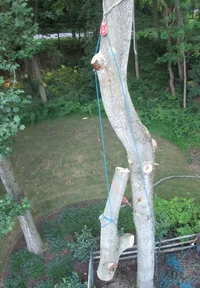
Here's a piece of standing dead tulip we rigged off the spar (negative blocking) today, on 1/2" line.. groundie said he barely felt it... only targets were a fence and some shrubs.. that dry tulip is light.. I would have gone smaller or at least switched out to a heavier line of it was oak.. Stretch in the line is important.. hopefully the groundie lets it run a bit too!
 

Attachments

  • 368095-bigrigresize.webp
    368095-bigrigresize.webp
    186 KB · Views: 121
Re: how do I know \"How big I can go?\", until.....

[ QUOTE ]
your sling was tied lazy , way too loose .

[/ QUOTE ]

agreed... that's something I AM usually on top of... the extra drop makes a huge difference in the force... I see a lot of guys leaving a foot or two of neck in their slings as SOP... NFG...
 
Re: how do I know \"How big I can go?\", until.....

Riggs has attitude to fill a chip truck...and knowledge to fill more.

Ignore his attitude and try to listen to what he's saying
 

New threads New posts

Back
Top Bottom