Help with diagnosis

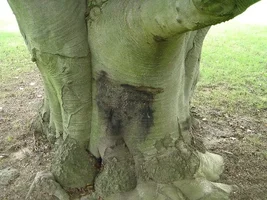
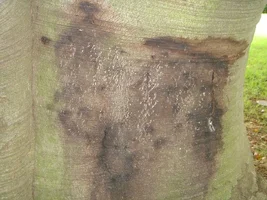
I noticed in the close up there are some pin holes in the bark may be borer or bark beatle. Noticed the first in the upper left darkest spot. then used the curser like a switch back in CO down the stained area and picked them out. Most of them are in the darkest areas.
 
I think it looks like a couple things going on there. The white spots are probably scale. The holes could be from a bark beetle. The oozing is most likely caused by nectria canker also called beech bark disease. It is quite difficult to control.

The beetles come in causing wounds then the nectria canker comes in later. I think even pruning can contribute to the spread within the canopy.

If the site is irrigated causing water on the trunk, it creates a good spot for more infestation.

Beech Bark Disease has been claiming a good number of beeches here in philly.

Steve
 
Bleeding canker, caused by Phytophthora citricola. To ID cautiously pop off dead bark; the recently killed cambium is bright red. Sinclair/Lyon Diseases of trees book p 356. Can be suppressed by calcium or gypsum fert and killed by surgery and heat. I'd use agri-fos on it too.

Mark I hope your company goes more into diagnostics and treatment of stuff like this. Important to charge by the hour, as who knows? how long it takes to do. It can be a very straightforward and valuable service to your clients.
 
Thanks gang. Always use all of your resources and Treebuzz is my favorite!

[ QUOTE ]
Mark I hope your company goes more into diagnostics and treatment of stuff like this. Important to charge by the hour, as who knows? how long it takes to do. It can be a very straightforward and valuable service to your clients.

[/ QUOTE ]

"We" do Guy. I sometimes like to make sure that everything on our clients property has been noted and everything we can do is being done. This tree is very important to them so I'd like to hear from you all on this to double check what we are thinking at Aspen. I appreciate it a great deal.
 
Cool deal. thanks also for the reminder on nursing home choice. very sobering. I think I'll go make em a nice dinner now. /forum/images/graemlins/cool.gif

re phytophthora, to see these treatments in a mainstream reference is encouraging.

Excising and cauterizing infections and treating phytophthora such as SOD with calcium and other soil work are considered "fringe", even "snake oil" by some. Sinclair/Lyon's recognition seems like validation, and a reminder that controversial, experimental or not generally accepted methodologies can provide value to clients, and the public, and help our trade advance and evolve. And they can also get into texts before long. :)

Hats off to those who Labor boldly and take chances that help trees survive and thrive.

/forum/images/graemlins/lily.gif
 
Is there any die-back of the crown?

Is it localised to the same side or just low branch of the crown? If it is, it could be phytophthora. Not much you can do about that, except monitor for the decline or onset of decay behind discoloured bark.

Looks more like the onset of Beech Bark disease to me though - Nectria coccinea and Cryptococcus fagisuga (Don't you just love saying those names with different accents? /forum/images/graemlins/grin.gif).

Not much you can do about that either, although the coccus can be washed off with soapy water, and is actually effective compared to other snake oils. If they're kept at bay, the canker might occlude without spreading further.
If not, monitor for further ill health and onset of decay behind the lesions. Washing off coccus regularly has helped prevent decline from infestations over here before.

I don't know if a fertilising programme might help it resist decline?

Let us know what you decide, and good luck! /forum/images/graemlins/cool.gif

 
It looks similar to a small discoloration on the lower right part of the trunk just around the corner from it, as well as a discoloration below it in an area that looks like a tiny hollow.

It's almost as if there might be something in the trunk, that's emerging in several areas.

Doesn't the lower flare look a little bit more pimpley than normal?
 
I know it's just going from a photo, and it's hard to tell, but I'd have to agree with Guy, looks phytophthor-ish to me, with some borer action after. It looks like a European Beech, they seem to have that kind of horizontal wrinkle look on the bark more and the "pimpley" flare.
p.s. Guy, have you tried Agri-fos on any eastern phytophthora species? If so, have you had any results?
 
generally when i see this on beech i'm thinking nectria, but there aren't any red-orange pustules for a positive i.d. i'm thinking phytophthora cactorum or citricola (and don't forget what appears to be exit holes)
 
I don't hink those are borer holes; that used to be my assumption too. The cankers are bleeding. That is why it's called bleeding canker. Mark can you cautiously remove the dead bark and look for insect holes? Betcha a nickel there are none.

I try to use agri-fos on the bark around the wound after disinfecting the exposed wood with hydrogen peroxide. /rate of callusing depends on a lot of things so hard to say what effect agri-fos has but read the label; it seems good to try.

Soil work also: Since some decay can be compartmentalized by a tree with adequate resources, the risk from decay may be lowered over time by managing the soil to increase those resources. Mulching, fertilizing with Ca etc, inoculating with microorganisms, and irrigating can encourage new root growth and increase the tree’s vitality and resources to resist decay.
 
Guy,
Please correct me if I'm wrong but aren't the borers related to BBD only cause tiny pinhole type instrusions, more like a sapsucker than an actual borer and you won't see any borer activity. Then the nectria gets in there causing a perenial wound, just kind of festering.

Mark,
I believe there are field tests you can due to determine if it is phytophera or you can send the samples away to a lab (more accurate). I can't think off the top of my head who does it though. Maybe someone else knows exactly.

Steve
 
hb good question. The holes I've looked at from these cankers do not have any sign of insect chewing, just ruptures. And these infections are bad even if nectria never invades. Nectria is often a secondary problem, as seen in the last Detective Dendro article in Arborist News.

Mahk, the Ca is less available to the tree after pH changes. Al, which is toxic at a certain level, is drawn up in its place. So making more Ca available works to retain the original mineral balance. Ca is important to cell walls just as it is making good bones and teeth.

I think that is why Sinclair/Lyon seem to recommend it.
 
There are test kits available for field diagnosis of phytopthera, I have an email link to a supplier, Horti International (I dont think they have a website) that is local to me in Vancouver BC, if anyone wants it, pm me.
 
Just to let you all know what we had decided previously to my post, we had told the client that it was a bleeding canker. We told her to have her sprinklers adjusted to avoid splattering the trunk. We also recommended adding some bios to the soil to try to keep the tree in full vigor. I will ask to see if we suggested CA added. Thanks a bunch for the feedback. It is greatly appreciated. I love having Treebuzz to turn to.


I actually took down a large Beech today (copper). It had canker all over one side of it. Half the tree was dead and failing in the yard. Sad to see them go.
 

New threads New posts

Kask Stihl NORTHEASTERN Arborists Wesspur TreeStuff.com Teufelberger Westminster X-Rigging Teufelberger
Back
Top Bottom