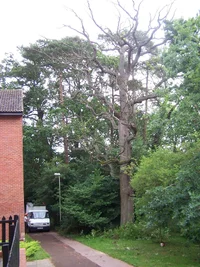
Good Call

I am planning to invest in twenty or so when the time is right, seems like they are a handy piece of kit! I would like to lay hands on one before I order though, perhaps in MN or at some other get-2-gether.
 
Not trying to throw rocks, but why can't the sales folks sound the trunks? Just a walk around the base, tapping with a closed pocket knife would have caught this one.

I don't know how you can bid a job with any accuracy if you can't identify the hazards involved, and have a work plan in mind.

My previous employeer would come in to the office at the end of the day, "I sold a big job today. You'll have to figure out how we're gonna do it." Those were ussually "good training jobs", as we didn't often make much of a profit on them.

Louie Hampton
 
Sales people sell they are incredably busy. I do not want the crews to have the impression " The sales person said it was safe". Crew leader makes all final decisions. These situations happen a few times a year when your selling millions of dallars of work you can expect it, that is why I feel it is more important to train the field crews. The sales staff always gets the red flags.
 
[ QUOTE ]
If your doing "millions" then you've obviously hit on a method that works for you. My thoughts are colored by my own experiences on a much smaller scale.

Good on you for having crew leaders that can, and do speak up.

[/ QUOTE ]

Amen brother.
 
[ QUOTE ]
Norm tought me to sound trees many years ago. The decay at the base was not detectable by just looking that is how the sales associate missed it. Sound your trees.

[/ QUOTE ]

Not quite, the decay is very visible if you look at all the signs. The area in red would be a big sign for main stem, root damage, the area in chartruse is another sign,a bad one, very obvious. In the first pic of the half dead crown of the tree it has root problem written all over it.

Not being critical, the sales person dropped the ball on this one, the signs were there even without the sounding. Training the eye to look for details like this is a good way to spot a tree that could be trouble.

I applaud your company policy on sounding trees and having the crew leaders make the final call, they are the ones doing the actual work and who knows you just might have avoided a potential serious accident.

I had a similar incedent this spring involving a Walnut that everyone thought was a verneer grade log. While doing the estimate for the people I pointed out signs on the main that showed it had defects in the stem, to prove it to them I went back and got my rubber mallet from the truck, sure enough a big resounding hollow thump could be heard. The final cut proved the mallet doesn't lie.

Going against the grain of the thread here, just my two cents worth.

Larry
 
We use those mats too, saved my behind doing some pruning right before graduation (4 hours before) for a high up dead branch that was said to leave till graduation was over. Love those mats cause if not turf crew would have loved us even more.
 
The small area in red is probably old mechanical damage from the construction. Tip die back is very common around here. So is a little decay like in your posted pic. Decay like that is daily around here. All of the other decay had all of the bark on with no signs. The small area of wound wood is the only solid part of the trunk. All that bark on the ground came off by Luis.
 
Too hard to tell from the pic. With the research Bartlett did saying around 70% of tree failures happen at 4' above the ground or lower it's too hard to tell with out a complete and systematic inspection
 
I might cosider it if I could get a closer look. I think above ground its fine. But all the rain you get keeps things moist below ground, so who knows what's down there.
 
Now, I haven't been an arborist as long as some others on this site, but I am a tree fanatic and am constantly observing trees in both their natural setting and urban settings. One thing I do pay close attention to is dead trees and how long they stand on there own in both situations... I realize that different species have different levels of decay resistance, and of course every situation is different so this is always taken into consideration.

When I look at a dead urban tree such as this it immediately gets a slightly higher price tag due to the hazard level. First choice should always be to flop it if there is room. When deciding to climb a tree or not I figure, "are the Lilacs underneath worth the price of my life if this tree fails with me in it?" NO! Rigging and shock loading a dead tree are beyond mindless if you are tied into that same tree. If the landscaping is that important, or if the tree is over a house then the customer must agree to the price of a crane. The tree in question can easily be removed in sections with no shock loading at all using a crane (providing there is room, and all other obvious variables involved). If worried about the baserot... toss a throwball in it, pull up a rope and give it some gentle to strong tuggs... observe how the tree responds, i.e. swaying movement... this will give you at least some idea of the soundness of its roots. Also, when deciding whether or not to climb, consider this: determine the actual weight of the entire tree, (wood mass) compared to how sheltered it is (wind resistance) compared to how long the tree has been standing dead/rotting, compared to the species (wood strength). Now fugure how much you weigh... you won't be shock loading it, so your climbing wieght will be "COMPRESSION" stress (very important). Do you think that your compression/climbing stress will outwiegh the standing mass and wood strength of this tree? If so... don't climb it: rent a small skylift, or bucket truck. One other note to remember when flopping a dead tree... dead wood doesn't hing the same as green wood. I've seen dead trees break under their weight in the wrong direction once the back cut was deep enough.

Climb safe.

 
Good Points. We summed it up in as many ways as possible. Dropping was not an option, due to space, there wasn't any. No space for a crane or bucket. You can see my truck in the picture, thats squeezing in down a cycle path about a quarter mile from the nearest road. Then we had to reverse back out again.

We had do adopt a slightly unusual method for this one, I'll post the pics later.
 
Not that I would use one, but if you got your truck down there, a 70ft tuepen lift would have easily got in.

Looking carefully at the size of your LDV, you also could get a 20 tonne citycrane in there - but thats just looking at the picture, I dont know what else there was to get through.


did it overhang the roof of the building?

Kato ultra compact 20 tonne city crane.
10T%20kato.jpg
 
First distant impression says it has a good strong taper, so not much resonance when rigging. If it isn't decayed excessively in butt, branch and root, I'd be inclined to climb and rig. However, swinging dead branches leads to a lot of deadly shrapnel for surrounding targets - would that matter?

Throw a line up, pull up a rope and give it a few good tugs.

Have you drilled it?
 

New threads New posts

Back
Top Bottom