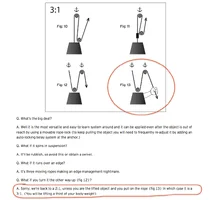
Using a few of the diagrams from that DMM article, here are some numbers, using a 180 lb climber, to demonstrate the forces involved. All the verticle forces must balance.
First case, where a 180 lb climber on one end of a line requires 180 lbs on the other side to balance the load. The combined forces on each side sum to exert a total of 360 lbs on the anchor pulley.
Next case, where the tail of the line is connected to the load (climber). Now each side only has to support half of the total load, or 90 lbs each, placing a 180lb load on the anchor to balance your 180 lb body. So if YOU are the load, you only need to exert a little more than 90 lbs to lift yourself.
Case 3 - I am standing on a limb next to your canopy anchor. I have to exert only 90 lbs to hold you. The canopy anchor is pulling the other 90 lbs.
Now it gets complicated. We anchor a second pulley above. It's a combination of the first and third case. The climber's weight is divided and supported by 90 lbs on each leg from the pulley at the load. The 90 lbs on the leg going to the higher pulley must be counteracted by 90 lbs on the tail leading to the ground. A groundie could lift you by exerting just over 90 lbs.
Finally, the combination of case two and three. Take the tail and connect it to the load. Now three legs are available to support your weight - 60 lbs each. It takes only a force of 60 lbs to lift yourself.