Getting back from a limb walk.

Which link, Dave?

Let's try to keep personal insult aside? You said it, you're a tree man, not a mathematician. So why do you disagree with them, the mathematicians? Am I missing the part where you transcend the laws of physics simply by donning a tree climber' s harness?
 
I measured the leg of rope were the effort was being applied, as is the proper way.
I just looked at your video. You said "I moved the tail four feet to advance the load two feet." That was from the upper pulley. That's not where you, the climber, would be pulling from. You have to include the two feet from the top pulley down the tail to the point next to the BDB. You have to pull yourself up two feet in the process of pulling four feet of rope through that BDB. You would pull six feet of rope to raise yourself two feet.
 
Yep, when you're the anchor and the load, the anchor moves up with the load. When you hand that same anchor line to someone else, the anchor is now stationary and only the load moves. Since the difference is the anchor moving or not, this changes the amount of rope moving through the system (at the NEW anchor point )and the advantage gained.
 
That is precisely where I would pull from, were I the climber.

So increase the distances by a factor of ten: 20' and 40'. If you're suspended 20' below the revolver, you can't pull from there. If you pull yourself up tight to the top, you have to pull that 20' of tail plus all 40' of the rope that runs from the anchor through the BDB and the revolver.
 
I can remember when I first started climbing SRT for limb walks too. It felt funny because I was used to pulling twice as much rope to achieve the same distance. Eventually I began to realize that limb walking SRT was more efficient because it takes less time. If you feel like a particular limb is too far away from your anchor point, no problem, setting a re-direct is fast. Or if it's a rather large section of the tree you can set a re-direct after you get out there.
 
Let's say you weigh 180 lbs. You're tied on the end of a rope. The rope goes through a pulley suspended from a limb and back down to the ground. Someone else would have to pull at least 180 lbs to lift you off the ground. Each leg of the rope has 180 lbs of tension on it. (And like a basal anchor, the limb is feeling 360 lbs from the combo.)

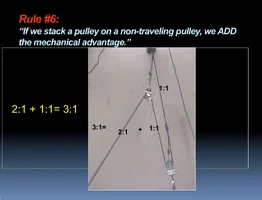
Now, you grab the tail yourself. How much force do you have to exert to lift yourself? Just 90 lbs, because now each leg of the line is supporting half of your weight. That's how you get yourself off the ground climbing DdRT. The force has to be referenced to the climber.

In the haul back system with the extra pulley, you have three legs supporting your weight and you only have to pull a third of your weight to lift yourself.
 
Come on dudes, let's see some links to data and formulas supporting your claims! I put up a handful of links to credible, 3rd party information to support mine...
 
I can remember when I first started climbing SRT for limb walks too. It felt funny because I was used to pulling twice as much rope to achieve the same distance. Eventually I began to realize that limb walking SRT was more efficient because it takes less time. If you feel like a particular limb is too far away from your anchor point, no problem, setting a re-direct is fast. Or if it's a rather large section of the tree you can set a re-direct after you get out there.

That is so true! With SRT the tree can be worked in columns. You can set a primary suspension point at a good high central location, and then shoot out a high lateral and set a redirect. Drop down the outer canopy and eliminate the need for limb walks altogether. Then ascend back up and set the next quadrant redirect to work the next column of the tree.
 
Links like that are probably out there but hard to find. In what applications is the load pulling itself? Maybe a dumbwaiter or elevator? That's why all these pulley diagrams are referenced to someone who isn't moving with the system.
 
Come on dudes, let's see some links to data and formulas supporting your claims! I put up a handful of links to credible, 3rd party information to support mine...
Levi what is so cool is we are in the leading edge of technology in this industry and there hasn't been much of a history at all with the load being the hauler...when has that really ever been the case. even in rescue rope work there is a team that is at the hauling end. There is little information about the hauling being linked to the load, but all of these examples are all demonstrating that there is a clear difference when you pass the haul line to the climber.

Edit: I guess Tuebor and I were on the same page.
 
How about "On Rope"? Scour the book, there is no mention of this extra M.A. Surely the authors would have been aware of this... no?
 
So maybe there needs to be a 2:1/2 sort of notation for the climbers perspective.

Levi, I agree there is a lot of rules and literature discussing the hauling perspective, but that doesn't negate the fact that it is much easier to haul yourself up a tree then having someone else haul you up. The climber is climbing the haul line. The hauler is merely pulling and is stationary. This has to contribute to the mechanical advantage. But I totally get the reservations you have with the conflicting facts or what seem to be conflicting.
 
I don't think you will find it mentioned in On Rope because they were primarily cavers only interested in SRT.
 
Certainly, however there is an outline of a tree climber's taught line system, no mention of MA. There is also extensive information regarding MA and some self belay rescue systems that are the same as the climber haul back system. No mention of this extra MA though...
 

New threads New posts

Kask Stihl NORTHEASTERN Arborists Wesspur TreeStuff.com Teufelberger Westminster X-Rigging Teufelberger
Back
Top Bottom