Fungi ID help

evo

Been here much more than a while
Location
My Island, WA
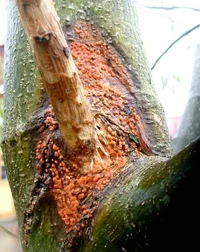
Just wondering what is infecting this Mimosa tree. The fungi is scattered though out the canopy and invading the trunk though this dead branch.
New to this so any help would be great!
Thanks
 

Attachments

  • 202974-S7302459.webp
    202974-S7302459.webp
    86 KB · Views: 172
nope from location and color and looks more like coral-spot nectria, N. cinnabarina. very common on oaks here as a saprophyte. wilt may be an aggravating influence though.

what's a drink made of champagne and orange juice called?
 
"what's a drink made of champagne and orange juice called? "


Ficken nasty that's what!
drinking.gif
drinking.gif
 
So taking the photo into account; the larger stem in the photo is the trunk. The tree is still really small about 15' max. Is there much that can be done?
 
Nevermind..... should read 1st and then ask right?


"Control
Fusarium wilt is a lethal disease for which there
are no controls. However, most tree species are
not susceptible to Fusarium oxysporum f. sp.
perniciosum, so replacing diseased mimosa with
a non-susceptible host tree (i.e. genera other
than Albizia and Ailanthus) is the best option.
Currently, there are only a few mimosa cultivars
(‘Charlotte’, ‘Tryon’ and ‘Union’) with
resistance to Fusarium wilt. However, these
cultivars do not appear to be widely available in
the nursery trade and strains of the Fusarium
wilt pathogen have been reported to overcome
resistance in ‘Charlotte’ and ‘Tryon’. Resistance
to Fusarium wilt also appears to break down
when root knot nematodes are present."
 
Evo, it's not Fusarium, Guy got it right, it's coral-spot nectria, N. cinnabarina . I found some online literature advocating trimming out areas where it's showing during the dry season. Literature said it's not a killer. Same text also said it enters via wounds, which would seem to pose a pruning challenge. I'll defer to Guy on treatment options, since he's encountered it
 
[ QUOTE ]
what's a drink made of champagne and orange juice called?

[/ QUOTE ]

Bucks Fizz.

Nectria sp are Ascomycete fungi they are very widespread we have a great variety in Oz they are mainly considered saprophytes (of course Nectria cinnabarina is considered a plant pathogen), persistant and robust...target cankers often seen on Eucs here are the result of nectria sp infections.
 
the drink is called the mimosa--that's what triggered the solution of the attached case; verrrry obscure.

evo if the client likes the tree why not excise the wound--cut out the dead tissue and the infected margin, then cauterize the infected wood with blowtorch
 

Attachments

Guy that sounds like fun and a good idea. My only concern is the photo is of the trunk about 5 feet up the trunk. As you can see the infection covers about a 1/4 dia of the trunk. So relative to the tree's size it's a fairly large wound. Has anyone here tried to cauterize with a piece of steel rod to reduce heat dispersal into living (non infected) tissue?
 
[ QUOTE ]
Guy that sounds like fun and a good idea. My only concern is the photo is of the trunk about 5 feet up the trunk. As you can see the infection covers about a 1/4 dia of the trunk. So relative to the tree's size it's a fairly large wound.

[/ QUOTE ] well when the alternative is removal, whaddya gotta lose??[ QUOTE ]
Has anyone here tried to cauterize with a piece of steel rod to reduce heat dispersal into living (non infected) tissue?

[/ QUOTE ]Hmm like a branding iron? no, not sure there would be adequate heat dispersal into infected tissue? and since surfaces are uneven ya might miss a spot.
 
Yes a somthing like a branding iron just what I was thinking only i lost the name for it. I'd think that you would get less collateral damage that way. Keep ya posted if it happens. And also if I can explain why I want to take a blow torch to his tree. I'll be sure to get some weird looks since it's a coffee shops front tree!
 
[ QUOTE ]
Yes a somthing like a branding iron just what I was thinking only i lost the name for it. I'd think that you would get less collateral damage that way. Keep ya posted if it happens. And also if I can explain why I want to take a blow torch to his tree. I'll be sure to get some weird looks since it's a coffee shops front tree!

[/ QUOTE ]
 

Attachments

Interesting reading, Guy. The report mentions follow up research in the years following; as this was referencing 1999 and 2000, have you come across any followup literature revealing the results of further research?

Evo, according to a friend in British Columbia, whose climate may be closer to what you experience, N. cinnabarina is a real problem. It apparently is aggressive and prevalent.

Whereas I am definitely not opposed to experimental treatments, I would assure myself that any treatment of this area would not create additional instability in this tree. (You mentioned a coffee shop, so I am picturing pedestrian and vehicular traffic.) Of course, you also need to determine if this infection itself compromises the integrity of the tree in its location. This is a small tree, though, so you should readily be able to assess the situation.

Keep us posted on what you decide to do. If you do proceed with any excisement and treatment, I hope you post pictures.

David (hubby) has a theory that the charred epidermis itself presents an unsuitable environment for fungal attack. This primarily from anecdotal observations here in our locale...may or may not be applicable elsewhere.

Sylvia
 
The Client has given me free reign on past jobs for me to do what ever I think is nessary. He has also offered 150% in trade back to me, so if any of you come by my lil island I'll be sure to buy you a cup or two.
I'll keep every one here posted!
thanks for the help
 
what is the possibility that it is too orange to be N. cinnabarina, but rather a different Nectria? I might have a name for it later.

I've been told that Nectria is somewhat of a secondary problem. What about site/ cultural practice improvements? Any necessary?
 
[ QUOTE ]
Evo, it's not Fusarium, Guy got it right, it's coral-spot nectria, N. cinnabarina . I found some online literature advocating trimming out areas where it's showing during the dry season. Literature said it's not a killer. Same text also said it enters via wounds, which would seem to pose a pruning challenge. I'll defer to Guy on treatment options, since he's encountered it

[/ QUOTE ]


what are the characteristics that ID coral-spot nectria, and rule out fusarium wilt?

I have a mimosa/ silktree that has a similar deal. Haven't been able to get the pictures loaded to put up.

Thanks.


PS. My earlier post was meaning to ask if how one tells the difference between the cinnabarina and some of the others that may look similar. I was told that the coloration maybe didn't look right for cinnabarina, and I no nothing about the whole situation.
 

New threads New posts

Back
Top Bottom