footlocking

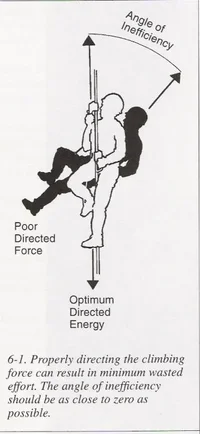
actually what I meant to descibe glens, was body positioning being either in line with the rope- arms bent and feet under butt ,or body away from the rope when taking a new lock - with arms stretched out and legs out in front of you. Wow, I'm still not sure if this makes sense. My friend uses the second technique and says it helps to ease some strain on arm tendons, by using bigger muscle groups- Less hanging on the rope with arms bent.
 
Yeah, the "not making sense" is slightly present for me here. Ultimately, since the rope is essentially free-hanging, the point at which you've locked it with your feet will need to be directly under your body mass before you can stand upon it to gain height. It sounds like your friend is going to some extra effort in terms of laterally displacing the tail of the rope. That might not be much of a performance "hit" early on in the ascent, but it will certainly cost a noticeable amount later on. Also, he may be conserving some energy from the rib-cage upward, but he'll be having to do so at least twice as much to achieve the same height.

See if he isn't happier overall by mixing in at least some "pull-ups" while purchasing a new lock.
 
I've got a descender that Denny Moorhouse gave me that has a screw to adjust the speed of descent depending on the load. I think that it could work if I set the screw kind of tight to mimic a two-person load. When I wanted to descend I could bounce to shock load the device.

It would take a bit of dialing in but there would be a way to make one using some pulleys and springs. When I had free access to a patent office search website I found that there were many rope climbing treadmills patented. After seeing the number of patents I go to wondering. How large a market could this be? How many people need to practice rope climbing?
 
Hey tree whisperer, I know what you're talkin about.
I used to lean back. Now I keep my body straight, and get my feet high with more of a jump (instead of leaning back like a teeter taughter). I stay straight because Beddes does. I mimick him cuz I'm short too.

By the way, my money's on Mark to break record next. I'll bet you do it all the time, just happens its not the time when they're timing you for the 'record', right Mark?
 
Take a lok at this illustration from ON ROPE.

Keeping the muscles and bones lined up in their normal aspect is easier in the short term and long term too.
 

Attachments

  • 34201-FLpower.webp
    34201-FLpower.webp
    23.6 KB · Views: 104
Thanks for the vote John! I guess we'll have to wait and see. Frank does a great job preparing for the event, and to me that means he deserves to hold the record. If you don't prepare for it with the effort it deserves, you shouldn't be the best. Frank deserved it last year and obviously deserved again this year. Next year, we'll see? /forum/images/graemlins/grin.gif
 
I wouldn't bother learning the footlock if I were you - as a day to day method of accessng trees, it is effective, but very inefficient ergonomically. I used to train 2 hours a day, and was unbeaten in the UK comps for a 3 year term.

However, I now know what I have done to my body to get that technique spot on. My partner is a highly respected remedial trainer. She thinks we've got our balls where our brains should be regarding body thrustand this technique. Even if you had the discipline to do corrective exercises for an hour each day, you still carry a high risk of Postural misalignment and pain in the future.

If I were you, I'd buy a Pantin for footlocking the tail of your Doubled Rope Technique System. With a croll and an ascension I'd practice SRT. You'll be glad you did in a few years.

I'm sure Tom would set you on your way!

Good luck.
 
there was a guy at the brion toss workshop this weekend named manuel, who came all the way from puerto rico for the class. anyway, he wants to teach his girlfriend to footlock and was showing me a doubled-rope "treadmill" he sketched which looks pretty cool. if i can get his email i'll try to get him to post it. he basically had 120 ft of rope or so tied (yes, knots are a problem) into a big loop, then doubled and run through 2 double pulleys: one to hang from and the other to keep the falling end of the rope out of your face. the idea was the climber ties in w/a standard doubled rope triple prusik loop, and as s/he footlocks the rope advances so the climber stays in the same place (makes for easier coaching and less risk too). if i've got it right, the friction in the system to counter the climber's weight comes from a 2nd prusik attached to a becket below the main pulley, which is pushed up with the climbers prusik. make sense? the sketch was pretty cool. i'll see if i can get him to post it.
k.

 
[ QUOTE ]
I wouldn't bother learning the footlock if I were you - as a day to day method of accessing trees, it is effective, but very inefficient ergonomically.

[/ QUOTE ]

My knees agree with you but don't you think it should be learned as a safety backup? I can't think of all the scenarios but it seems FL could get you out of a bind. Maybe if your hardware fails or gets locked up somehow.
 
FL is a good skill to know for short moves or when "all else fails" As a routine method of ascent we should look hard at this technique. Modeling our work day FL after the speed events at the TCC isn't the best for our bodies in the long run.

Knowing how to FL is just as important as knowing how to tie a simple rope saddle in case an ascent is necessary and there isn't any hardware or a saddle. But using a rope saddle for every day is on the low end of the spectrum.
t

The fastest way up a rope is to use one of the true rope walking systems that cavers have perfected. Take a look at ON ROPE, either the book or Smith's website ON ROPE1 and you'll see some complex but super efficient systems.
 
In my opinion, the footlock is good for short ascents. In some areas, 40' is a long footlock. If you only climb 3 trees tying in around 40', you'll still be on the ground putting on the chest harness while someone else is already at the top switching over from footlocking to DRT.

I do notice that on days where I footlock a lot, I can feel it the next day, sometimes in the knees, sometimes in the hips, occasionally in the ankles.

love
nick
 

New threads New posts

Back
Top Bottom