Finally broke some stitched eye "dog bones".

I broke the two sewn dog bones I made and the results were interesting. I used 8mm Maxim accessory cord rated at ~2800lbs & Marlow #8 twine rated at 75lbs. Both breaks happened right at the last couple stitches on the standing end side. The cord I used has a 7 strand core so I am guessing the last couple stitches create a weak point where only part of the core is bearing the full weight/tension and/or the stitches basically cut part of the core when under great tension. No load cell, yet, so I can't speak to the actual strength but I had to use my come-a-long in double line config with a pulley to break my samples. The strength of the stitching is very impressive. I am concerned about the weak point at the end of the stitching but I suppose that may be unavoidable, and a braided core might behave differently than the stranded core on my samples.

If anyone else has noticed breakage right at the last 1-3 stitches I would be interested in any thoughts as to why and how it might be prevented or made stronger.
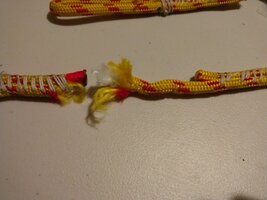
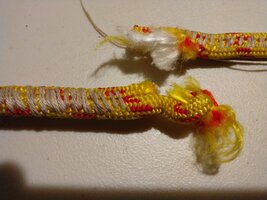
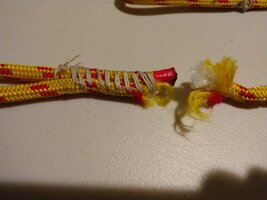
IMG_20221211_121324737.jpgIMG_20221211_121219417.jpgIMG_20221211_121335638.jpg
 
That’s where it first gets squeezed by the stitches, like knots breaking where the rope enters the knot.

Maybe put stitches on the standing part just before they are doubled, that begins very tight and decrease the tension with each stitch, tapering the tension?
 
Interesting idea to taper the tension. One thing is that one sample was sewn correctly for round stitching while the other was sewn wrong/differently yet the breaking location was the same on both.

I wonder if increasing the stitch density for the last 2-4 stitches would change the behavior. My thinking is that if the last 4 stitches on one side and then the first 4 on the other side were dense and plenty tight then maybe that would prevent a weak spot. I guess the more ya sew the more ya know.

As an aside I used the End Bound Single Bowline tied in 1/2" climbing line as the attachment point for carabiners at either end of my samples and what a great, secure, and easy to untie knot that is. I'm always trying to figure out which knots are the best for heavy loading but still easy to untie.
 
The more stretch, or the longer the rope can stretched, makes it stronger. I would think it better to have dense stitches at the eye and increase the distance between them sewing towards the end.
 
I wonder if the jacket didn't give first, and then the core. The core being mostly parallel strands may somewhat slide past the stitches where the jacket being woven isn't going to be doing any sliding past the stitches.

At the break point this may leave the jacket seeing forces that the internal strands do not share.
 
Usually the core breaks first on kernmantels, with the cover holding on a little bit longer, but at a lower strength. It was a pretty blunt break, if the cover went first it probably would have recoiled farther down the rope.
 
Some sewn termination failures are about 11 minutes into the video.
Seems like decreasing stitch tension is key to delaying cover failure at the end away from the eye. More so than stitch spacing. Should better accommodate the cover stretch that (ideally) increases with increasing distance from the eye.

If the two sections of cover are locked together tightly throughout the stitching, the cover can only elongate substantially at the end away from the eye. With most of the force pulling the cover at those last few stitches, makes sense that's where failures occur.

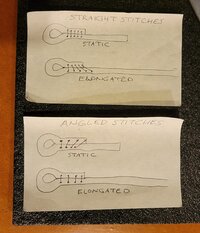
Progressive angling of the stitches might be beneficial as well. Since the working end is where the main elongation occurs, that could actually tend to orient the stitches so they're all perpendicular to the rope. A gross oversimplification:
20221212_143048.jpg
Interesting to think about what all occurs leading up to failure. I wonder if machine sewn eyes, which seem to be all tight, perpendicular stitches, could be improved by varying stitch tension and/or angle over the stitch pattern.
 
Interesting thoughts and discussion. Varying the tension would be short lived with loading cycles unless they were independent sections of stitching.
IF going to that extent, using mixed materials could be a benefit.
High mod fibers with very low stretch are strong, but cut the sewn material. If the cord is all poly, generally I'd think a poly thread would be best, BUT maybe the first few stitches should be nylon or something that offers more stretch than strength
 
Dan, why don't both sides of the rope stretch equally since they both experience the same load at the ends of the stitches? i.e. both ends of the stitch should contribute to stitch angle? just pondering
 
Dan, why don't both sides of the rope stretch equally since they both experience the same load at the ends of the stitches? i.e. both ends of the stitch should contribute to stitch angle? just pondering
I think I've seen break test video showing the tail end staying fairly static. The pulling force on the working end is, we'll say, going to the right. The force is turned 180° in the eye (and reduced by friction), so it pulls the tail to the left. Any force pulling the tail to the right has to be transmitted from the working end by the stitches and friction between the rope sections. The net effect looks like the elongation occurs mainly in the working end, starting near the eye.

At least that's my working theory, based on nothing more than mental musings.

I'm sure many other factors are relevant. The gradual application of force in a break test, the hardware in the eye, the strength of the thread, spacing and tension of stitches, slipperyness of the cover, resistance of the rope to movement of stitches
 
Thread is too thick diameter for the cordage width. I'm of the school of "allow no movement of cordage or stitches, it should be like a rock in the stitched area". The movement of the joined sides of the cordage allowed force to shift from a dispersed load to a focused cutting load on the first stitches on the end. Use a finer thread, more stitches, basting pass, then two more passes the last pass filling in/alternating over the second pass. It will never break at the point where yours did. Doesn't matter whether it's a kernmntle or double braid, behavior under load is the same when the stitching is done as described., cordage will fail first well away from the stitched area.
-AJ
 
This is 8mm cordage sewn with approx. 50 lb. strength waxed polyester, just to show what it should look like when complete:
9821954554_6e29d89bd0_b.jpg


This is 10mm Globe 3000 Dyneema core kernmantle sewn with the same waxed polyester thread and sewing technique. It was in service as a harness bridge for 4 years and broke at over 9500 lbs at the center of the bridge between the eyes after it was retired. There was zero perceptible (by eye) movement of the stitched areas during the break test. The eyes I'm referring to are on the green cordage attached to the Petzl Open rings.
16604055844_f9b1751ba3_b.jpg


-AJ
 
Interesting, @moss. Do you think being in service as a bridge for 4 years contributed to the cordage breaking in the middle where it's seen many hours of bending across a ring? Or is that breakage typical and repeatable with new unused eye to eyes?

What all do you base your statements on regarding stitching and breaking? I'm interested in knowing more about this.
 
Interesting, @moss. Do you think being in service as a bridge for 4 years contributed to the cordage breaking in the middle where it's seen many hours of bending across a ring? Or is that breakage typical and repeatable with new unused eye to eyes?

What all do you base your statements on regarding stitching and breaking? I'm interested in knowing more about this.

Cordage broke where the shackle was center attached on the "basket" pull. Braided Dyneema cores under typical tree climber uses really doesn't degrade much in a couple or more years, it was at very high strength 4 years later. For harness bridges the cover becomes abraded over time and the core herniates out and is quickly damaged by friction/abrasion. A bridge fail in this scenario is a case of gross inspection neglect by the climber.

My statements are observationally based. Early in my stitched eye experiments my stitched areas were tearing apart at 4200-4500 lbs force with 10mm Oceans Polyester cordage, 50 lb. thread (no focal point fail, roughly even stitching tearout) on I believe a basket (center) pull. I was advised to pre-compress the cordage before sewing. Since then no one has been able to fail my stitched eyes in pull tests, cordage always fails first well away from the stitched area. For 11.7mm range double braids these were straight pulls with 70 lb. waxed Nylon thread. For the bridge cordage and 8mm sewn eyes using 50 lb. waxed thread there were equally excellent results.

Seeing the fail of the 2800 lb. Marlow accessory cord, it is obvious that shifting of the "working" side of the cordage against the other side allowed a "choke" to develop in the last couple stitching runs and cut the cordage. If no shift occurs, force remains roughly equal throughout the stitching and there is no focal choke on the cordage.

Obviously there are many subtle things happening from a "fiber technology/physics/theory" point of view but these subtleties are fairly erased under normal tree climber use (as opposed to negative rigging) of well built stitched eyes.
-AJ
 
Last edited:
Also want to mention, while pull tests of unknown force are fun and interesting, it's really worth getting your stitching experiments tested by pros with graph output showing fail dynamics over time and peak load at final fail.

I haven't had my eyes tested in a long time, my technique/materials are stabilized after proven consistency and strength over multiple tests. However... if I come up with a different sewing/material paradigm, yes to testing!

I don't know who is currently providing pull test services, providers keep changing. I seem to recall Gap Arborist Supply is doing it, not sure.
-AJ
 
On a basket pull, wouldn't breaking somewhere other than the eyes be expected?
Yes. Although with 4200 lbs pressure on each eye roughly you’d see eye fails if the eyes are not done right. I expected a lower peak load failure number on the basket pull, pretty psyched to see the Dyneema core holding up so well after a long service life. Having the eyes hold up so well was gravy.

On straight pulls on my 11.5+mm double braid stitched eyes seeing no movement in the stitching and the line is failing well away from the stitched area.
-AJ
 
Thread is too thick diameter for the cordage width. I'm of the school of "allow no movement of cordage or stitches, it should be like a rock in the stitched area". The movement of the joined sides of the cordage allowed force to shift from a dispersed load to a focused cutting load on the first stitches on the end. Use a finer thread, more stitches, basting pass, then two more passes the last pass filling in/alternating over the second pass. It will never break at the point where yours did. Doesn't matter whether it's a kernmntle or double braid, behavior under load is the same when the stitching is done as described., cordage will fail first well away from the stitched area.
-AJ
Do have a rough rule of thumb for thread diameter in relation to cord diameter? The Marlow 1mm was the smallest braided twine I had and yes it looked a bit large.

As to more stitches are you essentially saying that by using the right thread and number/type of stitches you create a section on the cord that is actually stronger than what the cord is rated? If your work always breaks well away from the stitched portion then I can reach no other conclusion than you actually increased the strength. Am I wrong here? I'm curious because my gut feeling was that too few stitches at the end were creating a weak choke point even if the stitches didn't shift in the slightest. I've tried several different stitches but with roughly the same count, thread, and spacing and they all broke at the same point. So with sewn cordage it seems that a higher stitch count is needed not because of the strength of the thread as much as for perfectly blending the thread into the cordage to achieve maximum strength.


Thanks @moss for your old thread regarding your sewn eyes as it provided some initial inspiration and guidance. I was also wondering what type of needle you've settled on? I've been using a modified sail needle that I carefully rounded off and polished on my whetstones--a bit tedious but it works well.
 

New threads New posts

Kask Stihl NORTHEASTERN Arborists Wesspur TreeStuff.com Teufelberger Westminster X-Rigging Teufelberger
Back
Top Bottom