Eye to Eye with a ring

I wanted to make a eye to eye with a ring through the eyes, I'm using sampson ice. I made the first eye a locked brummel with the ring inside. Then went to make the second eye and realized I couldn't make the other eye locked (or atleast I dont think you can with the ring on). So I was wandering would I just do a brummel with the tail through the standing twice with a bury on the other side, or should I use some thing else. If some thing else what, and Why?


Thanks for the help

Norm
 
A straight burry will work as will a brummel (non-locking of course). If you are really concerned about strength a longer eye girth hitched is an opton.

What is the end product use?

Tony
 
You can do the inversion process to lock the brummel. I forget the name of said locked brummel but you invert the rope and it's like a magic trick. I don't do it much so as far as giving step by step instructions I will leave that to someone else but you can do this.
 
Ok, Tony end product will function as a prusik replacing a running bowline in SRT to make an easy transition back to DbRT for tie in and decent...(Crazy idea I'm having)

PUClimber, I cant use the inversion methed because the ring is on the one side and you cant pass it back through itself.(At least the steps I have tied, I have done the inversion before to make an eye to eye and that is like magic when you bring it back together.)
 
I would just go with a locked brummel girth hitched to the rings. I would do two, but that is entirely aesthetic. I like things even!! Very "Chinese art" of me. Damn education!!!

Sounds to me like you do not need to use small rings.

Just my .02¢


Good luck. Post some pix

Tony
 
[ QUOTE ]
A straight burry will work as will a brummel (non-locking of course). If you are really concerned about strength a longer eye girth hitched is an opton...Tony

[/ QUOTE ]

Tony, just to clarify one point, in almost all cases a straight bury is STRONGER than a locked brummell. I think it would have better to say, "If you are really concerned about security..."

[ QUOTE ]
You can do the inversion process to lock the brummel....

[/ QUOTE ]

PUClimber: The Mobius brummel won't work around a ring, which is what he is trying to accomplish here

[ QUOTE ]
...Sounds to me like you do not need to use small rings...Tony

[/ QUOTE ]

I'm kinda thinking the same thing. Why not a 'biner?
 
I'm with you Nick. I was refering to the extra grab a girth hitch would add reguardless of splicing method.

Yes, "security" would have been a better semantic choice.

x2 on the 'biner question.

Tony
 
[ QUOTE ]
Tony, just to clarify one point, in almost all cases a straight bury is STRONGER than a locked brummell. I think it would have better to say, "If you are really concerned about security..."

[/ QUOTE ]

Nick, I think your point needs to be clarified!

A straight bury long enough not to slip creates a splice essentially as strong as the rope, so obviously nothing is going to be stronger than that. If you add a locked Brummel to such a splice, you change nothing: it is not stronger or weaker or more secure or less secure, nada.

A locked Brummel adds security to a splice, and may actually be stronger than the splice, only when the bury is very substandard, that is, short enough to slip.
 
A locked brummel IS more secure that a straight bury. You can straightline pull the straight bury out. That's not secure. You can't do that with the locked version.

Ideally a good whipping or lock stitching would come in to play, but on several occasions I have seen tree guys climbing WITHOUT proper stitching for a variety of reasons. Because of this, I cannot compare the straight bury as an equal to the locked brummell.

Straight bury stronger, locked brummell more secure.
 
[ QUOTE ]
A locked brummel IS more secure that a straight bury. You can straightline pull the straight bury out. That's not secure.

[/ QUOTE ]

Good point. I was assuming everyone knows you are supposed to put strong stitching at the throat. Obviously, from your own experience some people don't.
 
OK, first thank you all for the help so far!! I signed up to tree buzz because of the knowledgeable members, and so far you have been great.

So let me explain what I see my end product as. I see a piece of samson ice about 33"long with a splice on both ends around a single large steel ring. It's 33" so that I can make a prusik with it, its a large ring because then it can not be side loaded,( why I'm not using the biner) and the rope will run thourgh it easily.

End product: This prusic will replace a running bowline in SRT allowing a climber to set a rope, place the prusic around the standing end with a hook or biner that you would normaly tie into below it. The tail end would then go through the ring. When pulled up into position the prusik and ring will act as the running bowline letting the climber acend,onceat the hook or biner you would tie in normal double rope and the ring and prusik will let the tail end run free. Easy transition form SRT to DDRT. No Ground guy to untie the rope when you get up there, no physics of weight on one side equals weight on other side, no tie with a lanyward so you can untie a bowline, just click in tie friction hitch and go..

So finally: the reason I wanted to go with the locked brummel was because there isint much of a bury with it only being 33" eye to eye. I do have one side done with a locked brummel on the ring and I am leaning toward a brummel on the other side where the tail goes through the standing end twice before the bury. All last thoughts apreciated.
 
Sounds fair. You could also do an end-to-end splice capturing the ring.

But, that is just a variation on a theme.

Don't forget the pix!!!

Tony
 
[ QUOTE ]
So finally: the reason I wanted to go with the locked brummel was because there isint much of a bury with it only being 33" eye to eye...

[/ QUOTE ]

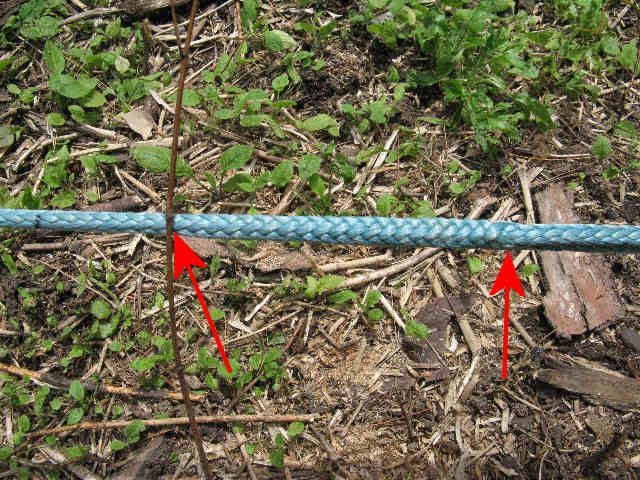
I have worked a lot with Samson Ice Tail and use it almost exclusively for my hitch cords. Naturally I wanted to test it before splicing up my custom cords, especially since I was interested in short buries that would allow me to keep the friction wraps away from the thick spliced areas. I started with a ridiculously short splice of just 4 inches, of which the last 2 inches was tapered, because I wanted it to slip. This was a simple straight bury without Brummels and without stitching. The idea was to progressively lengthen the bury, each time measuring the force needed to make it slip. The photo shows the test under way with about 2000 pounds tension. The red arrows indicate the limits of the bury, eye to the right (ignore the stick marking the end of the bury).

Ice4Splice.jpg


Sadly, it never did slip but broke near the end of the tapered bury at 8000 pounds! For my hitch cords I use buries of about 10 inches, no Brummels, and good stitching at the throat. I am quite sure one of these babies could lift my car and my pickup at the same time.
 
[ QUOTE ]
[ QUOTE ]
So finally: the reason I wanted to go with the locked brummel was because there isint much of a bury with it only being 33" eye to eye...

[/ QUOTE ]

I have worked a lot with Samson Ice Tail and use it almost exclusively for my hitch cords. Naturally I wanted to test it before splicing up my custom cords, especially since I was interested in short buries that would allow me to keep the friction wraps away from the thick spliced areas. I started with a ridiculously short splice of just 4 inches, of which the last 2 inches was tapered, because I wanted it to slip. This was a simple straight bury without Brummels and without stitching. The idea was to progressively lengthen the bury, each time measuring the force needed to make it slip. The photo shows the test under way with about 2000 pounds tension. The red arrows indicate the limits of the bury, eye to the right (ignore the stick marking the end of the bury).

Ice4Splice.jpg


Sadly, it never did slip but broke near the end of the tapered bury at 8000 pounds! For my hitch cords I use buries of about 10 inches, no Brummels, and good stitching at the throat. I am quite sure one of these babies could lift my car and my pickup at the same time.

[/ QUOTE ]


What kind of hitch do you use?? Ten inches outside of the working part of the hitch sounds like an awful lot. How often do you climb and in what type of situations, i.e. work or rec?
 
[ QUOTE ]
Ten inches outside of the working part of the hitch sounds like an awful lot.

[/ QUOTE ]

Mostly for working, but sometimes for maneuvering on a rec climb. The thing is, I don't try to rig it to self advance, so the 10 inches of slack (actually more than that, the cords are about 40 inches long) leaves the knot (a Schwabisch) within reach but with plenty of rope below the knot for hip thrusting or using an ascender or whatever.
 
Tony, Thats a great idea! I haven't ever done an end to end splice before, but with a little research and some help for Moray( who obviously knows his stuff with ice tail) I think I will make that version too. Thanks everyone should have it done tomorrowand will post pix soon.
 
Hydraulic cylinder with 10,000-lb. capacity connected to a load cell also with 10,000-lb. capacity. The readout has a resolution of 2 lbs.
 

New threads New posts

Back
Top Bottom