ever been wrong? or the sword of Damocles

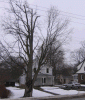
About 8 years ago we had a heck of a wind storm blow down a street in our town. It layed a dozen or so mature maple trees across the road and damaged many others. One of the damaged trees is the one pictured in the attachment. I talked with the homeowner and explained tension wood, included bark, new decay over time and recommended that the tree be removed as soon as possible due to the targets below... where they park their cars and the fact that their bedrooms would be reached.

Another tree company said that the tree could be saved (safed?) so they went with them, maybe because they liked the tree or maybe because it was cheaper. Don't get me wrong, I always try to save trees that are being removed for no good reason. This just seemed like a really good reason.

19770-wrong.gif


8 years later and I still expect to see the tree on the house every time I turn down this street. But I was wrong and although it is small in the grand scheme of things, it frustrates me that I look wrong, even though I stiil feel I am right.

Would any of you park your car under this tree, or let your family sleep under it?
Look closely at the pictures showing the decay, amount of material missing, and the lean of the tree.

Dave
 

Attachments

  • 19770-wrong.gif
    19770-wrong.gif
    199.6 KB · Views: 70
i would have said remove....not a healthy looking tree. i would advise them not to hang a swing from it, standing away from the lean...

jamie
 
Have you seen any strong windstorms since? maybe it is just a function of the remaining parts of the tree not being tested in a ten or twenty- year storm.
 
Removal- without question. All you did, Dave, was advise on the proper course of action considering all present conditions. I've removed plenty of trees that looked even worse, and I bet that they looked that way for quite sometime before I did. On the other hand, I've removed plenty that had failed and looked 100x better than your case. Go figure?

The opposite thing happened to me once. I was in Halifax visiting some of my Wife's friends not long after we were married. The couple asked me what I do for work. I explained and then we were off on a walk-through around their yard. They asked "what kind of tree is this..." and "how do they look?" I said, "Your trees look fairly sound, but your neighbor's Black locust looks troublesome." They asked why and I went on in detail about the type of tree, the co-dom, the lean... Next year I went back for a visit and they PRAISED ME! Seems that about 5 months later, that lead did fail and it hit the house. Hmmm, what do you know? I got the royal treatment ever since /forum/images/graemlins/wink.gif
 
I had the same thought, Jarod...but it sure looks like that one could fail at the drop of a hat! I don't think I'd like to have to climb it, judging from Dave's pictures.

There's one in my little town that I expect to see down most every time I drive by it. Luckily it is fairly small, maybe 14" dbh by 50 feet tall cherry, but it's target zone is the street, one of the main throughways in the residential section of town. It's been that way for 5 or 6 years... /forum/images/graemlins/confused.gif
 
A guy I work for off and on had this happen: After hurricane #2 came through my part of FL this last year a repeat customer of his had several pines blow over. He got called out to do the removals, most of them were straight forward, but one was different. It was about a fifty footer and leaning 45* away from the pool enclosure, leaning over the marsh. He told them to save their money, if it were to fall it would just go into the swamp, no big deal (it was kind of a natural area of the yard anyway). Well, hurricane #3 came to town and lifted said pine up and over onto the pool enclosure 180* from its previous lean. Then they had a more expensive/difficult removal for him. He felt bad. /forum/images/graemlins/shocked.gif
 
Yup, been wrong before.

Dave, I know that you have good judgement. You made the right call. By any accepted hazard analysis that tree is on the removal list. We all know that when it fails it's going to be nasty. Even if no one gets hit, its' close to the wires and house.
 
i don't think Dave was wrong. If he were the sort that had to prove his point, he could call whom insures the house!

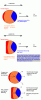
Besides the dry open scarring and inclusion, there is a fair amount of fiber loss on the loaded axis i think. This loss of fiber is also at most levraged support points, comprising the most elastic/young fibers (especially important on tension side?),also changing the base's shape from 'unlevrageable/round status'- to some more leverageable shape.

The loss of leveragted distance will not affect the area of compression from lean. So the loss is totally of leverageable distance multiplier for support. Also, this will cause more tensioned fibers to match same loading(with less leverage multiplier), reducing the leveraged distance/multiplier even more.

This all happens at the most leverageable point on the tree.

As far as the "W" word; heck yeah! The only way fer sure ya know you are walking the extreme power points of the possible; is when ya trip over it and land into the realm of the impossible! Then just meter back some the next time and go fer'nutha ride; but stay on the trail!!

Or, something like that!
 

Attachments

  • 19822-Compromised Tree Shape-b.GIF
    19822-Compromised Tree Shape-b.GIF
    45.3 KB · Views: 58

New threads New posts

Back
Top Bottom