
Navigation
Install the app
How to install the app on iOS
Follow along with the video below to see how to install our site as a web app on your home screen.
Note: This feature may not be available in some browsers.
More options
You are using an out of date browser. It may not display this or other websites correctly.
You should upgrade or use an alternative browser.
You should upgrade or use an alternative browser.
EAB Experience
- Thread starter Leroy
- Start date

Jackjcc
Participating member
- Location
- Twin Cities
Tree-age is guaranteed by many tree companies in MN. Take a look at this link, http://www.emeraldashborer.info/files/multistate_eab_insecticide_fact_sheet.pdf , it'll have all chemicals that have been researched for use on eab.

The problem is the type of treatment. When do you treat? When your ash tree shows signs of stress? Might be too late as the treatments are systematic. Larva could have damaged too much of the vascular cells to allow proper transport.
So, do you start early? Before any signs of stress? That seams like your throwing money away. The ash borer had been detected around me on two sides. Should I start advising my clients to treat now?
So, do you start early? Before any signs of stress? That seams like your throwing money away. The ash borer had been detected around me on two sides. Should I start advising my clients to treat now?
Jackjcc
Participating member
- Location
- Twin Cities
You have to treat preventatively with eab. By the time the tree shows signs it may be too late. You would probably be able to save the tree, but would lose significant portions.

tc262
Branched out member
- Location
- SE Wisconsin
Yes Royce prevention is more effective than waiting until the tree shows signs of distress. Usually by the time the homeowner sees it there has been major damage done. I advise my clients to treat high value ash trees or ones which will pose a high cost to remove.
Yes Royce prevention is more effective than waiting until the tree shows signs of distress. Usually by the time the homeowner sees it there has been major damage done. I advise my clients to treat high value ash trees or ones which will pose a high cost to remove.
So, EAB is active in your area? My problem is it has not appeared here yet. However it is at our boarders, approx. 80 miles away. When should I advise my clients to start treating? Once it has been detected in our town? Even then is it too late?
Jackjcc
Participating member
- Location
- Twin Cities
We started as soon as it was in our state. We had a jump of 70 miles identified last spring. That was huge and left a lot of people scrambling. You are probably getting pretty close, you can at least start an awareness campaign, leave it up to your clients to decide.
We started as soon as it was in our state. We had a jump of 70 miles identified last spring. That was huge and left a lot of people scrambling. You are probably getting pretty close, you can at least start an awareness campaign, leave it up to your clients to decide.
Thanks, that is some good info.
tc262
Branched out member
- Location
- SE Wisconsin
Start informing your clients now and prepare to treat this spring. Uptake of the pesticide should be best in the spring.
I'm no expert but I would wager that if it has been found 8o miles away that it is most certainly in your town to some capacity already. When it was discovered in the town next to me it had been there for a few years already.
That is my thinking as well. I think it is time to start the campaign

easyphloem
Branched out member
- Location
- Louisville, KY
Would any body care to share their experience with EAB treatments? I am curious how successful people have been in preventing death from EAB. I am also curious if people have prevented death with treatments after a tree already has the beetle. Thanks
We have been using Tree-Age since 2009, when EAB was first discovered in Kentucky. Last summer is when I began to see large populations of Ash trees dying in the City of Louisville. I have yet to see a tree that we have been treating show symptoms of infestation.
At this point, any untreated Ash in this area should be considered infested, but some Ash trees are stronger than others, and can hide the damage for a few years. I don't feel comfortable recommending treatment if more than 25% of the crown is exhibiting decline or is dead, but some clients will want to treat anyway.
We treat the Ash trees on the campus of UofL (since 2009), about 120+ trees, and have not lost one to EAB.
This coming Spring, more and more homeowners will realize that they have Ash trees after it is too late to do anything about it. The damage from EAB takes a while for the average Homeowner to pick up on. I can see it from a long distance, but most people probably just think the tree is "sick" for some reason.
SZ
easyphloem
Branched out member
- Location
- Louisville, KY
I've got three large Ash trees in a parking lot that were infested pretty bad in 2011. We treated them in 2012, and again in 2014.Thanks for that.
Really what I would love to hear is a firsthand story form someone saying "yes I have treated many tress post infection with ______ and the trees are still alive." or "I treated the trees and they died anyway." etc etc
By the time we treated them in 2012, they were significantly thin (I'd say about 50% thinner than you would expect a 35"dbh Ash), and I was concerned we would lose them.
Every season since then, they have been filling out in the interior, getting a darker green to the leaves, and the only evidence that they had problems is persistent thinness in the uppermost part of one of the Ash trees. Clients are happy, and I am impressed with the results of the treatments.
They are due this Spring for a third treatment, which I am confident the client will gladly do again.
I'm sorry I don't have pictures, it would have made a lot of sense to document this, but you'll just have to take my word on this.
SZ
easyphloem
Branched out member
- Location
- Louisville, KY
Yes. We treat with Tree-Age unless the Ash is under 6"dbh. But, if it is that small, I recommend removal and replacement with a tree that won't require treatments to live.
SZ
SZ

NE Tree
Branched out member
- Location
- fremont, Ne
Are the ongoing treatments something that you consider to be necessary for the entire life of the tree (at least in this point in time)?
easyphloem
Branched out member
- Location
- Louisville, KY
We have so many Ash trees in our county (15%-20% of total tree population are estimates I've heard), I expect to be treating for at least another decade, but hope to need less protection as the insect moves on.
SZ
SZ
We have so many Ash trees in our county (15%-20% of total tree population are estimates I've heard), I expect to be treating for at least another decade, but hope to need less protection as the insect moves on.
SZ
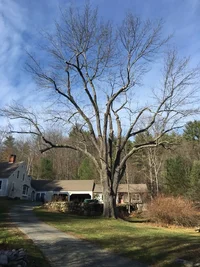
How often do you treat? I pruned this massive ash tree this fall. Its a beauty of a tree. Homeowner is very concerned about EAB. Very educated clients who know a lot about the insect and the threat is causes. They look to me for advice. They asked if it should be treated now, I said I am not sure, as the borer has not be spotted in our community. Like I mentioned before it is about 60-80 miles away.
So, I am leaning towards putting them on a program to start treating this tree in the spring. But, they will want to know how often it will need to be treated and how long this treatment will need to go on for. Thoughts!!
easyphloem
Branched out member
- Location
- Louisville, KY
We treat with Tree-Age every 2 years. Treat now, and within 5 years your clients will be bragging about saving their ash tree when the neighbors start losing untreated ash trees.
SZ
SZ
Jackjcc
Participating member
- Location
- Twin Cities
We treat every third year in MN. For us you get 10-15 years of treatment for the cost of removal.
We treat every third year in MN. For us you get 10-15 years of treatment for the cost of removal.
So how would you sell that? Someone calls you and is concerned about there tree. You would tell them that they need to treat once every three years to protect the tree? When compared to the cost of cutting down the tree they are saving money, right? What is the average cost to treat a 20" stem ash tree?
I know some people will just opt to cut there tree down. However, I am thinking of doing a campaign on how we should all pitch in to help save these trees. I will never see a street lined with Elms trees, I have never seen a large healthy chestnut tree. I would hate to have the future generations not know what an ash tree is. If we all do our part to save whatever ash trees we have on our properties it could really help to save the ash trees. Am I right in this thinking?
easyphloem
Branched out member
- Location
- Louisville, KY
I don't think EAB will completely eradicate Ash trees in North America. 10 years ago I thought so.
SZ
SZ
New threads New posts
-
test
-

-
What's on your mind? TCI Magazine wants to know
- Started by Tree Care Industry Assoc.
- Replies: 13
-
 Apr 09 (Free CEUs) & May 07 - 'Urban Forestry Today' Webcasts @ Noon (Eastern)
- Started by UFT
- Replies: 0
-

-
-


