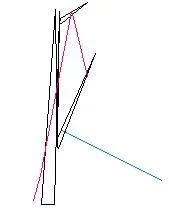
Drop cutting a spar limb?

I hope this is the right place to ask a dumb newbie question about technique? --Please have pity if not.

The other day I was removing a small tree that had several spar limbs, one of which rose up at an angle of about 30 degrees and this limb(about 5" diameter) was hanging over a fence. My plan was to drop cut it onto a balancer so to maintain it level until lowered to avoid the fence below. I put in an undercut at the butt then proceeded to finish with a top cut directly over the undercut so as to drop it onto the balancer. As my chainsaw was almost through the top cut, the limb began to drop but pinched the saw bar without completely breaking free, I think because of the angle of upward rise of the limb being so acute.

Can anyone tell me if there's a rule of thumb when the angle is to steep when not to drop such a limb or some technique to prevent this from occurring?

Thanks guys.
 
it will come with time.......hard to say without really seeing the exact situation. sounds to me like there must have been a slight sideways angle aswell that made it nip up?? if in doubt when doing cuts like this i will do the top cut fairly slowly, stroking the cut with the tip of the bar rather this way i can se if its going to pinch up early.
also i always do my top cut beneath the bottom cut, this prevents it from grabbing the saw too.
 
That sounds like end bind, the weight of the branch settling into the saw cut.
Choose a different cut or use a cut that compensates for end bind.
If there were obstructions preventing the branch from tipping in the proper direction then you could also be dealing with top bind or a combination of both.
You have to be able to look at the branch prior to cutting it to know what it will do before making the cut, sometimes that might include setting a rope in the top of it for added insurance.
 
Why not drop it vertically? it fits into a smaller hole that way. I usually only drop pieces in a balancer if it starts out horizontal and I'm concerned about one end dropping onto a roof or other obstacle. Assuming a TIP above the cut, the rope can help hold the spar up until the cut is made. If you were dropping into a TIP below the cut, it might have been better to cut 2/3 of the way through, then step up or down an inch or so and cut 2/3 through from the opposite side, then stow the saw and manually break the branch free with your hands. Either way, a vertical drop seems preferable. Just my opinion, of course.

k
 
Thanks guys.
I think maybe Steve hit the nail on the head, because I may have cut at a slight angle instead of perpendicular to the ground, so that the weight of the limb got caught on the stub and pinched the bar at the same time. I presume a drop cut should be perpendicular to the ground no matter what the angle of the limb is, right?
Also, Steve, how much lower would you place the top cut to avoid pinching? Can you explain? The books say to be careful of this because it could create a kerf that can grab and drag the saw down with the limb.
K, my second choice was to drop it vertically, but the fence below also had a small garden in front of it which would have been a little too close to the drop zone. I also thought it would be easier or take less labor to drop cut and balance, than to lift the tip to vertical then drop. Doesn't this require a little more skill also? --So that the hinge is perfect? --I gotta work on that one.

Thanks again.
 
Everything you do with a chain saw will require a level of skill and being able to see what will happen before it happens helps heaps.
You can suspend the tip and pull out on the bottom of the limb once cut with a separate line and take it in a direction that works for you but every job is different so this may not work as intended for this specific case but it's always a controlled option.
 
Kevin,
That's sounds like a great option, thanks. Not sure of the details though.
So you're pulling the butt of the limb out in a desired direction with a tagline? or with the rig line? or both?
--While the tip is suspended with the rig line? Is the piece in a balancer? I'm not sure I understand.
 
on a piece the size you described i would probably only do the step cut half an inch maybe. im not aware of any hard fast rule whe it comes to distance on step cuts. its something you just tend to get the feel for with experience.
you WILL get your saw jammed plenty of times..happens to us all im afraid
 
Forgot to mention, Beranek's book refers to a Slice cut for spar limbs which is keeping the cut perfectly vertical with gravity no matter what the angle of the limb which I wonder if it may have been appropriate here. He also says it has a bad reputation though because if there's obstructions toward the tip this could cause the butt end to drop first and lead in the fall and be dangerous if not expecting it.

Any of ya'll familiar with this cut and it's pro's or con's.
 

New threads New posts

Back
Top Bottom