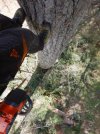
drop cut. cutting limbs to fall flat down

I dont mean to be critical and i dont know the context but Im also questioning why large lower limbs from mature oaks are being removed? was it a removal? It seems a popular thing to do around here as well but I cant stand seeing it done. lots of focus on topping but sky high elevating and large limb removal is also a big problem for trees in these parts. exposes the trunk to rot and decay in the worst possible place, and deprives the tree of essential understory leaves for respiration on hot and sunny days. Companies around here sell that work and so customers think it is proper tree work and im constantly having to fight the trend and tell people flat out no.
 
I agree with what most others are saying. I don’t deal with oaks much so take that as a disclaimer. But I do handle LONG conifer limbs frequently. A good hinge sometimes with a double thick curf. Next reach over the top start a 45 top cut directly in line with the under cut, roll the saw over the top of the limb and do the same on the near side. At this point you should have a triangle of holding wood and a lot less material to cut through with a back cut. Many times I’ll even cut the corners of the hinge leaving nothing more than the brittle heartwood and a small apex of sapwood on the top of the limb.
A fast sharp saw is a must but be ready to swing away, and be ready for the pop to be so violent your saw might be hard to control
 
Yesterday I had a lot of work in four trees, with few obstacles in the yard, so I was cutting big. One of these was a mature oak; I dropped the two lowest branches from it, each about 35 feet long, 12" and 16" diameter leaving the trunk about 20 feet from the ground.

I was making drop cuts (first cut beneath about 1/4 way thru, before bar pinches; 2nd cut about 4 inches outward . This works pretty well for me on smaller material, but did not work with these big limbs. I went about halfway out the limbs (to cut it smaller), yet the tips hit first and it bounces toward the tree. I hate this reaction, especially being base anchored.

I caused some damage to the root flare, ( some day I will be forgiven) and it seemed to be the theme of the day. I also corrected a multistem white Oak, and the lead did the same thing. Of course I know better choices like rigging, yet with the work order and tone of the day I was really seeking to drop big pieces. The usual style of drop cut was not working on these.

I wonder if a shallow mouth hinge would still allow the tree to settle and then jump it off sidways a bit when it popped. It may be a whole geometry around using the notch to aim the branch at a point of departure.

In any case, my method did not cut the mustard of where I'd like to be, although I got a huge amount of work done at the cause of some minor trunk damage (similar to what I see trees experience in the forest during regular limb drop).

Any insights on the mechanics of limbs dropping flat is appreciated.
(I think I already was here asking this question about logs, and learned the rule of fifths.
Limb acrobatics
 
I pruned some low branches from a winged elm this week. I wasn't able to get any of them to land flat. I think it had something to do with the tips being 4 ft off the ground and the attachment points being about 20 ft up the trunk.
 
Marv taught me how to setup butt cuts to get flat-drops, sweeps, tip-drops and other dances. It all started by considering the 'lean' of the limb off a line parallel to the ground. Then a face cut was made followed by a back cut.

He got me to think of a limb in the same way I would think of dropping a tree. Put the face in the direction of the fall and cut it to hinge down.

Along the way I bought D. Douglas Dent's book about felling big trees at the stump. What became clear was that felling limbs wasn't different than felling stems. The only difference was the direction of the pull of gravity. Dent numbers the cuts in the holding wood of big trees to control the fell. Marv taught me similar things to make cuts from various sides of the holding wood. Others in the thread have shared the same thing, Evo just did with his strategy of cutting to a triangle of holding wood.

After learning open face felling cuts it was much easier to get flat drops. the angle of the open face limb cut was close to the same angle that the limb was off of horizontal. Treat the limb like you would a tree with a heavy lean...the direction is less important when you're doing the geometry.

With all that put together popping off limbs and chunks got to be a lot more fun. It was especially cool to get a big piece move in the air and drop flat with a big whoosh while the client was watching!
 
A lot of good advice in here, but one thing I will add (not sure if it’s been mentioned so forgive me) is using a higher cc saw with more power.

I occasionally encounter this problem with my little Echo CS-271t which is why if I’m trying to drop flat bigger limbs I’ll use a heavier duty higher powered saw.
 
I pruned some low branches from a winged elm this week. I wasn't able to get any of them to land flat. I think it had something to do with the tips being 4 ft off the ground and the attachment points being about 20 ft up the trunk.
Just have the groundie stand under the tips with a pitch fork. Only works half the time, groundies use to be much easier to find. Hmmmm
 
A lot of good advice in here, but one thing I will add (not sure if it’s been mentioned so forgive me) is using a higher cc saw with more power.

I occasionally encounter this problem with my little Echo CS-271t which is why if I’m trying to drop flat bigger limbs I’ll use a heavier duty higher powered saw.
Agreed. In my world the 2511’s and 150’s are wonderful at everything BUT getting limbs to land flat without a bunch of creative cutting.
However the little tipped bars are great for this. Think if it as bucking a log in a bind. Same physics. I certainly won’t speak to oaks, but we have plenty of semi soft maples, weird ass growing madrones, and brittle alders with so much internal stress if you sit down for lunch by some freshly bucked wood it sounds like popcorn!
 
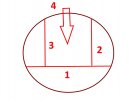
I was thinking about this thread while up some big firs the other day, for some reason I didn't take a photo of the cut though. Anyways, I was at like 50' taking off some big dead limbs, the bottom limbs on this tree, and they were like.... 8" and 30+' long. Someone made an earlier comment about a u-shaped cut at the bottom and sides, I'm essentially doing the same thing just straight cuts. Cut the bottom just before the pinch, then the far side, close side, then come in at the top as fast as possible. With dead limbs it was much easier than green since it didn't have much tip weight pulling it down, but I was able to get those huge limbs to fly and land flat from that high up. It's all about judging the piece, how much you can cut away without it failing, and how fast you can make that last top-cut before the tip starts drooping. Obviously very situation dependent, in this case there was a near-ish garage on one side, but nothing else to worry about.

00 flat limb drop 01.jpg

00 flat limb drop 02.jpg
 
Last edited:
I was thinking about this thread while up some big firs the other day, for some reason I didn't take a photo of the cut though. Anyways, I was at like 50' taking off some big dead limbs, the bottom limbs on this tree, and they were like.... 8" and 30+' long. Someone made an earlier comment about a u-shaped cut at the bottom and sides, I'm essentially doing the same thing just straight cuts. Cut the bottom just before the pinch, then the far side, close side, then come in at the top as fast as possible. With dead limbs it was much easier than green since it didn't have much tip weight pulling it down, but I was able to get those huge limbs to fly and land flat from that high up. It's all about judging the piece, how much you can cut away without it failing, and how fast you can make that last top-cut before the tip starts drooping. Obviously very situation dependent, in this case there was a near-ish garage on one side, but nothing else to worry about.

View attachment 81575

View attachment 81577
Yep that’s pretty much exactly how to do it. Can also make a inverted triangle with the bottom two points at the tops of lines 3 and 2 and the one point in the middle at 1 in your illustration. I believe @evo mentioned that one.

Kevin brough up a good point though unless there is some defect present or it’s a removal very large oak limbs shouldn’t really be removed.
 
A lot going on in one of these cuts, and these same things set to full scale felling invite BC beast. This is a high stress against it's own wood deal. The full weight against it's own mirror, multiplied by speed squared to me.
.
i think of it just as Tom Dunlap said, mini felling as Dent's lil'pictures worked out very well turned sideways etc. even then turned upside down for crane lift of horizontal; as all the same science in the same materials and geometries, powered by same force of gravity pull on the cannonball of the CoG. Win over the CoG and the whole tree as an empty shell moves with the CoG, the tree framework just being geometry to access (to and fro)the CoG as the internal ruling force . And to that model i'd go with the kerf and backcuts being flat across on a more well centered CoG. But may go for deeper on lean side for earlier/faster closed as other side still pulls, and effect the back cut similarly, so the balance of pulls across is more even on a 'Tapered Hinge' sorta thing; into a kerf face. Might even whittle 'off-side' (from lean side -Dent). Another way played with to effect this but did not go too far is to make flat kerf and if side pull to left, cut some of the 'nose of the close' on the right, so heavier left side closes earlier all the same..
.
The kerf is still a face, just a very narrow one. Accidentally(or otherwise) kerfed inside a good notch, is thus a face within a face. This effect is expressed most as the kerf come perpendicular across the fiber columns to give close down the greatest strength/resistance of the fiber columns. NOT so much at all when kerf is from longer slanted cut bypassing the horizontal where the close is across fiber column at bending or Samson angle to the same fiber column.
.
For faster backcut i may play as 27RMT0N shows, as like a Dent pic, or even leave a triangle pattern, perhaps then nose out the sides more some, to then have less material to race thru, to then get faster close/slam against 'backboard' to rebound harder back outwards; to counter tendency to come back under cut towards trunk.
.
We want to close hard, and fast to get the 'pop' back out away from the cut what would be a swing under towards trunk and throw behind the cut force. Softer wood, would be lighter CoG input force into less rock hard face to rebound from. But still don't think this works as well consistently in larger pieces do to speed of backcut for the slam shut and pop/rebound back, and then the staunchness of the wood faces etc. Same thing if trying to purposefully power a Dutchman type response(that this is), slam hard and confident to get the punch back in felling, NOT close daintily, slight rest 1/4 second pause and kinda politely slide/roll off.
.
i also found it easier in slightly up from horizontal; that then slams close shut at horizontal for straight drop down. Any lower weight than horizontal giving more pull back towards tree/trunk as home/Mom.
 
Thanks for all the replies. I tend to come ask here when I find myself out at the edges, running into things that didn't quite go well. I appreciate the chance to ask these questions so I can keep pushing my limits without acting like a fool.

The first Oak limb was growing into the top of a Cedar. (Could have just been reduced) The second one was growing into a Maple, and was from a place where two limbs left the tree right next to one another. I advocated pretty hard for simple reduction of that one, but this client was adamant that he "doesn't like bush trees, he likes them tall and then going up" kinda thing.
It was a bit of a challenging day in that way, a banter between my advocating for tree health and his desire for some sort of neat look. I kept telling him the more we take the more the tree is going to sprout and be bush-like...

@treebing : ... why large lower limbs from mature oaks are being removed? ... customers think it is proper tree work and im constantly having to fight the trend and tell people flat out no.
Thanks for saying this. We did have a full conversation while I stood on the limb, stressing that it's way better to just reduce this one. I am going to take a bit of strength and armor from you here though, and as the guy who is up there, not make that cut. A part of me acknowledges, it's their piece of the Earth and I cherish giving them the chance to see a design that fits their view and imagination of space. Yet I feel these folks also do show a lot of respect for my view and experience, and if I put my foot down, they aren't going to lose it or go find someone else to cut it, (in this case anyway).

I am glad this came up, because it was a major theme of the day; being requested to cut, cut, cut with the dual sided "I trust your judgment" while not quite accepting my suggestions.
It is a whole other topic but I got a lot of feedback from how the job went that something about it was off. The dance of the artist/arborist and the sponsoring commissioned tree work...
 
I dig a lot of the finer points about holding wood. That triangle suggestion makes a lot of sense @evo . It combines with the "smiley cut" as more ideas for these scenarios.

great find on that drop cut video, @Phil . It's way more clear what happens to grab the bar. and good point about that method @Daniel , it seems obvious now, but I was just following the usually prescribed drop cut scene, with a sense and hunch that it's different on big wood, not a clear distinction.

For me, at this stage the most appropriate advice may be the handful of folks suggesting to go out and take it in a few pieces. That's more typical of my style, to do more, easily, than struggle with some monstrous piece with multiplied risks. Again, something about the tenor of this day asked me to drop it big, I followed, and got results I didn't love. I had plenty of rope angle to walk way out on these pieces. The 2nd one I did drop in 5 pieces, but the log was still massive to get to drop well.

That said, I will be practicing and bringing these cuts up to speed and size. The importance of sharp chain and power is also something I need to keep in mind that technique alone will not compensate for lack in the tool itself.

I have thought of this concept that the felling techniques are the same, it's just the gravity in a different direction. I had success with one of the tips on the 2nd branch here by cheating it diagonally away from the trunk, when the tips hit it followed to the side, not back to the trunk. The oak really provides plenty of hinge power to work with.
There is a bit more for me to explore there, akin to what @TheTreeSpyder is saying about timing the pop of the hinge to the moment the tree butt will launch it away. "the backboard".

Also, can't say enough for the good of hearing any warnings about a technique, what to watch for. I know we have all earned some lessons with the hurt, and I THANK YOU for the chance to learn by reading some words rather than limping around for half a day due to a whack from the master.

Thank you ~

 

New threads New posts

Kask Stihl NORTHEASTERN Arborists Wesspur TreeStuff.com Teufelberger Westminster X-Rigging Teufelberger
Back
Top Bottom