
EasilyCan the Super Hawg dill a 3/4” bit 4’ through the trunk of an Oak for installing a rod?

Navigation
Install the app
How to install the app on iOS
Follow along with the video below to see how to install our site as a web app on your home screen.
Note: This feature may not be available in some browsers.
More options
You are using an out of date browser. It may not display this or other websites correctly.
You should upgrade or use an alternative browser.
You should upgrade or use an alternative browser.
Driving auger bits?
- Thread starter LordFarkwad
- Start date
Did you look at the ansi standard chart? If you have a 4' trunk, the other trunk is probably large too. The ansi may specify 7/8" rod, so you'll want a 15/16" bit.Can the Super Hawg dill a 3/4” bit 4’ through the trunk of an Oak for installing a rod?

Rooted.Tree.Solutions
Branched out member
- Location
- Elkhart, IN
So one trunk is 20” and the other is 22”, roughly 4’ of drilling. Just curious from someone whose done this a lot could tell me if the Super hawg can drill that?Did you look at the ansi standard chart? If you have a 4' trunk, the other trunk is probably large too. The ansi may specify 7/8" rod, so you'll want a 15/16" bit.

It will bind up unless you clear the chips regularly. Also a good idea to have a pipe wrench along in case you get bound so tight that the drill won't back the bit out. Been there, done that.I have never tried to drill such a hole, but I would guess that it will do it. You will probably have to drill it in steps though, say 6 inches at a time, I don’t think even an auger bit that long will effectively pull chips that far without binding up.
That is bread and butter. You probably want to clear the bit 2 or 3 times. I run up to a 15' long 15/16" bit with my corded superhawg. The cordless superhawg 2nd generation is supposed to be slightly more powerful than the corded superhawg.So one trunk is 20” and the other is 22”, roughly 4’ of drilling. Just curious from someone whose done this a lot could tell me if the Super hawg can drill that?

flushcut
Been here much more than a while
- Location
- Delavan, WI
15’! Beast of a tree, do you have any pictures?
I don't have pics of that tree. It is a medium sized live oak split at the base into two or more leaders. One was actively wagging around. It's been a while so I can't remember how many of the leaders were part of the bracing install. The live oaks frequently have multiple leaders. Several live oaks busted all over the county when Irma came through. The bit length is limited by the length of the fabricator's room. I could easily need a longer bit on a larger live oak if one presents. The flex in the bit shaft at 15' length is the biggest problem. The drill is not the problem. It's good to have shorter bits to form the hole for the long bit. I have a 10' (13/16"), 6' (13/16"), and several =/<2' of various diameters.15’! Beast of a tree, do you have any pictures?

- Location
- Retired in Minneapolis
The flex in the bit shaft at 15' length is the biggest problem.
I remember @Don Blair talking about a friend of his who had a gunsmith use barrel blanks as extensions. The bits connected with machined couplers with countersunk set screws.

LordFarkwad
Branched out member
- Location
- Chatham Co.
I think there's a verse that goes, "and they'll beat their barrel blanks into auger bit extentions."I remember @Don Blair talking about a friend of his who had a gunsmith use barrel blanks as extensions. The bits connected with machined couplers with countersunk set screws.

SumoClimber
New member
- Location
- Fox Cities, WI
I've used a SuperHoleHawg with a 30" bit and 24" extension before. Cleared the hole four or five times boring through; probably could've just let it ride. I have used the same 30" bit without clearing, for an 18" hole. Starts to feel like it wants to bind near the end, never did though. Same bit will chew through two telephone poles (used as dock pilings) at a time without clearing when run in the linesman's impact.
I get that approach, but I heard stories about detachments of extensions and did not like the downstream ramifications of that. Additionally, the Milwaukee extension system is too thick in diameter to fit in some hole diameters - I think it's built first for plumbing roughouts in wood frames. Some of y'all know I've largely gone in on lots of general Milwaukie kit principally because the superhawg is a superior tool for bracing, so milwaukee-specific features sometimes affect my decisions where they do not affect others' decisions. Using multiple bits w/o extensions feels best to me because of the mere idea/possibility of having a bit in a tree and being unable to recover it. It's just a bad potential situation that would be hard for me to recover from.I remember @Don Blair talking about a friend of his who had a gunsmith use barrel blanks as extensions. The bits connected with machined couplers with countersunk set screws.
- Location
- Retired in Minneapolis
too thick in diameter to fit in some hole diameters -
My design took all of that stuff into account. I never lost a bit in a tree nor had an extension coupler come apart.
With a good design and build there are many solid, successful solutions to the problem.

Evo
Been here much more than a while
- Location
- My Island, WA
I use extensions, and have even modified some of the ones with a larger coupling diameter to make them work. The BIG thing is on the drill bit end, make damn sure there is a solid recess for the set screw to seat into the bit. The extra diameter can be reduced by just putting the extension in a drill(drill press) and a sanding block or angle grinder.
It’s also not that hard just to weld the extensions straight to the bit. But it’s nice to just add a little at a time, instead of building scaffolding to push a 6’ bit while aloft
It’s also not that hard just to weld the extensions straight to the bit. But it’s nice to just add a little at a time, instead of building scaffolding to push a 6’ bit while aloft
- Location
- Retired in Minneapolis
make damn sure there is a solid recess for the set screw to seat into the bit
YES! This is sooo important. The tip of the set screws on the female end of the extension must fit into countersunk holes in the tang of the male end of the extension. If you rely only on the set screw tightening onto a flat of the tang you are guaranteed to have the setscrews loose their grip and the bit is lost inside the tree.
When I made mine I used a piece of angle iron as my fixture for welding each of the pieces together.
Rooted.Tree.Solutions
Branched out member
- Location
- Elkhart, IN
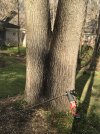
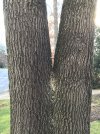
New threads New posts
-
test
-

-
 Alternatives to standard asphalt around roots
- Started by southsoundtree
- Replies: 11
-
-

-

-


