Definition of 'Professional'

Tom Dunlap

Here from the beginning
Administrator
Definition of \'Professional\'

Today while I was reading a post on a woodworking forum I read a new definition of professional. Here's a cut/paste of what was posted. I'm going to read up on this a bit more.


This is one that I like a lot:


Curtis Buchannan, the Windsor chair person, has a provocative definition of "professional". In his mind you become professional when you become confident of the result. This skill based definition has merit, compared to the economic based definition often used.
 
Re: Definition of \'Professional\'

I like that one too Tom. The economic is what we start out after, but then hopefully we wise up and pursue the skill side. That one will definitely carry us further and give infinitely more satisfaction, course economic doesn't hurt either.
 
Re: Definition of \'Professional\'

Up until reading this my definition was economic.

Anyone who is paid to do something is a pro. This sure doesn't account for the skill of the person or how able they are to know exactly what will happen though.
 
Re: Definition of \'Professional\'

Nice, it kind of combines the adjective and the noun, skilled professional, all into one. Remember when Olympic athletes could not be professionals,
 
Re: Definition of \'Professional\'

There is a moral definition out there too, written by a professor at Harvard school of business. If I find it, I'll post it.

Tom
 
Re: Definition of \'Professional\'

[ QUOTE ]

Curtis Buchannan, the Windsor chair person, has a provocative definition of "professional". In his mind you become professional when you become confident of the result. This skill based definition has merit, compared to the economic based definition often used.

[/ QUOTE ]


Doesn't that definition lead into the somewhat murky waters of undefinable relativity? If you become a professional when you become confident in the result, then the title hinges on your confidence which in turn hinges on your own perception of reality and no other criteria. That would mean that you could label a splice, lets say, as professionally done because you are of the opinion that it is a solid piece of work; to take that to an extreme, couldn't an insane or very misguided person be confident in a splice that consists of two ropes held together by glue and macaroni? A somewhat forced example, perhaps, but the point remains at least somewhat valid I think.

I agree that simply being paid to do something is an odd and similarly problematic definition for "professional," but perhaps the two need to exist alongside each other to keep both of the loose ends of the other in check. This is especially true when you consider that the etymology of "professional" will always infer that the person is doing the trade for a living, so removing the economic definition would be a bit confusing. Buchannans definition is perhaps a better reworking of the concept of proficiency vs. professionalism, albiet still with the same limitation that I pointed out above.

Obviously, this is just my reaction based on a single quote so he may go on to talk about more of this. Without additional context, however, that is my 2cents. Very interesting idea.
 
Re: Definition of \'Professional\'

Perhaps Buchannan's definition could be slightly altered to read:

...In his mind you become professional when 'any group of un-biased observers individually and together, upon adequate critical observation of your means and methods, becomes as' confident of the result 'as do you'.
 
Re: Definition of \'Professional\'

Thanks,
So maybe I'm approaching 'professional' status in regards to analyzing and commenting on such posts in the forum
wink.gif


As far as tree work, even after 28 years I doubt to a certain degree the outcome of every event, each climb, each tree falled, each pick with the crane, each cut with the saw, each branch fed through the chipper.

There are times my knees still shake and days I work for no-longer-unbiased customers who 'know' everything will go well because we are on the job (and who may never know that the grain of self-doubt that courses through me as constantly as the grain of the tree I am working on is what I feel helps to keep me safe).
 
Re: Definition of \'Professional\'

This seems more like the difference between a journeyman, and a master in any particular discipline. Both are doing it for money, but the master is recognized to be practicing at the height of their craft.
 
Re: Definition of \'Professional\'

[ QUOTE ]
Bonner,

Why didn't the guys on the flat roof have on fall protection?

[/ QUOTE ]

What kind of fall protection would you recommend for a flat roof? You are getting out the Z133 territory and going towards industrial fall protection. I would be willing to bet that you couldnt find appropriate equipment (full body harness, decelerator packs, self retracting lifelines, scaffolding, etc....) on 99.9999% of the tree trucks in the WORLD.

Wearing a tree harness, even tied into a tree while standing on that roof isnt considered fall protection, rather its fall restraint. All that being said, a flat roof, 12' off the ground was hardly a serious hazard on that job, in my opinion.

Anyone else see the lack of industrial fall protection while on a single story flat garage roof as an issue?

Whats the point in being so argumentative Tom? I believe the work I showed in that video was safe, controlled, and done in a thoughtful professional manner. We wear chaps, all other PPE, 2 handed chainsaw use, we conduct job briefings etc... Are there not other more serious offenders than I?

Here is the link in case anyone missed it.
http://www.youtube.com/watch?v=Z5_-a57U7C0
 
Re: Definition of \'Professional\'

[ QUOTE ]

Anyone else see the lack of industrial fall protection while on a single story flat garage roof as an issue?

Whats the point in being so argumentative Tom? I believe the work I showed in that video was safe, controlled, and done in a thoughtful professional manner. We wear chaps, all other PPE, 2 handed chainsaw use, we conduct job briefings etc... Are there not other more serious offenders than I?


[/ QUOTE ]

I guess you could interpret my question as being argumentative.

That's not my intention.

OSHA has regulations in place for work at height. Some sort of fencing or barriers to keep workers from getting close to an edge is part of the OSHA system. If worker's have to be close to an edge they need to be protected from a fall in some way. Lots of solutions.

In our Z133:

8.1.18 While working aloft, the climber shall have available a climbing line and at least one
other means of being secured on his/her person at all times (example: an arborist
climbing line and a work-positioning lanyard). Two means of being secured shall be used
when the arborist determines that it is advantageous.

'While working aloft' includes on a roof, even flat.
'Arborist' doesn't apply only to the person who's doing the rigging/cutting in the tree.

YOu could consider this a bit of fine tuning. Just because there are other 'worse' examples doesn't exempt any of us from the law of gravity.

From page 67 of the 2012 Z133:

ANNEX I
(Informative)
Fall Protection Systems
FALL RESTRAINT SYSTEM
Equipment designed and used to prevent the
worker from reaching an area where a free fall
could occur.
WORK POSITIONING SYSTEM
Equipment designed to position the user at an
elevated work site in order that he may have free
use of both hands. Not intended to arrest a fall.
FALL ARREST SYSTEM
A product specifically designed to arrest a fall
from an elevated position.
SUSPENSION SYSTEM
Equipment designed to suspend or lower a person
to a work site. Not intended to arrest a fall
 
Re: Definition of \'Professional\'

https://www.osha.gov/doc/outreachtraining/htmlfiles/subpartm.html

How do you propose I install that fence/barrier without cutting the tree first?

Where is the 3000 lb anchorage? Should we have brought in a crane? You know OSHA would have required a man basket.... I would have felt silly in a man basket 10' off the ground.

Can anyone guarantee that a given tree will hold 3000lbs? Can it be scientifically PROVEN without pulling the tree to destruction? Should I have resitographed the surrounding trees and then compiled extensive testing on the tensile strength of the wood types present, written a report stating that the 3000lb anchorage was there, then set up some scaffolding to safely access the roof. Once I was up there I could establish my un-verified/semi-verified anchor, then installed a barrier... then I could have taken my self retracting belay off?

Shew, I am tired! I havent even got my chaps on yet...

"Sure sir we can remove that fallen limb from your garage. It is going to take 5-7 days on site and it should cost somewhere between $7000 and $10,000
 
Re: Definition of \'Professional\'

So what is defined as "at height"?
Should a 10 foot step ladder have hand rails?

That being said I've seen where someone was working in a very similar circumstance and while his back was facing the edge spun around and stepped off the edge since he thought he was further from the edge than what he was. He wasn't hurt bad.

Something like some cones with sticks in them with some orange plastic net fencing tied to the sticks could be thrown up pretty quick to just delineate the edge.
 
Re: Definition of \'Professional\'

There are a couple of laws that I pay close attention to:

Gravity sucks
Electricity goes to ground

There are a lot of regulations related to both. We can choose to follow regulations but not natural laws.

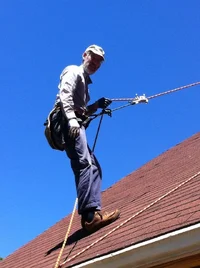
I can't site chapter and verse of all the regulations. My solution for working off the ground is to be secured. It isn't that hard to be secured on a roof. In this picture my landlord who is in his late 60's and a Doctor in General Practice is up on the roof. We both were up there doing some repairs. I setup two ropes so we could be secured. It only took him about 60 seconds to understand how the Unicender worked. In the past he'd used handled ascenders or a prusik-type hitch so he was familiar with the setup.

My point is...simple solution.

What would any of us say if one of our friends/coworkers stepped/fell off a roof?

My definition of work is related to what my high school physics teacher defined:

Work is moving something.

If we were walking around on that flat roof, maybe no protection needed. Once workers start to move things...time for protection.

Step ladders are a real conundrum though. Orchard ladders included. Being secured while working from step/orchard ladders isn't going to be easy. Do your best. So far, Z133 doesn't require any sort of fall protection while on step/orchard ladders.
 

Attachments

  • 369069-CRRustyonroofUnicender.webp
    369069-CRRustyonroofUnicender.webp
    102 KB · Views: 41
Re: Definition of \'Professional\'

[ QUOTE ]
Dude, it was an $800 job.

[/ QUOTE ]

I AM with you ion this one Nick.. commons sense trumps OSHA here... fairly simple to operate safely on a flat roof... Fall protection and fencing sound like they'd create more problems (danger) than they'd solve.. Getting on an off the roof and carrying equipment, setting up a safe ladder, and care in throwing stuff off the roof... all considerations, nothing too crazy though eh?
 

New threads New posts

Back
Top Bottom