Dead (and Undead) Wood

Here's an anecdotal story about this topic. Since the results would be impossible to replicate you have to decide how credible the outcome is.

A compan that I know had a client with a large American elm that was infested with a number of critters including fungus, bugs etc. that were weakening the tree. IN order to keep the nasties at bay a very involved and expensive chemical treatment and fertilizer program had been followed for several years. The tree had improved just a little but the client was concerned about the expenses. The arborist suggested a VERY thorough deadwooding down to pencil and matchstick diameter. This trim job wasn't cheap either.

Over the next couple of growing seasons the arborist tracked what the tree needed to keep the nasties at bay. What was found was that the costs for treatment plummeted and the tree improved. The variable was the thorough deadwooding so the conclusion was that the pathogens had deadwood to 'eat' and openings into the tree for exploitation. The tree does expend energy isolating deadwood and trying to grow over stubs. With that energy left and reallocated to growth the tree seemed to be in better shape.

It would be nice to read about peer reviewed research about this.

ICAN out of Evergreen College in Washington would likely be a resource. At one time I had a subscription to 'The dead wood Journal' which highlighted research into the topic as it related to forests.
Well, this is a more sophisticated why of explaining what I've thought and explained to customers. It also makes sense, if we are instructed to be good stewards of this earth.
 
It also makes sense, if we are instructed to be good stewards of this earth.

Don't think for a moment that the tree company in the story did the deadwooding out of the kindness of their heart or stewardship of the earth. The company is financially successful and rarely gives money up. In this case the pruning WAS expensive!
 
Don't think for a moment that the tree company in the story did the deadwooding out of the kindness of their heart or stewardship of the earth. The company is financially successful and rarely gives money up. In this case the pruning WAS expensive!
Oh, yes, I see. Though, if they had done it free of charge, at least it was only one tree. Being very large, it might be equivalent to a small outfit, pruning a smaller tree, as a bonus for the customer.
 
Last edited:
Recently I did a long distance consultation, it had its challenges and overall it was pretty rewarding, mostly providing educational info.

About a month or more later the client sends me this, a reference back to this thread.
Funny how it comes back full circle sometimes
 
Recently I did a long distance consultation, it had its challenges and overall it was pretty rewarding, mostly providing educational info.

About a month or more later the client sends me this, a reference back to this thread.
Funny how it comes back full circle sometimes
Bob definitely provided a lot of good to this fOrem. Thanks for the full circle share!
 
Bob definitely provided a lot of good to this fOrem. Thanks for the full circle share!
What a great piece of thinking and writing. Gospel as far as I'm concerned. Part of that gospel is to continue questioning existing paradigms in tree work and take into account observations we make over time working in and looking at trees in general.

I'm just finishing a massive deadwood prune in a mature open-grown black oak Quercus velutina. The prune is aesthetic, mitigating some amount of risk over a driveway and a walkway, and primarily... removing a ton of small/mid-sized deadwood that otherwise gradually rains down on a well kept front yard. It is preemptive yard cleanup. Makes life better for the lawn service. Customers are often confused when they say, "Looks beautiful, my tree is so much healthier now, thank you!" and I reply, "Tree doesn't care, its health is not changed but you have a lot less yard clean-up work for a few years". If they want to know more I tell them more, referring them to look at mature broadleaf trees in the forest and their beautiful (wabi-sabi) displays of retained deadwood structures lower in their crowns.
-AJ
 
Last edited:
Excellent question, Tom_Otto! I realize this is an ancient thread to which I may have already responded but perhaps for newcomers:

The case for removal of attached, dead branches is more inferred than directly proven by research. (1) A dead, attached branch precludes wound closure, leaving open a large portal of entry by wood decay fungi. (2) A dead, attached branch provides a food source and a channel of opportunity for facultative pathogenic wood decay fungi to enter further into the branch or the main stem (a "sugar stick" in Shigo lingo)..

I've messed around with how to best design an experiment to validate (or discontinue) those inferences, but I don't know of any actual published research testing those.

Makes sense to me to remove dead, attached branches as close to living tree tissue as possible without breaching constitutive defenses (such as the protective zone in branch bases).

And sure, Matt_hawley has it right, CODIT answers it pretty well.
 
Recently I did a long distance consultation, it had its challenges and overall it was pretty rewarding, mostly providing educational info.

About a month or more later the client sends me this, a reference back to this thread.
Funny how it comes back full circle sometimes
Loving the Trees First approach, looked through their mission statement and video, they speak my mind.
-AJ
 
Loving the Trees First approach, looked through their mission statement and video, they speak my mind.
-AJ
Not a fan of articles that make adamant statements and recommendations based on what 'can' take place, totally discounting all the instances it doesn't.

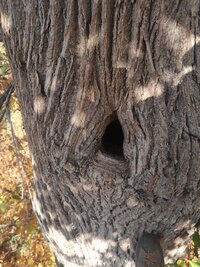
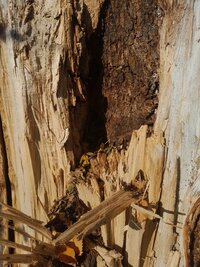
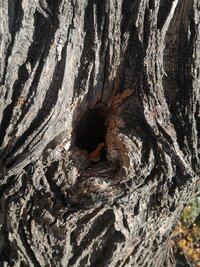
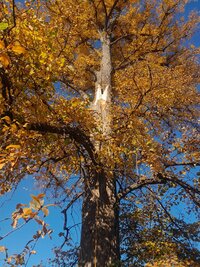
I see interconnected columns of decay from naturally shed limbs all the time, it happens.
 

Attachments

  • 20221019_103900.jpg
    20221019_103900.jpg
    879.5 KB · Views: 17
  • 20221019_101521.jpg
    20221019_101521.jpg
    830.6 KB · Views: 14
  • 20221019_101950.jpg
    20221019_101950.jpg
    941.8 KB · Views: 16
  • 20221019_104119.jpg
    20221019_104119.jpg
    1.2 MB · Views: 17
Not a fan of articles that make adamant statements and recommendations based on what 'can' take place, totally discounting all the instances it doesn't.

I see interconnected columns of decay from naturally shed limbs all the time, it happens.

Nobody's perfect! I like the overall point of view, the pendulum has swung too hard the other direction in my area. Stampeding customers into craning out 8+ trees is super common. Neighborhoods get leafleted, "We'll have our crane removing some trees for your neighbor, would you like us to look at your trees?". I've been present at a customer's request while a locally well-known tree/crane service owner did a site visit. Started out pleasant enough but when he started suggesting that several other trees were a threat besides the one obvious hazard, and then talked about what a great deal they'd get taking out 4 or 5 trees versus just one I pushed back and things got weird. At the end of it he had the nerve to try and hire me to ride his crane ball ;-) Nope nope nope. I've talked several of my customers off the ledge, one had two tree services condemn all their white pines. On assessment I found one with issues but no targets, the rest was fabricated BS including "Climate change is killing your trees, you should take them down ASAP". Another told them a specific fungi was killing all their pines, absolutely not true. I kid you not.

This has nothing to do with the biology of retained deadwood but the article in question spoke my mind about exploitative practices in the industry, and deadwood is part of it. As mentioned somewhere above, deadwooding is essentially aesthetic landscape maintenance and obvious hazard mitigation over property and people targets. The trees often in question will outlive two generations of property owners. The hazard issues are more typically related to codominant structures, rot processes from previous storm damage, or mistreatment of the root zone and/or volcano mulching. I've seen many examples where rot (fungal intrusion) entered the heart of a tree through a collar where deadwood was in place for a long time. In my area typical for Quercus velutina and red oak family species in general. I think the scientific deadwood discussion needs to go deeper into specific tree species and regions. Quercus alba in the northeast doesn't follow Q. velutina rules, I'm sure many of you have seen hulking old white oaks full of hollows and empty "collar sockets", tree's good for another hundred plus years.
-AJ

 
Last edited:
Nobody's perfect! I like the overall point of view, the pendulum has swung too hard the other direction in my area. Stampeding customers into craning out 8+ trees is super common. Neighborhoods get leafleted, "We'll have our crane removing some trees for your neighbor, would you like us to look at your trees?". I've been present at a customer's request while a locally well-known tree/crane service owner did a site visit. Started out pleasant enough but when he started suggesting that several other trees were a threat besides the one obvious hazard, and then talked about what a great deal they'd get taking out 4 or 5 trees versus just one I pushed back and things got weird. At the end of it he had the nerve to try and hire me to ride his crane ball ;-) Nope nope nope. I've talked several of my customers off the ledge, one had two tree services condemn all their white pines. On assessment I found one with issues but no targets, the rest was fabricated BS including "Climate change is killing your trees, you should take them down ASAP". Another told them a specific fungi was killing all their pines, absolutely not true. I kid you not.

This has nothing to do with the biology of retained deadwood but the article in question spoke my mind about exploitative practices in the industry, and deadwood is part of it. As mentioned somewhere above, deadwooding is essentially aesthetic landscape maintenance and obvious hazard mitigation over property and people targets. The trees often in question will outlive two generations of property owners. The hazard issues are more typically related to codominant structures, rot processes from previous storm damage, or mistreatment of the root zone and/or volcano mulching. I've seen many examples where rot (fungal intrusion) entered the heart of a tree through a collar where deadwood was in place for a long time. In my area typical for Quercus velutina and red oak family species in general. I think the scientific deadwood discussion needs to go deeper into specific tree species and regions. Quercus alba in the northeast doesn't follow Q. velutina rules, I'm sure many of you have seen hulking old white oaks full of hollows and empty "collar sockets", tree's good for another hundred plus years.
-AJ
I was just going to say something about the importance of species-specific approaches to these questions but you already said it @moss. Silver Maples come to mind as having much different rules to play by when pruning versus Honey Locust. One prunes itself in a light wind shortly after dying and the other keeps deadwood forever. Ongoing discussion and observation is more interesting than debating absolutes.
 
I was just going to say something about the importance of species-specific approaches to these questions but you already said it @moss. Silver Maples come to mind as having much different rules to play by when pruning versus Honey Locust. One prunes itself in a light wind shortly after dying and the other keeps deadwood forever. Ongoing discussion and observation is more interesting than debating absolutes.
Honey Locust is insane. "Yeah dude, I'm holding my deadwood for another 60 years, stop looking at me!"
 
...
This has nothing to do with the biology of retained deadwood...

The article in question was billed as "scientifically" addressing whether removing deadwood had health benefits for the tree.

A snap shot in time of cladoptosis in limbs in no way provides information on long-term outcomes.
 
Last edited:
Just a reminder that some species such as oak and sycamore will form a "collar" of woundwood on long dead limbs far further out from the stem then we are often taught take our cuts.

Food for thought
Always feel for the collar (it can be difficult to see) extending much further than you think under bark away from the trunk on oak species. Other species as well I'm sure.
-AJ
 

New threads New posts

Kask Stihl NORTHEASTERN Arborists Wesspur TreeStuff.com Teufelberger Westminster X-Rigging Teufelberger
Back
Top Bottom