Cut protector for climbing line

I try to not let my rope run along my right side where I stow my saw. I worry about incidental muffler contact as well as sharp cutters. If I'm making a cut and my rope is gonna be close, I reposition or redirect or make the cut somewhere else and take a bigger or smaller piece.

Interesting idea, but possibly might make a very false sense of security or protection, unless you got something in mind that's cut resistant. Plus you'll start cussing the first time your hitch or mechanical tries eating the sheath.
I used to keep a short piece of tubular webbing on my flipline, reduced friction when pivoting around on a spar and whatnot and kept pitch off my lanyard. Stole the idea from the older Grillon fliplines. Sure enough it got caught in the hitch and made me start cussing.
 
Most I've heard of people doing is the tubular webbing or cordura sleeves...sometimes a sheath from some other rope but you need the sheath to be a bit bigger than the host line to be able to move it around and for the line to move through.
 
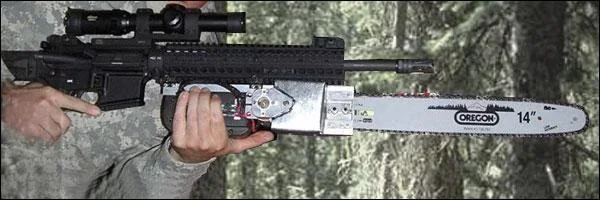
Just have a 6"-8" long piece of pvc on your rope above your hitch. If your handsaw hits it the pvc will spin rather than letting the saw teeth cut into it. Can also grab the pvc and use that to compress the hitch to go down. If you want to get real tactical you can mod a pistol grip cover to it for contoured finger channels. Then you can add another 6" piece above your anchor knot or terminal splice and put a picatinny quad rail on that. Now you can attach a laser sight for precise pruning cuts and a tactical light with strobe option for those night time black ops trim jobs. Could also attach a bayonet in case of an aerial rescue. Bonus...the laser sight can be used to rescue cats. Cus cats are curious creatures...which is why it's stuck in the tree in the first place.
 
Has anyone ever thought of using some sort of a line sheath to protect the climbing line from saw contact while tied in?

Stop the train...back up...get on a different train. This train of thought...adding protection to your climbing line...is going over the cliff.

Wrong thinking

Don't add protection...keep cutting things away from life support.

Years before two safeties were required for chainsaw use a lot of people did that because it made sense. Go forward a few years and it makes as much sense to use two attachments when doing any cutting in the tree. Just because a good idea isn't mandatory or legislated doesn't mean it isn't a good idea

Don't cut life support. Don't add 'layers of protection' to life support. Think and plan. Go home alive and walking at the end of the day
 
I try to not let my rope run along my right side where I stow my saw. I worry about incidental muffler contact as well as sharp cutters. If I'm making a cut and my rope is gonna be close, I reposition or redirect or make the cut somewhere else and take a bigger or smaller piece.

Interesting idea, but possibly might make a very false sense of security or protection, unless you got something in mind that's cut resistant. Plus you'll start cussing the first time your hitch or mechanical tries eating the sheath.
I used to keep a short piece of tubular webbing on my flipline, reduced friction when pivoting around on a spar and whatnot and kept pitch off my lanyard. Stole the idea from the older Grillon fliplines. Sure enough it got caught in the hitch and made me start cussing.
Yup the only added pro is a 1” webbing on my ring to ring..

However, I was reading a thread on Facebook where a few climbers have fallen due to their base anchored Srt ropes coming in to contact with broken stubs sawing away at their lines
 
Yup the only added pro is a 1” webbing on my ring to ring..

However, I was reading a thread on Facebook where a few climbers have fallen due to their base anchored Srt ropes coming in to contact with broken stubs sawing away at their lines
So maybe a cordura sleeves on your base anchor ?
Many other ways to metigate cut risks I know, just trying to keep ideas going...
 
Yup the only added pro is a 1” webbing on my ring to ring..

However, I was reading a thread on Facebook where a few climbers have fallen due to their base anchored Srt ropes coming in to contact with broken stubs sawing away at their lines
That has always weirded me out, and I try to be mindful about sharp things on my rope no matter what. I've seen some fresh cuts that had an edge on them.
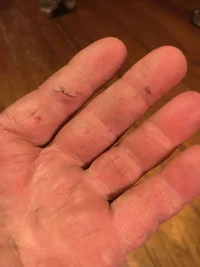
I also don't clean sawdust from notches with my hand anymore. I slid my finger tip across an edge about 1/8" thick where my cuts weren't quite all the way done and sliced straight down to my nail.
 
However, I was reading a thread on Facebook where a few climbers have fallen due to their base anchored Srt ropes coming in to contact with broken stubs sawing away at their lines

If this is true why weren't the climbers taught to do a proper Pre-Climb Inspection? DId they not read The Tree Climber's Companion?

Accidents like this need to be laid in front of people who are training as well as climbers who are so unaware.

Adding all sorts of layers of 'protection' won't do them any good if they aren't paying attention to basics.

Sad to hear...
 
If this is true why weren't the climbers taught to do a proper Pre-Climb Inspection? DId they not read The Tree Climber's Companion?

Accidents like this need to be laid in front of people who are training as well as climbers who are so unaware.

Adding all sorts of layers of 'protection' won't do them any good if they aren't paying attention to basics.

Sad to hear...
I agree, a shall for me is never climb a rope that I cannot see the psp. I keep a pair of binoculars in the truck mostly for this reason. If in doubt pull out!
 
The only real gain from sleeves I see is in the industrial market whereby rope protection against metal structures, welding sparks, grinding sparks, paint, solvents etc is important. Technically we are already using double protection whilst cutting by using lanyard (or should be...) and as Tom says should be doing pre-inspections, and during-inspections as we climb...

Worst time for possibly cutting climb ropes is during palm pruning, or cutting epicormics and water shoots near TIP or rope path and due care and attention is probably better than sleeves which can have their own issues with regards to getting in the way/jamming etc... I wouldnt want a sleeve above my hitch etc...
 
The only real gain from sleeves I see is in the industrial market whereby rope protection against metal structures, welding sparks, grinding sparks, paint, solvents etc is important. Technically we are already using double protection whilst cutting by using lanyard (or should be...) and as Tom says should be doing pre-inspections, and during-inspections as we climb...

Worst time for possibly cutting climb ropes is during palm pruning, or cutting epicormics and water shoots near TIP or rope path and due care and attention is probably better than sleeves which can have their own issues with regards to getting in the way/jamming etc... I wouldnt want a sleeve above my hitch etc...
I agree too which is why I'm thinking it's not bad to have a sleeve on your base anchor if your working with a new crew or u just don't trust the ground guys working near it.
If the tree has very rough bark/thorns or has bad sap like a white pine then sometimes I'll use a 2'-2.5' peice (or sometimes shorter depending on size of tree) of tubular webbing on my lanyard but I don't do it for my saw. I do it to help keep my lanyard clean and to prevent picks and abrasion from thorns/ rough bark.
That Sterling tritech is great for a lanyard, don't need anything to cover that or other tight kernmantles.
 
Yes even the Petzl Grillon and other industrial lanyards often have that black sleeve loose or secured to the snap end of the lanyard. The industrial climbing rope sleeves are usually used with the rig/d4/d5 type descending devices, and not much chance of it becoming a safety issue.

Only real tree I around here I would use such a protected lanyard on a climb line is a Silk Floss Tree, and would try to avoid climbing a tormented one if possible to avoid rope damage, but I don't often have to deal with pitch like many on here do...

I dont see many thorny trees - how much damage do locusts etc do to lanyards ropes?
 
Stop the train...back up...get on a different train. This train of thought...adding protection to your climbing line...is going over the cliff.

Wrong thinking

Don't add protection...keep cutting things away from life support.

Years before two safeties were required for chainsaw use a lot of people did that because it made sense. Go forward a few years and it makes as much sense to use two attachments when doing any cutting in the tree. Just because a good idea isn't mandatory or legislated doesn't mean it isn't a good idea

Don't cut life support. Don't add 'layers of protection' to life support. Think and plan. Go home alive and walking at the end of the day

Tom beat me to the punch here, but the obvious answer is to NEVER EVER cut your life support (climbing-line, flip-line, etc.) Problem solved!!
 
Yeah a honey locust could probably wreck a rope or lanyard under the right conditions. Black locust too I guess, but the honeys are friggin scary.

The thorns on honey locust could puncture through the rope and pick at the strands. In theory the puncture could sever a strand, but I suspect it'd just part the strands and make a smooth hole, kinda like a fabric needle would. A moving rope in a perfect storm situation might see some real serious damage though. A stationary rope at least won't be dragged through them over and over. The thorns are often big clusters of them, dozens or hundreds of them, and they're pretty hard.

The thicker bark on the bottom of a mature honey locust can get kinda sharp and is quite hard also. A base tie should probably be watched closely and can consider a webbing sheath or other extra protection. Same deal with porty slings.

Also worth mentioning, they will absolutely puncture through soft soled shoes, and any other clothing and gloves.

I don't see many squirrels in those trees.
 

New threads New posts

Back
Top Bottom