

This codom Elm was reduced heavily by another arborist a couple years ago, was a harder reduction that I think I would have done, but I can understand the reasoning given the situation. Also, very much in line with the reduction work that appears to be commonplace in the EU/UK, as well as what I have started to see recommended in consulting arborist recommendations here in the PNW.
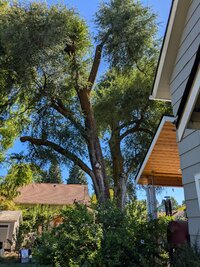 Here's where I enter the picture: The property owner is committed to retaining it, given that what kicked off their desire to have the tree assessed several years ago was that the union was "opening up" (and then apparently closed up once the reduction work was done), I wanted to establish a more rigorous approach to monitor the separation of the stems, as part of the calculation to inform weight reduction pruning intervals.
I was discussing this issue with a structural engineer friend of mine and he suggested I use a "crack monitor", primarily used to assess cracks in stone/concrete construction over time.
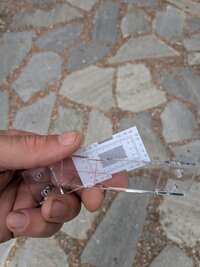
I came up with a mounting system for this tree.
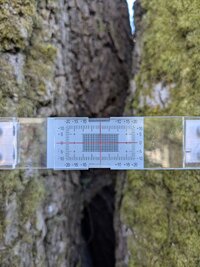
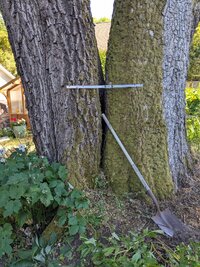
Curious to hear any thoughts or if anyone has tried something like this?
Here's where I enter the picture: The property owner is committed to retaining it, given that what kicked off their desire to have the tree assessed several years ago was that the union was "opening up" (and then apparently closed up once the reduction work was done), I wanted to establish a more rigorous approach to monitor the separation of the stems, as part of the calculation to inform weight reduction pruning intervals.I was discussing this issue with a structural engineer friend of mine and he suggested I use a "crack monitor", primarily used to assess cracks in stone/concrete construction over time.
I came up with a mounting system for this tree.
Curious to hear any thoughts or if anyone has tried something like this?


