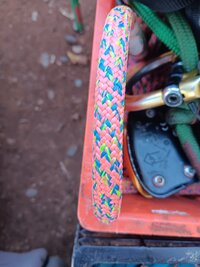
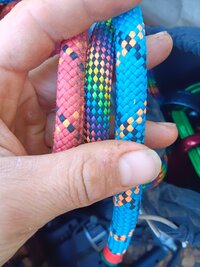
Before climbing on Voyager I was able to milk just over 5feet of cover. Removing that 5ft, did keep the rope noticeably more round, upto 30ft from spliced eye, but closer to the free end, it stayed oval, making it too touchy, in inducing bending, due to the oval profile, to easily self tend. And, simply was too oval for ideal.
Unfortunately milking a rope makes the cover braid strands more parallel to the rope, so you lose some grip.
I have yet to climb on the Kalimba I purchased, waiting to milk, soak, then milk.
Have others soaked their Kalimba, or milked it before or after?
Have others found that Squir has a slight trapezoidish profile to it.
Funny seems some are looking for a rope that won't flatten, has high strand cover count, very static, and light weight.

It seems, to have more than 3 carrier strand could be better that even being 32 strand.
A good rope could be 4 carrier in a 24 strand. To eliminate flattening, a tightly wrapped cover over the core might be necessary, most static true kernmantle (most flatten anyway) ropes, cannot be spliced anyway, so why not make a rope that has a very tight cover braided over a partially pre-stretched core. And, to reduce bulk of the sewn eye, have a low profile sewn eye, like the one Edelrid does on their rock climbing ropes.
A nylon cover and core, to save weight. Nylon is plenty abrasion resistant, the Beal rope was used for 3 years showing less than typical wear of the cover, compared to loosely braided polyester covers.