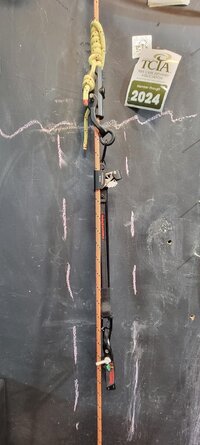
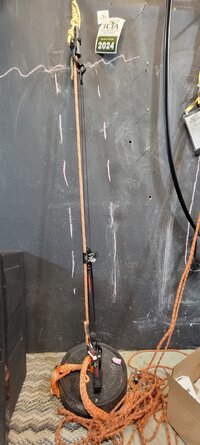
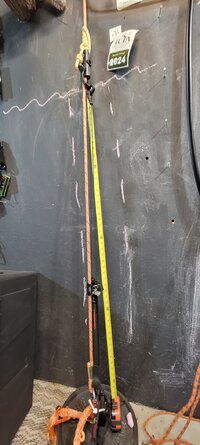
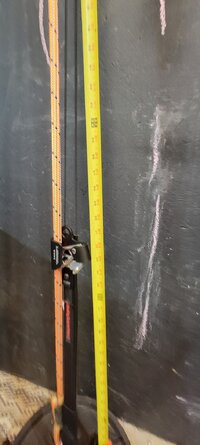
Components of a Self-Advancing Knee Ascender (SAKA)

My choice to post in this thread has caused a lot of confusion. I am not putting a bungee in a tube and I am not trying to DIY a SAKA. I want a durable high-stretch non-abrasive bungee cord to advance the floating foot ascender that I already own. Shock cord from REI is stretchy enough but abrasive, and the 4mm Robline Dyneema is slick but not as stretchy as it is supposed to be.
Curious about the "can't be abrasive" aspect. Abrasive to what?
-AJ
 
Curious about the "can't be abrasive" aspect. Abrasive to what?
-AJ
Skin, clothing, and most importantly harness webbing and other load-bearing textiles. There are ways to work around this but I prefer a bungee that is inherently low friction.
 
Skin, clothing, and most importantly harness webbing and other load-bearing textiles. There are ways to work around this but I prefer a bungee that is inherently low friction.
As a point of reference I’ve been using the REI spec bungee cord for my knee ascender (uncovered) with no abrasion issues whatsoever over a few years. It may be that the path of the bungee cordage does not contact anything to any significant degree the way I have it set up. Probably more relevant, the amount (length) and rate of movement per stretch and relax cycle of the bungee cover is pretty low. Theoretically there is greater probability that some surface on my climbing harness or my climbing line will eventually abrade the bungee to failure. So far no signs of that happening. It is most likely that cycles to failure will kill the bungee cord eventually.
-AJ

 
It amazes me that this was started ten years ago and has been a primary focus for me over those number of years.
So my comments here will be primarily about the bungee.
For many years I used a solid rubber core with a dyneema cover. The intent was that the dyneema has a low coefficient affection. The bungee travels inside of a tube. I was using a polyethylene tubing that was glued inside of webbing. The PE tubing is also low friction. For that reason you will find it used often on the bowden tubes for 3D printers and such.
In spite of these things , I started to notice that the bungee would start to fluff up and then in so doing would lose some of its stretch. Mind you the bungee on the SAKA has a direct path with no bends and very minimal friction but still there's a lot of movement there.
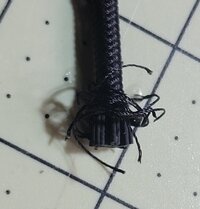
Currently I use a bungee with polyester cover and a more traditional core of numerous elastic strands. It is manufactured to my specifications and has a looser weave that allows it to have a tremendous amount of stretch. It needs to be cut with a hot knife as you can see in the picture, if it is not it will start to unravel quickly.
So one of the major advantages here is that we have plenty of stretch to take the ascender directly to the bottom of a climber's life support multiscender. This avoids having to have any components or bungee from rope walking adjacent to or above the life support device and it also avoids having any curves or bends or friction type of travel in the bungee cord.
The tubing is now LLDPE, or linear low density polyethylene.
 

Attachments

  • 20240517_194226.jpg
    20240517_194226.jpg
    338.1 KB · Views: 19
  • 20240517_194317.jpg
    20240517_194317.jpg
    388.3 KB · Views: 18
  • 20240517_194424.jpg
    20240517_194424.jpg
    350.5 KB · Views: 18
  • 20240517_194435.jpg
    20240517_194435.jpg
    261 KB · Views: 18
  • 20240517_194609.jpg
    20240517_194609.jpg
    200 KB · Views: 23
Would you ever use the SAKA without also using a foot ascender?
One case might be climbing with sandals or bare feet in a recreational type setting. With a second foot loop both feet can be placed in the SAKA and a foot-lock technique can be used for ascent.
Under normal circumstances, If I had to leave one or the other on the ground, I would take the foot ascender first.
 
One case might be climbing with sandals or bare feet in a recreational type setting. With a second foot loop both feet can be placed in the SAKA and a foot-lock technique can be used for ascent.
Under normal circumstances, If I had to leave one or the other on the ground, I would take the foot ascender first.
Agreed, knee ascender only ascent without locking the tail with a foot ascender (or footlock) not good.
-AJ
 

New threads New posts

Kask Stihl NORTHEASTERN Arborists Wesspur TreeStuff.com Teufelberger Westminster X-Rigging Teufelberger
Back
Top Bottom