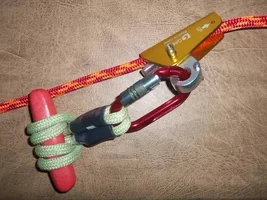
Components of a Self-Advancing Knee Ascender (SAKA)

Another form of secondary LS, would be a hand ascender with a short lanyard or an Ascentree with a nylon sling attached to the bridge or Multiscender. Just other backup ideas. Never a backup below the bridge! That's a hazard waiting to happen!


Dave6390 in WI
 
It is not that I want the life support to be below the waist, it is just that that is the best place to put it without having to add another point of attachment to the rope. As Richard suggests you can add a prusik or mechanical attachment above the primary ascender, but then you have a total of 4 attachments going up the rope, which is a lot of stuff, and takes a long time to get on and off. So, it seems to me that a tether to the bottom of the knee ascender offers an alternative. And if the top ascender fails, you don't end up completely upside down - you end up hanging on a sort tether between your bridge and the knee ascender. It is not particularly comfortable, but it does make it possible to get yourself upright again, whereas a heel hang obviously does not. But this discussion does make me wonder if there are OSHA rules (or some other rules) that stipulate that ascenders used for life support must be above the waist? If so, I would appreciate you guys educating me on that.
 
Arlo,

A bit of Google time will answer your questions about fall arrest systems.

Reading the book "On Rope" is a really good place to start too.

There is a lonnnnnnnng discussion that will likely never end about the need to have two points of attachment for a work positioning system. Think about this at its most basic form. For decades climbers have worked on a DdRT system where there is one rope and one knot. Problems? Not many.

Next...we need to understand the difference between fall-arrest and work-positioning. Arbos use WP. One of the base fundamentals of WP is that here is no slack in the system.

I'm going to stop here...time for homework.
 
Ok, do something for me, walk up to a set of stairs. Who do you know that can't walk up those comfortably? Most stairs are built to a 7-11 type code, 7" rise -+, 11" run. So put your first foot on the first stair....now the other on the next....step up, how far did you rise? About 14 inches right? Lets make it about 16 inches just 'cause tree climbers are cool. Now the optimum travel for MOST situations is to be able to lift the leg with the foot ascender about 16 inches before it contacts the ascender at about knee level. This in essence provides between able to walk the stairs one or two at time, that is what the SAKA should provide. Picture you are standing in front of those stars again but with your SAKA and foot ascender, you lift your foot ascender up and it should reach the height of that second stair before it contacts the ascender on the SAKA.
If that does not work, the SAKA could be adjusted in length. Children would do well with a shorter length as it is difficult to raise the rest of their gear high enough to be comfortable.
Now what we did was without the rest of our gear, so the next thing is to look at the other gear that may prevent our steps.
Adjustable bridge...adjustable tending tether...suitable attachment placement...extending the footloop above the laces...
............to be really dialed in, ALL of this stuff has to be considered, not just where an ascender is positioned at the knee. Maybe we shouldn't even call it a knee ascender but the "upper" ascender.


Very well said! Definitely what i needed to hear. In one of your videos i remember you reffering to walking up stairs, this explains it perfectly! Thanks bud!
 
Arlo,

A bit of Google time will answer your questions about fall arrest systems.

Reading the book "On Rope" is a really good place to start too.

There is a lonnnnnnnng discussion that will likely never end about the need to have two points of attachment for a work positioning system. Think about this at its most basic form. For decades climbers have worked on a DdRT system where there is one rope and one knot. Problems? Not many.

Next...we need to understand the difference between fall-arrest and work-positioning. Arbos use WP. One of the base fundamentals of WP is that here is no slack in the system.

I'm going to stop here...time for homework.
Yes, never ending, well said Tom.
The only practical application I have seen is when using a doubled SRT system, but I never really got into that.
 
Arlo,

A bit of Google time will answer your questions about fall arrest systems.

Reading the book "On Rope" is a really good place to start too.

There is a lonnnnnnnng discussion that will likely never end about the need to have two points of attachment for a work positioning system. Think about this at its most basic form. For decades climbers have worked on a DdRT system where there is one rope and one knot. Problems? Not many.

Next...we need to understand the difference between fall-arrest and work-positioning. Arbos use WP. One of the base fundamentals of WP is that here is no slack in the system.

I'm going to stop here...time for homework.

Ok, Tom, I can tell from your response that I am probably not going to convince you on this issue, but here goes. First, I have all of the sources that you mention in my library and have read them all many times, and none of them explain why I am recommending using the knee ascender as a back-up. My reasoning is as follows: I am seeing many videos of new SRT climbers who are using ascenders such as the RR, RW, BDB, and HH, and virtually NONE of them are using any back-up at all. They just clip in and head up the rope, using either a foot ascender or a foot ascender and SAKA or HAAS to ascend. I think the reason they do this is because they think the top ascender will never fail and because it is a real pain in the butt to install a secondary means of life support - it adds friction, and just generally gets in the way. So, if they are not going to add any additional life support, my feeling is that it is safer to at least clip into the knee ascender as a back-up. By doing so you have some chance of surviving a failure of the main ascender, whereas the alternative is a heel hang. So, I completely understand the issues you raise, but I still think that my approach is safer than no back-up at all.

 
Ok, Tom, I can tell from your response that I am probably not going to convince you on this issue, but here goes. First, I have all of the sources that you mention in my library and have read them all many times, and none of them explain why I am recommending using the knee ascender as a back-up. My reasoning is as follows: I am seeing many videos of new SRT climbers who are using ascenders such as the RR, RW, BDB, and HH, and virtually NONE of them are using any back-up at all. They just clip in and head up the rope, using either a foot ascender or a foot ascender and SAKA or HAAS to ascend. I think the reason they do this is because they think the top ascender will never fail and because it is a real pain in the butt to install a secondary means of life support - it adds friction, and just generally gets in the way. So, if they are not going to add any additional life support, my feeling is that it is safer to at least clip into the knee ascender as a back-up. By doing so you have some chance of surviving a failure of the main ascender, whereas the alternative is a heel hang. So, I completely understand the issues you raise, but I still think that my approach is safer than no back-up at all.
What do you imagine a multiscender failure would be like? I dont see how anything more than the multiscender slamming into the knee ascender would happen. I guess I'm not seeing your point? By 'back-up' in this scenario do you mean an active mechanical stopper knot?
 
Ok, Tom, I can tell from your response that I am probably not going to convince you on this issue, but here goes. First, I have all of the sources that you mention in my library and have read them all many times, and none of them explain why I am recommending using the knee ascender as a back-up. My reasoning is as follows: I am seeing many videos of new SRT climbers who are using ascenders such as the RR, RW, BDB, and HH, and virtually NONE of them are using any back-up at all. They just clip in and head up the rope, using either a foot ascender or a foot ascender and SAKA or HAAS to ascend. I think the reason they do this is because they think the top ascender will never fail and because it is a real pain in the butt to install a secondary means of life support - it adds friction, and just generally gets in the way. So, if they are not going to add any additional life support, my feeling is that it is safer to at least clip into the knee ascender as a back-up. By doing so you have some chance of surviving a failure of the main ascender, whereas the alternative is a heel hang. So, I completely understand the issues you raise, but I still think that my approach is safer than no back-up at all.
Yes, you are right, this has permeated for sure. But modern srt concepts are fairly removed from the stuff in On-Rope. What is your reference, your history? I worry that young climbers make decisions from the status quo, researching old systems make modern component design safer. I build in redundency for safety and then try to shave components out, there is no way I would use a bona-fide back-up with a multiscender.
 
why tie in to the knee ascender? unless the top ascender comes off the rope completely, the knee ascender does serve as a backup to the upper ascender just by being there and not allowing anything to slide past it. I actually have had worries about this as it makes escaping a bad situation more difficult.

When I used to ascend with a foot ascender and an ascender above my device, all i needed to do was kick my panting off the rope and my other foot out the foot loop and descend. with the HAAS or SAKA, I have to kick my panting out and then remove the knee ascender off the line. If I forget to remove the knee ascender and descend in a panic before removing the knee ascender I literally end up in a jam.

I feel in tree work that it is more likely to end up in a situation needing a fast exit rather than a situation where my ascender just fails on me. That said, the HAAS/ SAKA make going up the rope too easy not to use. Tying into the Saka doesn't make any sense to me though as it would just make exiting even that much more difficult.
 
Agree treeing, If I were going up a hazardous tree, sneaking past a bee hive for example, I would use the Unicender in a modified frog walker, (Uni as the upper ascender to a footloop, Pantin on the other foot). As fast as I can kick off the Pantin and loop the rope over the Uni, I'm descending. Literally about a second.
But for everything else, I just don't see a practical need for backing up a multicender.
It would be like backing up a swivel.
No more swivel, no more multicend IMO.
 
@ ARLO, if you are hard pressed for a back-up in a contemporary SRT system for Work Positioning, climb DSRT and carry along a positioning lanyard. You can do everything from ascending, descending, and moving laterally, all with a minimum of 2 points on life support connection at all times.

That being said, I do not feel that today's Mulitiscenders require any type of back-up at all.
 
why tie in to the knee ascender? unless the top ascender comes off the rope completely, the knee ascender does serve as a backup to the upper ascender just by being there and not allowing anything to slide past it. I actually have had worries about this as it makes escaping a bad situation more difficult.

When I used to ascend with a foot ascender and an ascender above my device, all i needed to do was kick my panting off the rope and my other foot out the foot loop and descend. with the HAAS or SAKA, I have to kick my panting out and then remove the knee ascender off the line. If I forget to remove the knee ascender and descend in a panic before removing the knee ascender I literally end up in a jam.

I feel in tree work that it is more likely to end up in a situation needing a fast exit rather than a situation where my ascender just fails on me. That said, the HAAS/ SAKA make going up the rope too easy not to use. Tying into the Saka doesn't make any sense to me though as it would just make exiting even that much more difficult.
I built a Shunt knee-ascender for my 8mm TRT, you can descend with it on rope!!
 
Ok, Tom, I can tell from your response that I am probably not going to convince you on this issue, but here goes. First, I have all of the sources that you mention in my library and have read them all many times, and none of them explain why I am recommending using the knee ascender as a back-up. My reasoning is as follows: I am seeing many videos of new SRT climbers who are using ascenders such as the RR, RW, BDB, and HH, and virtually NONE of them are using any back-up at all. They just clip in and head up the rope, using either a foot ascender or a foot ascender and SAKA or HAAS to ascend. I think the reason they do this is because they think the top ascender will never fail and because it is a real pain in the butt to install a secondary means of life support - it adds friction, and just generally gets in the way. So, if they are not going to add any additional life support, my feeling is that it is safer to at least clip into the knee ascender as a back-up. By doing so you have some chance of surviving a failure of the main ascender, whereas the alternative is a heel hang. So, I completely understand the issues you raise, but I still think that my approach is safer than no back-up at all.
Do you back up a hitch when you are climbing on it? I see a mechanical ascender as no more likely to fail than a hitch. You can only back up so many things before you are just standing on the ground wishing you could climb that tree.
 

New threads New posts

Kask Stihl NORTHEASTERN Arborists Wesspur TreeStuff.com Teufelberger Westminster X-Rigging Teufelberger
Back
Top Bottom