Compact Bulldog Bone

As far as the pressure required to initiate descent, this is largely determined by the pivot distance from the upper pivot link and the friction link. I would like to send you a demo Bone with a shorter pivot length to try out on your rope, the trade off is that it may not grip effectively, but if you are willing, I will make one up and send it out for you totry.
Thanks, Gordon

So this is what he was saying about the demo bone that should arrive Saturday.
 
I am actually quite busy right now with my "real" job (Land Surveying), but not so busy that I cannot check in here : )
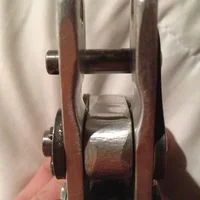
Some ropes swell with use, and some are just thick to begin with. In those cases the Bone is helped by having a deeper and wider groove on the inner portion of the arms. I have been grooving the arms to allow a 9/16" space between the arms, but for a thicker rope a 5/8" groove is better. Also on the Demo Bone I am sending Steve I have shortened the pivot length as DMc has on his, and shortened the length of the upper arms as he and others have done also. The trade off is less grip, and it may creep for Steve on his rope, or be twitchy on release.
 
That's cool of Gordon to do, but (maybe chime in here DSMc) won't that create more pinch?

I'm wondering if there's a way to get some contour to the pressure points...similar to Gordon's bronze bushing mod way back in the ZK-1 days. I still have some of them somewhere! They wouldn't work here except potentially on the top bollard location, but that's a drill bit away. The tough (costly?) part would be getting a contour to the backbone/spine where the lower arms pinch.

What do y'all think? Is that worth visiting? The RR makes rope flat too but it also has 3 pinch points instead of 2 like the Bone. More musing...but would that potentially make the Bone more immediately compatible with a wider variety of ropes?
 
Since I have not climbed on them yet Oceans I was keeping quiet but I think contouring the spine may help also. I and many others have done this to our RR's. It definitely helped mine with adding pinch while decreasing release pressure at the finger tips. It is a slippery slope though as I made one shape that worked so well that it tooked about an ounce of pressure to relaese, not so good in the real world of trees.
 
That's cool of Gordon to do, but (maybe chime in here DSMc) won't that create more pinch?

It does transfer more load to the bottom arm and spine but that is not a bad thing. The reason I changed mine was to lighten the release force on the top arm and that is exactly what it did, in spades. The upper hole spacing could be used to create more or less release force depending on how much it is moved.
Mine works great! I see no reason to mess with the shape of the spine or the lower link. ML, you need to climb on yours and give us a report on your impressions on how they differ.
As for 16 vs 24 strand ropes, as long as it is 1/2" 24 strand is much smoother running and for me that just feels right.
 
It does transfer more load to the bottom arm and spine but that is not a bad thing. The reason I changed mine was to lighten the release force on the top arm and that is exactly what it did, in spades. The upper hole spacing could be used to create more or less release force depending on how much it is moved.
Mine works great! I see no reason to mess with the shape of the spine or the lower link. ML, you need to climb on yours and give us a report on your impressions on how they differ.
As for 16 vs 24 strand ropes, as long as it is 1/2" 24 strand is much smoother running and for me that just feels right.
Thanks, David. Though again, ropes that are prone to flattening will flatten more?
 
Thanks for the pic Eric, and it looks like the steel pin may go awhile longer also.

I doubt the flattening will be worse on DMc's, because the same cantilever pressure is being applied there at the spine as you descend on rope, balanced between the spine and the link pin.
 
Last edited:

New threads New posts

Back
Top Bottom