Codom Advice

Dan Cobb

Been here a while
Location
Hoover
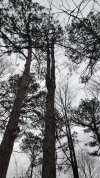
I have a bad codominant fork in a tree in my backyard. If it were to split, worst case is some damage to adjacent trees; no structures nearby. Anyhow, I'm considering taking off the left side. I may rig it to a line coming down from the tall pine to the left to (1) maintain control of it and be able to lower it and (2) be able to pull upward tension on it when cutting to help avoid pinching my saw. I'm thinking of making a broad notch and slowly enlarging it until it's cut through since there's no room for a saw between the stems at a height that seems safe. Tree is only 6" dbh and forks at 15'. I'm thinking the final cut should be at about 45 degrees. Opinions on that, or the best way to cut and not get pinched?20210315_084859.jpg
 
That’s a pretty large wound from the looks of it. Is this your tree or a clients? With no targets what’s really the objective here?
It's in my backyard. Are you saying removing one leader will make for a large wound that may not seal well and potentially compromise the tree? I'm thinking it's better to address the codom issue now while the tree is relatively small. My main concern is damage to adjacent (understory) trees if it breaks. I've removed several large dead/dying trees, roping each piece down, to avoid damaging smaller trees that will eventually fill in the gaps in the canopy. I don't want the (currently) small trees to have structural problems from getting smashed.
 
It's the largest tree in the immediate area except for a loblolly 12 ft away.

What angle do you recommend? I can maybe see closer to 30 degrees off horizontal. I remember a good presentation that, IIRC, suggested splitting the angle between perpendicular and the bark ridge.
 
Not sure of the species. Tree ID is not my strong suit and no leaves at the moment. I'm guessing it's some type of oak. Mostly have loblollys, red oak, water oak, hickory, sweetgum, cedar and poplars around.

No major disease or pest issues. Worst thing recently was the drought 3 summers ago. Went 62 days without a drop of rain. We normally average 56 in/yr.
 
EDIT!
My comments below are based on the pine in the foreground. My eye didn't even see the tree...maple???...in the back ground. Even so...same advice but even more important not to cut at the codom union.

Reduction of the back tree will gain you more than what you might do to the pine.

***Which tree are YOU concerned about?

************
Reduce don't remove. Lower the top and maybe do some shortening of the laterals.

There is no branch collar at codoms so you will get a LOT of decay if you remove it at the union.

If you're worried about it breaking do an easy and cheap brace using some old climbing or rigging rope. Tie it loose so there is no constriction. The rope would be there just to reduce extreme movement from wind or ice/snow loads.

Every tree solution isn't made with a chainsaw.
 
The tree in question is the foreground tree right in the center. The picture is from close to the tree looking steeply upward, so it looks about the same size as the 24" pine with the bird house. Background tree to the right is not a concern, just an optical alignment due to camera angle.

Anyhow, the tree looks like it will end up with a lot of included bark at the union and be failure prone. My reading seems to suggest that one leader needs to go. Think I should just leave it alone? Having one less chore is nice. Safety strap seems like a good idea, except for having to look at it when the trees are bare. Might have to rustle up some brown or gray rope for low contrast.
 
That tree is only 6"? So the codom is like, 3"-4"? And only about 20" from the tree on the left? Looks deceiving. Must be the angle of the photo.
 
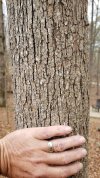
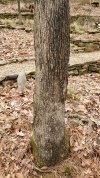
Overcast here today, so looking up is basically a silhouette. Maybe bark pics will help. Hodgepodge of leaf types under it, so no real help there.20210315_131034.jpg20210315_131355.jpg
 
Think smaller diameter cuts away from the main stem/trunk
and not necessarily a need to ever cut it at the main stem. If perfect form is desired, do as Tom suggests and I'm thinking he means cut back progressively over three applications over six years with the stem cut made after strong dominance is shown in the chosen leader.
We need to look at pruning as working slowly from the tips in, and to stop cutting as soon as the goal is achieved, before an overdose is committed. Looks can be decieving and aiming for perfect aesthetic structure can result in poor aesthetics through decline, or poor wound healing. The nodal approach vs the fork approach can lead to better aesthetics in the long run anyway.

Sent from my SM-G930W8 using Tapatalk
 
looks like sugar maple, if so will likely decay badly, tolerate it well, like tilia, but would be best with subordination vs drop crotch or heavy handed. Because handling it well doesn't mean remaining structurally sound, it means the remaining leader could fail from decay caused by the overdose cut. Which isn't a fail for the plant. It will just grow epicormics from near the break point. Maybe not highly vigorous but the species can remain high vitality, given storm damage or similar overdose pruning. Prune more to mimic the light storm not the heavy one. Otherwise those Sugars ate usually strong and tapered well and succeed open or in a stand, with one to one ratios. Details. Thats why posts need better context info, no offense good conversation, got my attention. This, my long drawn out comment is one derail of many possibilities given the lack of context. Again no offense, in your defense, most posts lack context.

Sent from my SM-G930W8 using Tapatalk
 
sorry sugar maple in the background. not sure but White oak sounds like a good guess for the foreground.

Sent from my SM-G930W8 using Tapatalk
 

New threads New posts

Back
Top Bottom