climbing on a spar

[ QUOTE ]

One application that I really like using the Gri Gri for is when I am blocking down a spar. It was a technique shown in a Sherril catalog a few years ago. I tie a running bowline around the trunk with my climbing line and leave a ten foot tail hanging down. Then I put the Gri Gri on the main part of the climbing line so I can rappel down that but then release the bowline by pulling the tail. The Gri Gri never leaves the rope and the bowline never leaves the trunk it just slides down to your next cutting point. Works great on our big douglas fir trunks around here.

[/ QUOTE ]

Ryan that is how I use the Kong Indy.

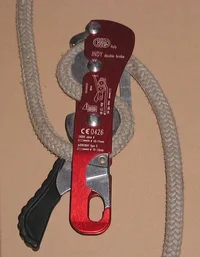
I never hear the Kong Indy mentioned. I have the Indy C which can take up to 13 mm rope. The photos are of the Indy with New England Safety Blue. With the Indy it is a little difficult to pull half inch rope through when working down the spar and I don't like it. I haven't used it on Blaze yet but I bet it's 11mm diameter would pull through easier than than the Safety Blue 1/2inch(12.5mm)

I plan on making an AFC like Mahk is so fond of. It looks like a better system than the srt I'm using.

68633-KongIndy.jpg
 

Attachments

  • 68633-KongIndy.webp
    68633-KongIndy.webp
    72.8 KB · Views: 67
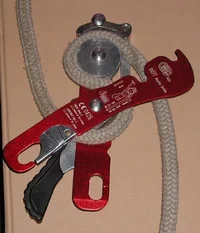
Here is the Kong Indy opened. With the Indy you have to hold the handle in a particular position to descend. If the handle is let go of it locks........and if the handle is gripped in a death grip it locks.

68635-KongIndyopen.jpg
 

Attachments

  • 68635-KongIndyopen.webp
    68635-KongIndyopen.webp
    95.6 KB · Views: 44
To Ryan,
Thats what Im talking about! Chisholm taught me once instead of tying your bowline with a ten foot long tail-just tie it with a 6" tail, if your line is spliced, leave the carabiner on it and run the tail below your decent system through your carabiner, that way you can decend any amount of distance and still retrieve your bowline-plus, this is the nice part, it takes less time to tie.

TO ALL ADJUSTABLE RING RING JUNKIES:

Can you decend on that system and easily reset it lower on the spar without having to untie your climb line to retrieve it?
 
[ QUOTE ]


TO ALL ADJUSTABLE RING RING JUNKIES:

Can you decend on that system and easily reset it lower on the spar without having to untie your climb line to retrieve it?

[/ QUOTE ]

Yes..A piece of throwline tied to 1 ring and to back side of tree allows it to be pulled down.Ive only done it on a couple smoothe bark trees but it worked on them
 
trees4life,

If for some reason my ring/ring FC won't slide down the spar (almost always releases with a little shake of my climbing line), or gets hung up on a stub I didn't see... It only takes 30 seconds to reset by pulling my line through.
 
[ QUOTE ]
TO ALL ADJUSTABLE RING RING JUNKIES:

Can you decend on that system and easily reset it lower on the spar without having to untie your climb line to retrieve it?

[/ QUOTE ]

Yes. Just unclip the carabiner from the eye of the climbing line and pull through the slack.

[ QUOTE ]
Has anyone read Chisholms article intitled "Tie-In Technique Too Troublesome to Title" in the article section? Its a nice read.

[/ QUOTE ]

Yes. A very good article. Mark gives a good run-down of the dangers of working a spar. I just prefer a different way to tie-in and work.
 
[ QUOTE ]
trees4life,

If for some reason my ring/ring FC won't slide down the spar (almost always releases with a little shake of my climbing line), or gets hung up on a stub I didn't see... It only takes 30 seconds to reset by pulling my line through.

[/ QUOTE ]

So you normally retrieve the AFS by just shaking it, without pulling the climbing line through?
 
[ QUOTE ]


If you use an AFS use a small ring, rather than a screw link, for retrieval.

[/ QUOTE ]


Why do you say this? I'm getting ready to splice up an AFS and not having used one before any advice is appreciated.
 
Just to be clear, when I said "...small ring, rather than a screw link..." I was referring to what is used to retrieve the system, not the small ring of the friction saver itself.

A screw link will sometimes jam between the big ring and the spar when you try to retrieve the system, particularly if the rings are set far apart. It can usually be shaken free, but it is still a nuisance. A small ring (such as the ring from an old throw weight) slides through the big ring of the FS much more easily than a screw link.

Described in (stifling) detail, with photos, here:

http://www.treebuzz.com/forum/showflat.php?Cat=0&Number=61178&page=0&fpart=2&vc=1


Scroll down to my post that begins "This is long..."


There is a lot more discussion about these techniques in that same thread.
 
Thanks Mahk. I'm assuming that if a screwlink has problems passing through, then the trusty old fig8 stopper knot that I usually use to retrieve my ring/ring FC may not work here.

EDIT: Just checked that link. You're not kidding that WAS long and detailed! But also very clear and informative. Those pictures make a great visual aid for explaining the use of the technique. Thanks again.
 
Mahk Adams,

Yes. Depends upon the tree. Shaggy-peeling bark is a problem; epicormic sprouts or stubs that I failed to remove. On a spar relatively free of obstructions I will lanyard in, pull a few feet of slack up through my climbing hitch and shake my line or "send waves" upwards. This is usually enough to allow the rings to spread and the FC will slide down the spar.
 
In my opinion the rope guide pulley available from greg good for 60$ with an eye to eye on it attached to a standard long friction saver makes a very economical and amazingly versatile tool for spar work. Better than the art rope guide because of the thick and flippable friction saver webbing
 
Bobbin-type tools like the Stop/Indy are nice because they have a sweet spot...let go and they lock off or grab tight and they lock off. They ARE meant for small diameter ropes and shouldn't be used with trad arbo ropes. The camming mechanism doesn't work properly.

If less gear is the criteria the AFC/AFS is the ticket. All of that kit is with me during the crown removal.

For SRT descents the I'd is my tool of choice. It's purpose-built and comes in two sizes for different rope diameters.

Today I plan on going out to use the newest version of the Unicender for working up and down ropes. A while ago I used it for a 100' ascent and it worked fine. Since I had never used it for a descender I opted to I'd down that one.
 

New threads New posts

Back
Top Bottom