Climbing on a Pulley

Alright, at the rec climb yesterday, I got to climb on a pulley/anchor bridge set up. Now, that thing was smooth and sweet!!!! I also liked the idea of being able to rescue the climber from the ground via the grigi in a rescue situation. I had a few questions on this set up though.

First, is there a certain type of rope, pulley, or carabiner I need to use. I'm getting ready to replace my Fly line with a Tachyon line, so would the fly work. And for a pulley, what's the best one for the job. I was thinking the medium green/gold one from Sherrill would work, so a Stainless steel one of the same size, but stronger. And for the carabiner, does it need to be a steel rigging carabiner or what??

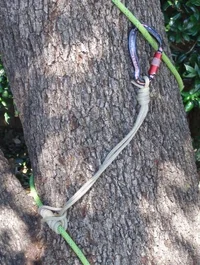
Next, what's the best way to anchor the pulley rope to the tree. Most everyone uses a grigi, but to start out, what would be the easiest way. (after buying the new rope, a pulley, and an anchor bridge system, this stuff get's expensive!!

Thanks!!
 
The Gri Gri is not rated as a two person belay tool. Read the specifications for the load rating at the Petzl site.

My current preference is to use a trunk wrap with a brake system. Add enough round turns on the trunk to compensate for a two person load. Reducing the trunk friction is easy even with the brake system on the rope. Just walk backwards around the trunk until the victim/rescuer are lowered under control.

A rack is a good alternative too. Lots of friction and it is very easy to teach a 'rescuer' to use.
 

Attachments

  • 146709-anchorbelay2.webp
    146709-anchorbelay2.webp
    100.2 KB · Views: 201
Yes, there is a possibility of the trunk wraps rolling up the tree unless a good route is chosen. When the trunk wrap is setup it's important to find a branch or maybe an old branch collar knob to use as a redirect to keep the rope fair. Another way to wrap is to have the first wrap be quite vertical and then make the successive wraps a bit more horizontal. This is something that people who have rigged with trunk wraps will understand perfectly. Trunk wraps are a part of the skill set that is being lost unfortunately. Being able to rig, for lowering limbs or a climber, with only trunk wraps takes skill.

There's no need to use static line for the floating false crotch line. In fact, having a rope like Fly or Tachyon with a little stretch is probably better for lowering. The stretch will dampen the jerks [not the ones on the rope :) ] just a little.
 
RD, this is the system we use in the field on a day-to-day basis. Once learned it is fast to set up and easy to use.

For the anchor point, I prefer the port-a-wrap and a whoopie sling. It is very easy to control the rate of descent and lock off if necessary during a rescue. It is also something that anyone familiar with ropes (firemen, rescue personnel, etc.) will understand at a glance. There are no lever, latches or such.

You are right, the ability to rescue a climber from the ground is HUGE. And I frankly can't see, with the safety-consciousness of the industry today, why this is not utilized more often.

A downside to this system is that you will be putting more load on your friction device. This will be noticeable and you will have to adjust your VT or whatever knot you are using to compensate. This was a price I was willing to pay.

Any rated pulley should work, such as the Sherrill's 2.4 stainless steel at 8500 lbs with a steel, triple-locking carabiner anchored with a scaffold knot. Then you are good to go.

Dave
 
Cool, thanks Dave. I can see where using the Porty would be very usefull. I actually thought about it, but I didn't quite know if it would work.

Can I ask though, what size Port o Wrap you use. A large would be extremly expensive, so would a mini or medium work??? Like I said, a 7/16" line will be used for the anchor line.
 
The mini porty would be fine for a ground anchor. You could also use a micro pulley for your floating false crotch.

Aluminum is fine for life support as long as you're not bombing it from the tree.
 
RD, Small from Sherrill. According to Sherrill all the Port-a-Wrap IIIs have a 2000 lb SWL.

Dave
 
Thanks guys!!! A mini doesn't cost that much, so it should work out!!

And no way will I climb on a micro pulley. I know they are rated for life support, but looking up and seeing that small pulley carrying all your weight would not be a good feeling to me. Plus, I like a bit larger bend radius, if I'll be climbing off a pulley.
 
MP has the same bend radius as a rope guide...

A munter hitch wouldn't cost anything, assuming you have a HMS caribiner lying around. I have used a backed-up munter in this application before.
 
[ QUOTE ]
RD, Small from Sherrill. According to Sherrill all the Port-a-Wrap IIIs have a 2000 lb SWL.

Dave

[/ QUOTE ]

Not true. The mini has a SWL of 1,000 pounds.
Are you getting the mini confused with the small?
There are 3 versions of the Porty 3 available; Large; Small; Mini.
The mini was designed for rescue operations such as what Zac describes.
 
Norm, that's why I said according to Sherrill as they specifically state that all three of the Port-a-Wrap IIIs are rated for 2000 lbs. And their sizing states small, medium and large. We purchased the small.

Wespur on the other hand, on the same product, calls them mini, small and large as their three sizes and, as you state, references the mini as 1000 lbs. SWL. Which if correct, is still plenty strong enough.

Wespur's latest catalog that I have, though a very nice catalog and product line, has had some problems with accuracy on their tensil strengths and working loads. With that said, I have not confirmed who is correct through Buckingham on the Port-a-Wrap IIIs.

RD, There are many ways of tying off on this setup that will work so just pick one that will work for you. I prefer the Port-a-Wraps because it is a tool-based system that remains consistent regardless of the type of tree you are using it on with a very simple and secure tie off.

Dave
 
[ QUOTE ]
Yes, there is a possibility of the trunk wraps rolling up the tree unless a good route is chosen. When the trunk wrap is setup it's important to find a branch or maybe an old branch collar knob to use as a redirect to keep the rope fair. Another way to wrap is to have the first wrap be quite vertical and then make the successive wraps a bit more horizontal. This is something that people who have rigged with trunk wraps will understand perfectly. Trunk wraps are a part of the skill set that is being lost unfortunately. Being able to rig, for lowering limbs or a climber, with only trunk wraps takes skill.

There's no need to use static line for the floating false crotch line. In fact, having a rope like Fly or Tachyon with a little stretch is probably better for lowering. The stretch will dampen the jerks [not the ones on the rope :) ] just a little.

[/ QUOTE ]

Your right Tom,taking wraps is an art frm that is being lost,i rig like that everyday i'm working.I use a 3/4" tree master 3 strand for it.The 3 strand goes over crotches smoother than braided lines imo.
 
The biggest downside to using this system is that when prunning a tree you risk cutting the rope that is holding you. Its under a lot of weight and any accidental nick of a handsaw could be your last time in a tree. When i set it up the rope is hugging the tree which is right where i'm making the final prunning cuts. Not something i like to be cutting near.

I do like the system but there is too much of a risk of the line getting cut.
 
3/4" pshaw.... It's overkill for 98% of rigging work. I bought a new 200 footer 4 years ago. My 150 is worn but fine. Have maybe used it twice.....And we certainly do way way more work, including big stuff, that your part time near start-up operation. 1/2 inch old climb lines, or True Bleu for natural crotch rigging, and 1/2 inch poly double braid with blocks get the most use.....the 9/16th db, and the 9/16th jacketed spectra are next. The HMWPE line is awesome for overhead rigging with no shock loading....another reason the 3/4 rarely gets used...Same tensile, so for taking trees whole, tip tied, and butt cut, or for storm work, with the GRCS and Hobbs, it is the line of choice.
 
[ QUOTE ]
I do like the system but there is too much of a risk of the line getting cut.

[/ QUOTE ]

Focus, grasshoppa, focus

Yes, caution must be observed...but that's a good trait to develop anyhow....

I will usually remove the floating false crotch after working and pruning up the opposite side from where the tied off line runs.
 
[ QUOTE ]
I do like the system but there is too much of a risk of the line getting cut.

[/ QUOTE ]

Countryboy, I agree with Roger's humorous statement.

New systems may seem awkward and ungainly until you have used them for awhile and have learned to work within their range. We often forget how long it took us to truly be fluid in the trees with the systems we learned on.

For the most part, a floating false crotch, extra rope danger is a nonissue that you will very quickly get used to. You will figure out different ways to route it away from your major work zones and at times where it does cross paths with a branch that needs to be cut, you merely lanyard in, release the weight from your high line, give the false crotch rope a good yank to clear it from the cut zone and make the cut.

After all you have figured out how not to cut your ropes that you are using now, even though they are in front of you the whole time. A ground tied system, such as this or SRT as Tom uses, are the only systems that I know of, that can so efficiently and speedily accommodate a ground-based climber rescue.

Like I have said many times, this is of enormous benefit.

Dave
 

New threads New posts

Back
Top Bottom