I somehow get the feeling we're not as much on different pages as it may seem due to differing terminology maybe.
If the jack fails the tree ain't going nowhere. The back cut is continually being filled with solid material (okay, maybe it'll sit back a half inch from any given point). In any event it's a rare situation I'm talking about; not a matter of course.
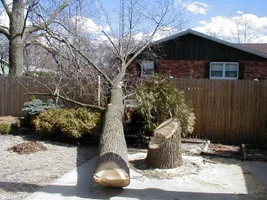
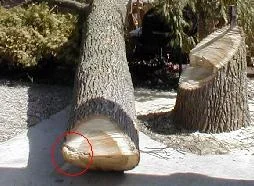
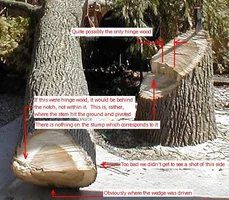
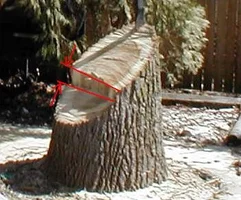
Looking at the stump it's obvious the back cut and the notch are in different lateral planes. Looking at the base of the stem it would seem the notch was the more perpendicular-to-the-stem of the two. That's why the hinge would have been taller on the neighbor's side of the cuts. Is that what you're calling "more hinge"? The fact that it would have been taller? Usually, in my experience, that would make it more flexible if fore-aft thickness were consistent and thus not tending to pull to that side.
I feel just about any one of us here could flesh this thing out, but what the heck. Let's look at what we can discern as facts:
The tree was growing near a larger one. As a result it was growing away from it. Looking up the stem as it lay there it seems obvious that was the situation. Except for a couple of low branches going toward the larger tree, the stem veers away from it. The balance would seem to favor falling away from the neighbor tree had the hinge been a centrally-located cylinder.
Acknowledging that, the fact that the tree actually went rather toward the other tree would indicate it was at some point in time being held by branches from that other tree.
The wires overhead, [edit: just looked at the picture again and instead of being wires running over "our" head, I think that it's an antenna tower, so never mind the rest of this paragraph] if they were low enough to have been the cause of interference, seem to indicate they would have guided the tree almost 180° the other way from the direction it fell. They appear to be going away and to "our" left from the tree as they pass over "our" head. So I think we can rule them out from being a factor here.
I posit that the tree started to go as expected but was held very early by the neighboring tree. The feller drove the wedge in which either caused the insufficient hinge to fail or that the hinge was subsequently made insufficient. Either way, it failed.
The tree slid down and to the left on the back cut which slopes both those directions. Whether the tree top then slid down the limbs which were holding it at the top, toward the neighboring tree, or the balance was now merely decidedly in that favor due to the base now being further left than it was, we see the result.
I don't believe the hinge proportions from side-to-side are responsible in any way.
If it weren't a matter of an insufficient hinge, the top of the back cut where the wedge was inserted would have split ("barber-chaired") down and away. It seems it did not, so there couldn't have been very much pressure exerted by the "felling" wedge.
Overall this was actually quite close to being a successful operation in the end. There seems to have been no real damage to the house beyond perhaps a couple of roughed-up shingle edges; just a section of fence and perhaps a limb on the larger tree. The guy may even get called by another neighbor in the future

$500 to get that tree down is a bit of a bargain, after all...