Certified and Tested Ropes for Ascenders

Im starting to get into the SRT world, for access into those certain trees. I am hearing all sorts of different conflicting answers like yeah it's ok to use ascenders on your Vortex climbing line and your Blues Streak climbing line, Ive been doing it for a long time and I have no problems. Then you talk to someone else and they say NO their not rated for that if you ever sustained a fall it would tear through and your going DOWN! So a back up w prusik. Ive also heard that you should back up with another ascender cam type not a prusik. Then Ive heard the testing that was done they never dressed the prusik so it slipped and didnt hold during testing. uhgggg! So I was just directed to a climbing line supposedly certified for both ascenders and knot climbing. why waste the $$ to just climb up and only access but then have to use a different rope all the time. The rope is callsed TECH11 from Sterling. Anyone have knowledge on what should be certified for mechanical and knots, CE , EN NFTA?? ive seen a few but now I need more knowledge!
 
When you get into CE ratings on rope they will most likely be either EN 1891 Type A or Type B which references the strength and fall protection from height (Blaze is type B, but most others that are CE are type A) for use with ascenders I was told to rock out with something like Tachyon which holds its shape a bit better when it is in the camming mechanism and holds up better to the teeth.

For wear and tear I was told that you want a rope with more fibers (24 strand or up, makes a smoother rope) because when the teeth bite in you want as many in the rope as possible to help share the load, the bigger the strands (true blue) the more pitting that may occur leading to the rope getting more wear on it than say a Kernmantle rope like KMIII or something like snakebite. However with ascenders you would definitely want to use it on something with a core. So if the outside mantle gets stripped it bunches up around the core and stops your fall.

I have not tried the Tech11 but I have heard from several people and overheard the conversations at ISA and TCIA with the New England guys and they said that Tachyon is a great option when it comes to SRT.

That is my 2 cents, and I may be wrong so we will see.
 
Another consideration is whether you're using your ascenders for life support or not. With many typical 24 strand DB climbing lines, if your ascenders are below your primary life support, and only used as climbing aids, you should be fine.

A scenario of that type of set up may be Rope Wrench (Hitch Hiker/Unicender), HAAS, and foot ascender. If you're using something like a Croll, or chest ascender as your primary life support, it would be best to have a line designed for use with ascenders.
 
Be sure that you choose a rope diameter that is compatible with any rope tool. If you're using Blue Streak, a half inch rope, you're oversized for most gear. This is a much more important issue than a concern about shredding a rope.

As you learn more about rope compatibility you'll understand the testing procedures. Take some Google time and find out what it takes to shred a rope with an ascender. Then, look at your climbing style. Will you ever generate those sort of forces?

When people talk about shredding ropes I always ask...Do you know anyone who has ever shredded a rope? Do you know what it takes to shred a rope? Climbing on a friction hitch made from Tenex or the like is much more of a concern than ascenders shredding rope...in my opinion. Arbos are much more likely to generate enough heat to melt those fibers than they are to generate rope-shredding loads.
 
Tom is correct about the loads that it takes to shred a rope, if you are ascending into the canopy and then moving off the ascender system you really only need to be concerned with the time spent going up. Biggest thing to be aware of is your rope over something that could break, other than that I wouldnt worry about it.

I do believe that toothed camming devices were originally designed for use with kernmantle ropes. Could be wrong though.

On another note I use toothed ascenders on both double braids and kernmantles that I own.
 
Using toothed ascenders on 16 strand Yale xtc has shown significant picking. I've been using a pantin for years on 16 strand in ddrt configuration with no concern. First time I used a hand ascender and pantin with my hitch hiker on 16 strand yale xtc the picking was significant. This is oviously due to the fact that in ddrt the pantin is only seeing half the weight of the climber and in srt pantin and hand ascender is getting all of the climbers weight with each stride. I'll be picking up some new blue moon when founds allow!
 
Yale tx is half inch rope too incompatible with handled ascenders

Most of the time picking is a result of how the ascender is slid up the rope if the ascender isn't slid straight up the teeth can still be in the rope which rips fibers. Slide the ascender parallel to the rope and up not out
 
If you are using ascenders for access only I would use a 10-11mm kermantanle static line. Yale and NE and Sterling all make good ones. Some of the tests done used a fall factor 2 fall on various lines. If you generate a fall factor 2 fall, you have done something very stupid and probably will die anyway doing something else. (sorry Brian, but its true) Those folks saying your are going down have been spending too much time reading and not enough time doing. They should get off the computer and go out there and get some real data before they flap their lips. Backing up an ascender with a friction hitch is for folks that are inexperience and scared. (unless for some reason you are hanging your [pick a different word] off one ascender)
 
Whenever people start talking about this I just ask for the accident statistics to show that it is really a problem. In my long rock and tree career with thousands of feet on ascenders including a few falls onto my ascenders, I've never seen rope damage caused by ascenders. I've had ascenders slide down the rope because of debris between the cam and the rope, and I've heard of fatalities in the rock climbing world when people used ascenders during traverses and had the ascenders pop off the rope, but never an ascender cutting a rope or causing any damage other than picking.

I know that it "could" happen. I just want to see the data showing that it has happened in a real world environment, not just pre rigged scenarios where people are trying to prove their point. With so many people out there using ascenders these days in so many different rope access environments, if this truly was an issue we would really know it by now.
 
Thanks Guys, all good points! after some more research, I have found out to my surprise that there really is NO certified standard for certain rope use with ascenders and that is what I call need to get up to speed on that topic. I think ascenders have been around so long there is no reason to not have a certified standard compatible rope/ ascender use that's been tested and passes all. Right now it's more the manufacturers recommendations and I learned about the Ansi and CE standards, Ive seen a set up with a prusik above the ascender like a foot lock set up with ascender below it, your not even tied to the ascender it's just to get you up the rope easier with the prusik to hold you. Amazing how we just keep on learning.
 
I will second points made by Tom and Ryan. The shredding potential is inflated to be of greater importance than selection of union these days.

I don't typically use handled ascenders as a point of attachment in my ascent system though I use ascenders constantly. Recently I took a considerable drop when my rope slipped off some epi on a shallow angle scaffold and rolled a few feet into the union. I dropped like a rock standing in my foot loop on HTP and definitely felt the landing (4-6' by my best guess). I took a long hard look at my whole system at that point and there was not a single damaged fibre bundle to be seen. Best case scenario on the rope choice mind you.
It was quite a wake up call for how a 2' drop in a union represents a 4'+ stretch drop with a basal anchor.

Quality of anchors and how the basal systems are being constructed is where we need to turn our attention in my opinion.
 
[ QUOTE ]
A Yates Screamer might have a been a good componenent to include. I keep meaning to order one.

[/ QUOTE ]

Once you get it, where in the system are you planning to use it? Keep in mind it is not rated 5300#. (I use them)
 
Just thinking. Would a Screamer be good to incorporate into a basal anchor system?

Seems like the only shocky fall scenario would be an SRT TIP (on a non-isolated crotch) or redirect failure. Slipping on a limb walk would not be so shock, but you might slam into the stem, probably not a big deal.

Are there other fall scenarios, if you tend slack reasonably conscientiously?
 
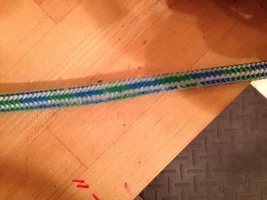
I have a piece of velocity that I use to test every haas that leave my shop.
because of the nature of the test and how its set up the teeth always hit on the same side of the rope in about a 3 inch area.
two things lots of haas have been tested here, and I am not nice to the rope, each unit gets multiple jerks, and sets, we are still under 1000 units but you are looking at probably 5000-6000 abusive interactions with teeth. [image][/image]
 

Attachments

  • 386550-photo-4.webp
    386550-photo-4.webp
    35.7 KB · Views: 61

New threads New posts

Back
Top Bottom