Center of Balance with Spider Legs

Treezybreez

Been here much more than a while
Location
Lancaster, SC
Hey all, I have been a long time lurker on the buzz and have learned so much that I decided to join.

I have read some of the threads on spider legs but have not seen anything on how to determine the center of balance. So my questions are, how do you determine where the Klemheist knots should be on the rigging rope? What is the most efficient way to adjust the system on a branch? Is there anything dangerous about using spider leg slings?

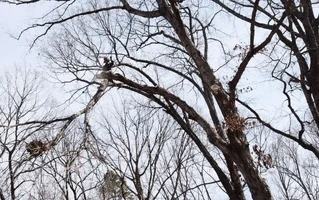
I spliced up a couple of 25' long Tenex spider legs that I used on a white oak removal where the branches went clear across the roof. Everything went smoothly but it took more time than expected and a few of the branches tipped a little more than I was comfortable with.

Thanks, Caleb
 

Attachments

  • 271602-intreewithrigging.099_1_1.webp
    271602-intreewithrigging.099_1_1.webp
    169.7 KB · Views: 337
Welcome Caleb. It's hard to say too much from pictures. How strong the rigging point was is unknown to me. But I'd say one thing you could of done different is move one attachment back so your more directly under the block, then you limit the amount of swing and it can pivot on the hinge just makes it more controlled. But with an oak that would be adding alot of weight. Then there's butt tieing to control swing as well.

As for balance it's kind of a tree wisperer thing, just when you think you got it you don't. The spider slings make balancing alot less of an art though. It's easier to guess balance with the main limb than the tips. In summer you throw in foiliage as well. Experience is about all I can tell you.
 
Thanks for the response boreality,

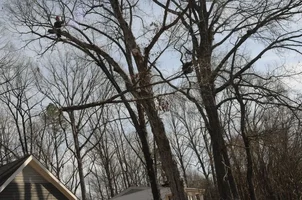
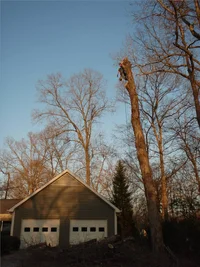
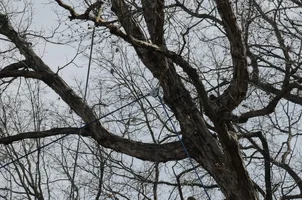
If I had put the rigging point any higher the limbs would not have cleared the edge of the roof. I only have one groundy so it would have been more difficult to pull the branch clear. I think I have a picture of the RP.

Good point about having an attachment point back further. Like you mentioned though I was concerned with the weight factor.

I wonder how much extra weight is added with the foliage?
 

Attachments

  • 271626-WhiteOakonBrierwoodRd.092_3_1.webp
    271626-WhiteOakonBrierwoodRd.092_3_1.webp
    153.8 KB · Views: 153
It's not a perfect science, but like Bo said, keep the klemheist as close to under the rigging point as possible. Another trick is to hang the spider leg so that it is exactly the same length as the rope, which makes it easy to keep the legs the same length... Which helps alot with balance.

And for the love of God, stop piling wood on top of brush. I got a backache just looking at that fourth picture! ;-)

-Tom
 
I wonder about the weight of foliage as well.

A way to get a stronger rigging point is to have a couple blocks, more of a redirect. From where you had it send the rope back to another tree, if you have one to use and they share the load. Ideally I'd try to take the whole branch right at it's stem attachment. But that was a big bugger. That would be the day I'd get to remove an oak as well so I have no idea on their green weight. I bet heavy.
 
If you're concerned about how much weight foliage adds to a rigging piece you're probably taking too big a piece. That should be the voice of reason, listen to it. Take a smaller piece, blowing out a rigging point can be deadly at worst and embarrassing at best.

Learn how to rig big pieces but rigging little pieces perfectly. When you can set spider legs and have the cut lift exactly like you expected 10 for 10 then take on a little bigger piece.

Use trees that are floppers as training trees.

Sweat today so you don't bleed tomorrow.
 
When using spider legs, try to get the same amount of weight on either side of the tie off point. The red line indicates approximately where the balance point of the rigging is. There should have been more butt weight. Also, the less the rope angle is, at the tie off, the more force there is on the spider leg. It's best to keep the tie off angles 45* or more.
Like Tom said, start with smaller pieces. Once those are doing what you want, go a little larger.
 

Attachments

  • 271646-271602-intreewithrigging.099_1_1[1].webp
    271646-271602-intreewithrigging.099_1_1[1].webp
    145.4 KB · Views: 210
From the pics it does look like the rigging point shoud have been higher. I find that the best balaned limbs have the RP directly above limb. When I use spider legs for balance I try to estimate where the middle of my piece will be from there I know thats where the klemhiest needs to be. Then simply move the legs out to counter react to the load. The experience will lye with different tree species and weight. Start small, work big. Caution for being tied in above rigging point. Are you tied in to same lead? If you couldnt rig any higher, how did you piece out the top?
 
We have done some of this balancing rigging as well. It seems to work really well for us when we are in a tight spot over a roof or something like that. It is a little extra time and effort for normal rigging situations, so we reserve using it for times when we can't afford much downward swing out of the limbs. Cool pictures, very good example of the technique.
 
Hi Tom,

"Another trick is to hang the spider leg so that it is exactly the same length as the rope, which makes it easy to keep the legs the same length... Which helps a lot with balance."

I will keep that in mind for the next time.

Another company was supposed to be there to pick up the brush and lumber. It is their fault for not being there earlier. Hope your back feels better now. ;)

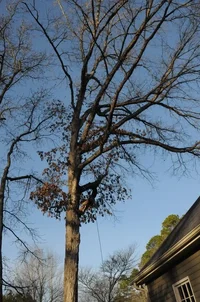
Here is another view of the tree.
 

Attachments

  • 271688-WhiteOakonBrierwoodRd.013_1.webp
    271688-WhiteOakonBrierwoodRd.013_1.webp
    109.9 KB · Views: 131
Well, I wasn't really concerned with leaves adding weight to a rigging point. I was interested in how much they change the center of balance for a particular cut. How much will have to be compensated for?

I did practice with some branches that were not hanging over the house before I worked on the overhanging.

I have attached a pic that shows how the tree curved over the roof. This made it difficult to raise the RP any higher, but I am pondering the majority consensus.
damnmate.gif
 

Attachments

  • 271690-WhiteOakonBrierwoodRd.006_1.webp
    271690-WhiteOakonBrierwoodRd.006_1.webp
    126.9 KB · Views: 130
[ QUOTE ]
Another company was supposed to be there to pick up the brush and lumber. It is their fault for not being there earlier. Hope your back feels better now. ;)

[/ QUOTE ]

Whew!
 
I personally wouldn’t have rigged it with trying to find the balance point, but would have instead used 2 separate lines. Most of the time I’m only working with one ground worker, so any help that I can give them is good.

I would have the ground worker throw a line over the limb well above the balance point and tip-tie the limb with a running bowline. Then I would run that line up to my rigging point block and down to my lowering device.

I would tie the second line butt-hitched close to where I am making my cut and running to a second rigging point block a short ways above me and down to a med-sized porty that I have tied off near me and with which I can control. This does a couple of things. It helps with how much swing the butt end of the branch has after it leaves the cut, and it enables me to control and help out the ground worker with the lowering process. It also saves me time trying to rig a balanced point limb.

Think about the leads (the direction that the line is running through a block) in your rigging and try to anticipate where the pieces are going to go.

Make that rigging point as high and as strong as you can and watch your angles, as others have pointed out.
 
Chris,

The scenario that you describe is a perfect place to use a Belay Spool.

The climber can snub off which ever rope they need to control. Sometimes the tip needs to move during/after the cut. the groundie can run that rope. Snub off the other one and when the climber is done cutting they can lower in tandem.

The Belay Spool takes the place of the upper block and bollard. Simple and smoooooth!
 
Right on Chris, it always puts a smile on my face when I have a portawrap up in the tree. Use it with vertical spars alot. When there's a deck built around the base and no drop zone even low. I'll tie the top of a chunk to a high block and move the porty down as I go. Too safe and controlled.
 
When I first started balancing loads I was really nervous but I was under excellent guidance and when all was said and done I started thinking WAY outside the box. Paul taught me to "tune" the rig by quickly false loading the lowering line to see if each leg took approximately the same amount of tension before committing to the cut. He brought up most all of the points already mentioned but also said if you can save 5 minutes clean up by introducing one of these in about 45 seconds, it's worth it but if you see you may need it before you start, don't send for it because someone will question you and waste the time you're trying to save. Put it on your person. It's situational and I don't always do it because it's the most efficient way to get things done. I sometimes do it to save clean up...and sometimes because I find it rewarding. You can really save a lot of set up time, Treezy, by learning to speed tie all of the involved knots and hitches and anticipate the set up and tear down of your rig. If you make a routing mistake or something, you can correct it quickly.
 
[ QUOTE ]
I personally wouldn’t have rigged it with trying to find the balance point, but would have instead used 2 separate lines. Most of the time I’m only working with one ground worker, so any help that I can give them is good.

I would have the ground worker throw a line over the limb well above the balance point and tip-tie the limb with a running bowline. Then I would run that line up to my rigging point block and down to my lowering device.

I would tie the second line butt-hitched close to where I am making my cut and running to a second rigging point block a short ways above me and down to a med-sized porty that I have tied off near me and with which I can control. This does a couple of things. It helps with how much swing the butt end of the branch has after it leaves the cut, and it enables me to control and help out the ground worker with the lowering process. It also saves me time trying to rig a balanced point limb.

Think about the leads (the direction that the line is running through a block) in your rigging and try to anticipate where the pieces are going to go.

Make that rigging point as high and as strong as you can and watch your angles, as others have pointed out.

[/ QUOTE ]

Great point Chris, Your plan would also distribute the weight so a larger section could be taken. The only concern I would have would be the but end jumping my way, or would it? I guess it wouldn't as long as the tip of the branch doesn't drop to far before the but end has a chance to drop off. What kind of cut would you use with the technique you just described?

Thanks to everyone who has posted so far. I am learning a lot.
bowdown.gif
 

New threads New posts

Back
Top Bottom