Catalpa help

oceans

Been here much more than a while
Location
RI
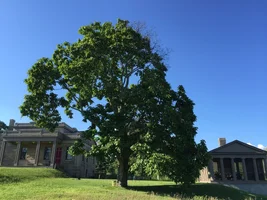
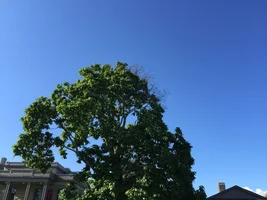
Has anyone seen a Catalpa suddenly defoliate a portion of its crown?

I know a bit about some recent changes to the site.
- Recent contruction had several trucks and pieces of heavy equipment driving all over the root system.
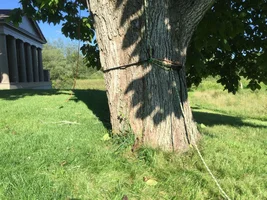
- The North side of the root system (entirely 50% of the drip line) had a grade change of roughly 8".
- The clients are on a watering program for the new grass.
- There was no trenching done for irrigation or any other services.
- We've experienced a very dry Spring and little rain this Summer.
- Client says the leaves browned out and fell.
- There are 3 other Catalpas on the property without similar symptoms, suggesting an Abiotic Disorder.
- Remaining foliage on the tree in question are uniform and healthy looking.
- Defoliated stems show small patches of new growth at the very tips, but nothing much anywhere else along those stems and branches.

I have already suggested a Root Collar Excavation and expressed the potential need for a well on the North side of the root flare. Would there be any need for fertilization (compost, fish emulsion, etc...) or increased watering on the South side of the tree? Should I wait to prune out senescing tissue to allow more relocation of starches?

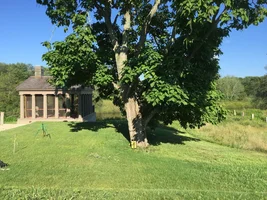
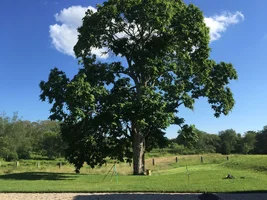
All photos were taken at 5:30 PM for shadow reference to NSEW. What might be going on here?

Thanks in advance for any help.
 

Attachments
  • image.webp
    image.webp
    716.4 KB · Views: 63
  • image.webp
    image.webp
    877.4 KB · Views: 62
  • image.webp
    image.webp
    536.8 KB · Views: 52
  • image.webp
    image.webp
    369.6 KB · Views: 51
  • image.webp
    image.webp
    972 KB · Views: 55
Last edited:
So the shadow is on the East side? Construction stress, grade change on top of drought sounds like trouble!
 
Yup, shadow on the East. I don't know how much compaction may have happened before the grade change, but the client said they sort of had a free for all around the property.

Can over watering be an issue for such a broad leafed tree? This pup must move some serious moisture.
 
Overwatering can be a problem, even for a large broadleaved tree, but the sectored defoliation is more likely due to root system injury / change in grade, etc. What you have is a large tree that needs to become a smaller tree due to an impaired root system. So fertilization to stimulate growth should be held off. But what about those complex amendments like fish emulsion or compost? I'm interested in seeing what others think about that. If I inherited this compromised tree, I'd likely wait and see how far the canopy dieback progresses, and prune back to that point. A gentle root excavation/inspection could provide more information, but would it make a difference as to treatment? Again, I'd like to see what others would do.
 
Kevin,

Thanks so much for your reply. I agree with waiting to prune. The stems exhibiting potential dieback also hold portions of full growth. Pruning would leave a significant hole in the crown and I would rather see new buds pop where they may on any portion of that leader.

Perhaps I could manage some aeration on the South side of the root system, among with an exploratory Root Collar Excavation, focusing around the North side.

Can Catalpa be subject to Verticillium Wilt? This is not former pasture or farmland, though there is significant watering now for the new lawn.
 
Yes, Catalpa is a known host for Verticillium Wilt....of course, lots of other species are hosts too. Have you looked for vascular streaking in the sapwood? The characteristic discoloration is pretty persistent in the wood, even in dead portions. I like to look for it either at the margin of live/dead tissue or just beyond in the pretty newly dead tissue. Not a good thing to have, but it is good to know if you have it! For sampling, a branch 1-2 inches in diameter is usually enough. look at both the transverse (cross-sectional) plane and the axial plane, through or near the pith. If the first sample looks "clean" try one or two more. No reason to go crazy with oversampling, but sometimes the streaking is more obvious in some infected samples than others.
 
Excellent. I will try a larger stem than I have cut so far. I was mainly looking for green vs. brown tissue in smaller diameter (1") wood. I will certainly go back and prune out a slightly larger branch and look for streaking.
 
RCX seems like Job 1, plus measuring the fill, and compaction below. Owner needs to pay for measuring and addressing these causes, before worrying about the effects in the crown. Pull some cores from the dripline etc. Owners screwed up and if they see it they might open their wallet.

"What you have is a large tree that needs to become a smaller tree due to an impaired root system." Common sense is refreshing sometimes. But branches are a longterm issue so you're right to keep the saw in the scabbard for now. Treatments for soil and roots = URGENT.
 
RCX seems like Job 1, plus measuring the fill, and compaction below. Owner needs to pay for measuring and addressing these causes, before worrying about the effects in the crown. Pull some cores from the dripline etc. Owners screwed up and if they see it they might open their wallet.

"What you have is a large tree that needs to become a smaller tree due to an impaired root system." Common sense is refreshing sometimes. But branches are a longterm issue so you're right to keep the saw in the scabbard for now. Treatments for soil and roots = URGENT.
Sounds great, Guy. Thanks so much for chiming in. I'll be poking around for V. wilt tomorrow or early Sunday.
 
Recent Construction? Are you talking about the Parthenon in the background? I'm pretty sure that's like 2,462 years old.

But seriously, how recent was the construction? That seems to be highly suspect. I would bet on root damage and soil compaction etc. over Verticillium Wilt or the like.
So are you saying the soil may have been compacted and then heavily watered?

You don't need to heed my rambling, I just am thinking out loud after making my Parthenon joke...
 
Recent Construction? Are you talking about the Parthenon in the background? I'm pretty sure that's like 2,462 years old.

But seriously, how recent was the construction? That seems to be highly suspect. I would bet on root damage and soil compaction etc. over Verticillium Wilt or the like.
So are you saying the soil may have been compacted and then heavily watered?

You don't need to heed my rambling, I just am thinking out loud after making my Parthenon joke...
Most of the construction was actually 2,463 years ago, but your estimate was close, Jon. The lion paws and gladiator sandals can do a number, despite what some may believe. It's an overall psi issue that's actual weight. Diverting the nearby aqueduct for watering the lawn was no small task either, so perhaps the workers weight was compounded by carrying stone. Dunno. I'll have to check with all the neighbors to see if they can recall all the details of this past construction. :D

Seriously, the septic system was upgraded earlier this year, along with a new patio. The patio led to the grade change, and the total remodel of the house has been going on for well over a year.

I would say there was probably significant compaction and then watering to boot. I still haven't had time to prune a larger limb to look for the vascular streaking, but will get to it this afternoon or tomorrow.
 
RCX seems like Job 1, plus measuring the fill, and compaction below....Treatments for soil and roots = URGENT.

Totally agree with Guy on this, Eric. Compaction coupled with back fill is a bad combination that will not self correct. The defoliation of the upper limb may or may not be related to the construction activities but without mitigation, this tree's health will be compromised.

Take some samples from both the back filled and compacted soil and get them to a lab for textural analyses in addition to standard analysis. This is not a fertility issue but you need to know what is in the soil in order to make proper corrections.

If you have access to a high pressure soil lance you might want to look into this company's
arborcare line. www.Growthproducts.com We have been using some of these products and are starting to see some good results.
 
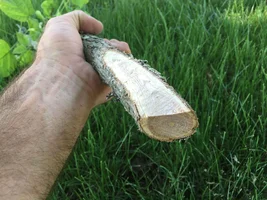
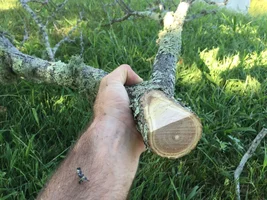
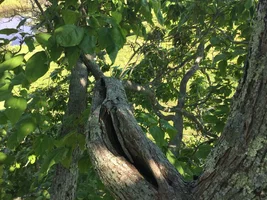
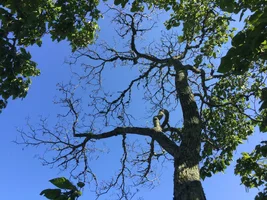
Here's a few more clues from today.

Live wood C & L section:
image.webp

Deadwood C & L section:
image.webp

Old split lateral (8" diameter) that died this year:
image.webp

Defoliated crown directly above split lateral, both on the same side of the parent stem:
image.webp
 
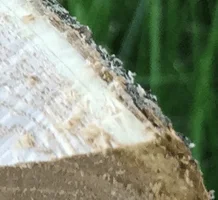
Sorry, but the relevant portions of the sectioned images are just not sharp enough for me tell definitively whether I'm seeing vascular streaking in the outermost wood or the tissue boundary between the cambium and the phloem or something else. Less glare and a smooth, razored surface would help. The collected sample is probably good, it just needs more surfacing and a higher resolution image for me to ID.
I'm not invested in Verticillium wilt being the correct diagnosis, but it would be useful to know.
upload_2015-8-17_15-56-35.webp
upload_2015-8-17_16-7-11.webp
 
We've seen lots of Verticillium wilt on Catalpas in Nebraska this year.
What do you know about past property usage where these trees are? I hear that old farmland can host V. wilt more so than other locations.

Also, what were your Spring and Summer weather patterns regarding moisture?
 
What do you know about past property usage where these trees are? I hear that old farmland can host V. wilt more so than other locations.

Also, what were your Spring and Summer weather patterns regarding moisture?
These are all city trees I am referring to. Old town areas. We had a very dry winter and a very wet spring and summer.
 
I have a question...can Verticillium Wilt be introduced through landscape mulch? I know you don't want to mulch with chips from a tree with V.W. ...but what if those chips go to the grinder and so on.
I don't want to highjack this thread, but I am curious what peoples thoughts are...

Oceans, Now that you have that branch in your hand you can grind it up and spread it around 1 of the other 3 Catalpas to see if it develops Verticillium Wilt. It's always nice when you have some test subjects on the same property.

I'm not seeing any sign of VW in those cuts, but that picture of the limb in the tree... is that new growth out there on the tips?
 

New threads New posts

Back
Top Bottom