Caps, conks, mushrooms, toadstools, basidiocarps, buttons, puffballs, clubs, corals, brackets, shelves, jellies, and crusts ID thread

colb

Been here a while
Location
Florida
Help me help you help me... :)

20230718_154020.jpg
20230718_154016.jpg

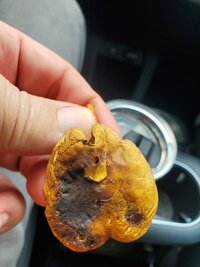
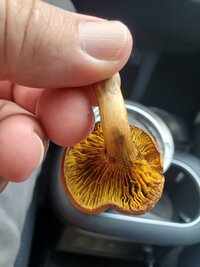
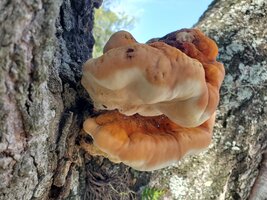
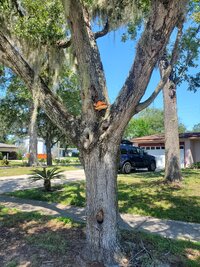
Single cap growing at intersection of soil and large southern live oak root near trunk. Any impressions of what it is?
 
Help me help you help me... :)

View attachment 89201
View attachment 89202

Single cap growing at intersection of soil and larodge southern live oak root near trunk. Any impressions of what it is?
Years ago, I had a local restaraunt that offered ~8" puff ball "steaks" sauted in butter. (pan sauted slabs)
They allowed me to buy some for me to cook at home.
 
Last edited:
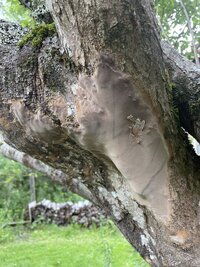
Found on a couple stems of a Salix discolor, one of the stems has completely died back. Very inexperienced with fungal ID, so not sure if this is related, pathogenic, secondary... ID help? Thanks IMG_2510.jpeg
 
Found on a couple stems of a Salix discolor, one of the stems has completely died back. Very inexperienced with fungal ID, so not sure if this is related, pathogenic, secondary... ID help? Thanks View attachment 89614
Totally a crust fungi, not unlike laminated root rot fruiting bodies.
It’s safe to assume you will have some decay in this area, but it might be non pathogenic. In some cases it doesn’t matter much, rot is rot. Being on the compression side, it will bode a little better. Check your targets.
 
Totally a crust fungi, not unlike laminated root rot fruiting bodies.
It’s safe to assume you will have some decay in this area, but it might be non pathogenic. In some cases it doesn’t matter much, rot is rot. Being on the compression side, it will bode a little better. Check your targets.
Thanks! I’ll certainly be removing some deadwood on the tree already and should be able to get a better idea of the extent of decay. Would be good if some of the stems are salvageable, so was asking in part in case it’s something that will likely continue to spread through the rest of the tree.
 
For Tremuel, sure, it's mostly non-descript but I see an effused-reflexed edge or margin to the patch and when I zoom in on the center, I think I see little teeth or pores developing. So I'd start with genus Odontia and go from there. Does indicate dead wood, but Odontia is secondary. Now, a real ID would really need a look at a slide under the microscope.
 
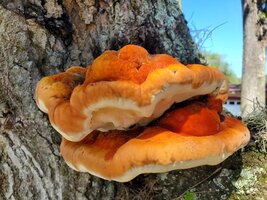
Looking at Inonotus hispidus Also known as Polyporus hispidus in Chris Luley's newest Book, seem to be the closest "Visual Match"

The common name is Shaggy bracket.
 

New threads New posts

Back
Top Bottom