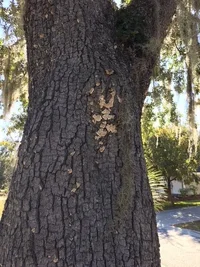
TC is right of course, some sharp, crisp, closeups of both upper and lower surfaces would help. Critical points are: Are the pores on the underside so small that they are not visible with the naked eye? Can you see them with a handlens? Is the upper surface covered with dense or sparse hairs? Also would likely need a handlens to see the latter.
I will, however, throw caution to the winds and suggest that the OP start with Stereum complicatum. Easy call. Might not be correct, but if I needed to know the fungus name, I'd start there. This is one we commonly see on the sapwood of broadleaved trees, both living and on stumps and wood in ground contact.
I suspect, however that Brian is more interested in what it means rather than on the current and soon-to-be current revisions of that genus. TC is right, this is a sapwood rotter. Not a super pathogen, but it does indicate dead tissue beneath the fruiting bodies, which are pretty extensive.