Cabling and bracing tools

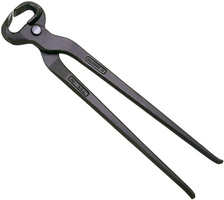
I use a large---14"---Diamond Brand hoof or farriers nipper to cut individual strands.
1695864510543.png

Get a nipper from a good company. The alloy and heat treating is critical. I had a junk nipper that I picked up at a garage sale. They work great for denailing as well as cutting ingrown wire fence cutter. After cutting some cabling strand left a divit in the jaws. Next trip to the flea market was dedicated to finding the Diamond Brand one I have now.
 
I have a Hackzall too. Then I bought an angle grinder. Now I want a bandsaw.:inocente:

The Hackzall will do great with the rods. It is slower, but safer than a grinder. No bueno for cable though, IME. I'd be curious to hear if anybody else uses a bandsaw on the cable. Grinder works like a charm.
It will cut cable if you are careful but I find it more frustrating than it's worth. I use a grinder with a cut off wheel for cabling and bracing. Bandsaws are better suited for "solid" material, the individual strands tend to grab the saw blade if there is any bending of the cable while cutting.
 
Tip for ground-measuring bolt/cable lengths.

Laser pointer
small 'torpedo' level.

Tape or hold the pointer to the level. Spot the laser on one end of the installation. Set the laser plumb then turn it 90 degrees and plumb again. You've created a laser plumb bob. Mark the spot on the ground.

Repeat for other side. Measure distance between spots.

Cut your materials a little long the first few times. You'll get better at accuracy

As I was typing I came up with another idea.

It's imperative to NOT cut the strands and let the extra pieces just fly away. Super dangerous if a lawnmower sucked them up.

Take a strong rare earth magnet and use some throwline as a tether. Attach the magnet to the cut off piece. Cut off excess.
Great point on the magnet.
 
Please redirect me if I'm not posting in the right place for this question or if it's already been answered.

I seem to be selling bigger cabling and bracing jobs. Debating starting to buy supplies in bulk and upgrading my tires old Milwaukee 1/2 inch drill (brushed style). Treestuff and other venders seem spendy these days. I wasn't sure if y'all had an in for some less expensive cabling and bracing gear.

I've got loads of batteries so I'm fixing to stay with Milwaukee, but that drill didn't have the gall to push through much more than 16" diameter without a struggle. What are y'all using for drills these days? I'm torn between a new cordless and a gas drill. Both will do soil aeration fine too. One's quiet. Lol.

Might have questions on tree injectors too. Lots of EAB/Oak wilt/Dutch elms disease. Training the wife in PHC and am debating adding an injector kit to our offerings.

Thanks y'all!
I understand wanting to stay with Milwaukee if you're set there with battery and tools. If you want the most power (×2?) in a battery drill look up the GRCS lifting video searchable here and on youtube.
 
Have any of y'all used the hole hog or their half inch drills for ice fishing? I'm going with the new fuel half inch drill and am wondering if I should try an 8" ice auger on my local waterway .

Also, the advice has been solid. The old 1/2" brushed works fine for mid sized stuff. Slow and steady. It didn't like it but handled it, once.

Oh, and there was a company called SH forestry supplies that at the time of my bid was the cheapest per unit cost for a lot of my supplies.

Thank you all for your input!
 
I need 5' of bit length for 5/8" rods.

Then you need 11/16" bits

I welded extensions to long bits. I never 'corkscrewed' a bit while drilling. Listening to the drill motor and having a rhythm of drill and pull to keep the debris moving back out the hole.

People have sourced long bits in the past. Some from sponsor vendors or places like McMaster or shipbuilding chandleries. Spend some time in Search.
 
Where do you source long bits and/ or extensions ?

I need 5' of bit length for 5/8" rods.

Thanks.
I’ve jumped to using 3/4” rods if that long. Extensions seem to be about 18” max and the coupling is slightly larger in diameter than 5/8th.
Pulled them off the hardware store shelf.
I have sanded the coupling down on a belt sander to make it work with 5/8ths rods. But that involved modifying the set screw so it’s not sitting proud.

24” long bits seem to be the most commonly found. Sometimes 30”.

My previous employer just welded a rod to the bit and it worked, but I’ve been timid due to heat effected zone fractures and keeping it straight.

I would take extensions over a 5’ bit for any off ground drilling, it’s time consuming but much easier to add on a little at a time when hanging from a rope. Keeping it ergonomic and using your lanyard out far enough you can brace your knees or feet to keep pressure on the bit if the guide screw gets gummed up with resinous fibers.
Irwin website is where I think I got my bits, but found good enough off the shelf too.
 
Addendum.
Tom is right about 1/16 larger.

Hole size between a 5/8 rod and 3/4 is basically negligible.

A modified hole saw, with a stub the same size as the bolt in place of the pilot bit works great if making a seat for the washer. Same diameter of the washer, and is much easier to use that to score the bark than a knife or chisel.
 
making a seat for the washer.

I may be wrong...but...I thought that the current practice was to, at most, shave off some of the thicker, corky bark and leave it at that. Not countersinking through the live bark tissue.

It makes sense from the smaller wound view. 11/16" wound rather than about 2" means less decay

Many times I would put two washers on the bark, a nut, a washer and a nut. Double nutting is there to allow future, non-damaged tissues, to grow around the stacked washers.
 
I may be wrong...but...I thought that the current practice was to, at most, shave off some of the thicker, corky bark and leave it at that. Not countersinking through the live bark tissue.

It makes sense from the smaller wound view. 11/16" wound rather than about 2" means less decay

Many times I would put two washers on the bark, a nut, a washer and a nut. Double nutting is there to allow future, non-damaged tissues, to grow around the stacked washers.
I may be wrong...but...I thought that the current practice was to, at most, shave off some of the thicker, corky bark and leave it at that. Not countersinking through the live bark tissue.

It makes sense from the smaller wound view. 11/16" wound rather than about 2" means less decay

Many times I would put two washers on the bark, a nut, a washer and a nut. Double nutting is there to allow future, non-damaged tissues, to grow around the stacked washers.
My understanding is that it’s elective. I’ve done it both ways and have found less damage seating the washer directly onto the sapwood. I’ve observed better callus, and quicker wound closure.
This is for actually pulling unions back together though. Without seating the washers I’ve seen damage from compression above and below the washer, and a larger wound from compressed tissues.
If it’s a snug placement I’ll skip the pre bark tracing.
X2 on stacked washers, I’ll double nut as a jam nut, and peen.
I don’t think I understand what you’re talking about with double washer, nut, washer, nut. What am I missing?
 
I ran into the same issue of my extension for 11/16" being 11/16" plus a tiny bit more, and then the set screw being proud by a fraction more. I ground the set screw down. Fought my way through it.


I considered making the bulb of the extension smaller, somehow.


I have ground level bolts to install, and tree house level bolts to install, so I would be standing, not hanging in a saddle.

I wonder if welding extensions is easy enough for a good welder to manage.
 
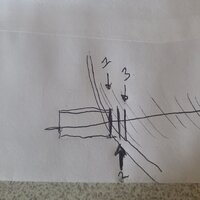
Associated question, with wedge-grips going into a stem that is angled a lot compared to perpendicular to the cable, how do you manage the forstner bit.

The cherry I just C and B'ed had a fair angle difference.

What is best forstner-flattening of the surface to position 1, 2, or 3?
The bark was 1/2- 3/4" thick.16987668288902816541184321220453.jpg
 

New threads New posts

Back
Top Bottom