
Cable or Remove?

Location
Mid-West
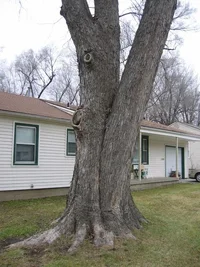
I have passed this tree many times on the way to a park not far from my house. I finally passed by it last week when the homeowner was outside so I stopped to have a discussion. The homeowner didn't seem to concerned, even after hearing my spiel and informs me there is limited funds for tree work right now. Despite the situation, I wanted to know anyones thoughts on wether they would trim & cable or remove it.

Acer saccharinum
Approx. 70' tall
Maybe 36" dbh
Homeowner claims it was planted in 1958 (on purpose).
Overall healthy tree excluding structure
There is visible decay in the old wounds
The trunk sounded pretty solid


Two of the main three sections are not so happily attached. One Appears to have included bark all the way to the ground on one side while the other side only has about 12". The section growing over the house also has included bark.

http://gallery.me.com/dustinbranick#100011&bgcolor=black&view=grid

Thanks for any thoughts,

Branick
 

Attachments

  • 152304-Acer1.webp
    152304-Acer1.webp
    80.7 KB · Views: 176
It doesn't look like a keeper to me. That species is susceptible to heart rot and poor limb attachment. If the limb that is leaning toward the house fails, BIG trouble.

If it were cabled, would the rest of the tree support the major leaning limbs? Again once the decision to cable and/or braces is made the owner is going to committed to annual inspections of the whole tree.

Sucks to lose the feature tree in the yard, but is the risk worth the reward?
 
while cabling and bolting would kept it together for a much longer time.

if it were my tree, I'd remove it. crapy silver maple with bad tight V junctions. heck yeah, remove it.

if customer really liked it, I would definitely give them a cabling an bolting option.

keep in mind i only saw one picture. from that picture, it looks okay to add hardware.
 
Where did the myth arise that all cables need annual inspection? This is a deal-breaker that tilts clients toward removal; could it be that the myth is promulgated by removalists? It is in most cases total bs--every 3-5 years works for most trees.

Species bias sucks--there are many solid and stable silver maples.

Cabling is an obvious choice for this tree (as viewed from here). Far cheaper than removal, and preserves the asset. Speaking of which, did you suggest mulch to the owner, so he stops bashing and gashing the base with his frickin mower?
 
I clicked on the hyperlink in brank's post to see 3 additional photos of the tree.

If I owned the house, that tree wouldn't have been there to begin with, but that's besides the point.

If the homeowner appreciates the tree, cable it.
 
In the one picture you can see extensive rot @ a large pruning cut. This proves that the trees strenght is impacted by decay, the extent can NOT be determined by pictures, the last time I checked.

By the looks and sounds of it, the tree has been poorly managed. In branks first post he says the tree was planted in 1958 (on purpose). This leads me to believe that the person who planted it still owns the home. If this assumption is correct, why wasn't it pruned for structure when it was small? Why were large pruning cuts made in later years? What arborist would retain this tree w/o some sort of caveat to CYA in the event the tree fails and crunches the house OR maims OR kills someone?

As far as species bias, I took the risk factors for this species right from Matheny and Clark's book-Evaluation of Hazard Trees in Urban Areas. That tree scores at least a 9/12 for risk. The part of the tree likely to fail rates a 4, and unless the target (house) is removed, it rates a 4. I would rate the potential for failure as a 3.

Cabling the tree may mitigate some of the risk, but this is where the homeowner has to weigh the risk/reward. As far as the annual inspection is concerned, Yup the hardware will be OK for a few years, I would be worried about the physical attachment points where the tree is cabled. This tree is already prone to rot, and polking hole in it for cables is NOT a great idea IMO.

I always put myself in the shoes of the people who have to live under such a tree, and ask myself "would I stay under this tree in a weather event?" I don't need any more practice removing trees, we have too few here anyways. But with this tree, when in doubt, cut it out!
 
I do agree that annual inspections of cables are not always necessary. Three to five years seems like a reasonable time interval to me. Considering KS and MO trees don't grow as quickly as they do in some other regions.

But... because the cables, in this tree, would be such a crucial part of it's preservation would it be advisable to inspect them annually or even more often?

And... would anyone decline to take on this cabling this tree without setting up a future inspection contract first?

These are hypothetical questions. If it were my home, I would have to remove the maple (tear) to make room for my big fat beautiful white oak that will someday be encompassing the entire front yard.
 
Dynamic cabling would eliminate the need to cause any further injury to the tree. In the last photo there seem to be major crown damage on the left hand leader.

What solution would be more in the realm of affordable for the client since money is an issue. Maybe a penny wise, pound foolish situation, it is a real consideration for the owner.

Looking at the home I would suggest that the idea of structural pruning wasn't even a glimmer in anyone's eye at the time of planting and thereafter. There wasn't a budget to do anything more than stick a tree in front of the house and hope it survives. I've had requests from many homeowners for a removal of a tree they planted years before without realizing just how big it would get. Plant it and it will take care of itself.

Good on you Brank for trying to sell them on taking care of this tree. You may want to ask them about the damage to the crown and how that occurred. Did insurance cover that? What is the likelihood of insurance covering major damage if there is a failure of all or part of the tree? What sort of deductible do they have? How does the cost of your proposal compare to the costs of clean up?
 
Well said Treehumper,

It makes perfect sense to incorporate their insurance into the equation. Not to mention it will cost just as much to remove one failed section from the house than it would to remove the whole tree still standing.

ALL of the insurance claims I've dealt with haven't covered a dime to move tree parts around, only repairs to the house. Which means this homeowner will get stuck with paying to take the tree off the house and the deductible to fix the house.
 
I've found that often times cables create a false sense of protection in home owners, and arborists. Cables are ment to prevent "harmonic motion" not to hold the branch on to the tree. I always urge caution when recommending cables.
 
[ QUOTE ]
Cables are ment to prevent "harmonic motion" not to hold the branch on to the tree.

[/ QUOTE ]??

The harmony's way out of tune when the branch breaks.
 
cable it. a tree that big is an asset that cant be replaced in a reasonable time. Prune the tree for weight reduction, cable it. it will be there for years.
You'll be long dead by the time a newly planted 'white oak" provides that much shade and oxygen.
 
I agree with treebing!Some good crown reduction/thinning cuts and dynamic cable system. you will just have to keep checking in on it in it's normal pruning cycle!
Enjoy the shade!
 
Indeed! Most things are cost driven! He needs to tap into the clients emotions about the tree . Good or bad, and then become the answer to the emotion!!
crazy.gif
 
Very important!---have a waiver the customer signs before you cable any tree that says they understand the cables are for support, but are not a "fail-safe", and that any hardware in the tree should be inspected by an arborist every 2-3 years for integrity. This may keep your butt out of a sling if the tree fails despite the cabling.
 
Harmonic motion is a term used in physics, to describe near perpetual motion, very similar to wave lengths. as a branch moves, the other branch will move to oppose it, and the tree will begin to oscillate. Once the branch begin to move like this the most force is put on the branch connection as both branches move opposite directions. I hope that makes sense, i normally explain this with my arms, and look like a goof imitating an airplane.
 
Think of how a spring moves or a pendulum or for those who are more technical, AC current. That's harmonic motion. Trees are for the most part complex motion dampened by the independent action of each order of branch relative to the main trunk. I think cabling will help in decurrent trees as they tend to deflect in the direction of the wind and then exhibit complex motion due to the interaction of the branches.

Unless a tree is reduced to a pole, it won't move in a simple harmonic. There's some really interesting studies out there on this.
 
[ QUOTE ]


ALL of the insurance claims I've dealt with haven't covered a dime to move tree parts around, only repairs to the house. Which means this homeowner will get stuck with paying to take the tree off the house and the deductible to fix the house.

[/ QUOTE ]

In my dealing with insurance companies they will pay for the removal of the tree from any structure as well as up to $500 for debris removal. Minus deductible of coarse.

Based on what i know of the average homeowner in that area i suspect the tree will either be;
1. cable w/ out regular inspection or pruning
2. removed altogether
3. Nothing done until it winds up on the house(and then the homeowners will be happy bc they may wind up with a free roof with their insurance claim. ( Some people aren't the sharpest!

Personally if it was my client i would sell maintenance pruning/weight reduction & cobra cabling.
 

New threads New posts

Back
Top Bottom