Burnt Valley oak

Status
Not open for further replies.
The origins of the Humboldt style face cut goes way back to the days of the crosscut saw and axe. There's massive old growth stumps here, like 15 foot in diameter, that exhibit the snipe hand chopped out from the bottom. Now I'll tell you, that has to be pure misery to hand chop out an undercut of that size from the bottom. Either the chopper was totally out of his mind or he knew something the others didn't. Well, simply put, the theory of the Humboldt cut is to prompt the butt of the tree off the stump, or, to fall off; for reasons: 1: to minimize breakage, and or, 2: have the tree conform to particular ground contours, or slope. Number 2 often times take the prescedent over #1, but the intent is generally to minimize breakage either way.

Now the mechanics of it takes a lot more explaination. In fact, so much more that it can't all be covered in one simple post. The main reason being; each situation is unique. What can be said about it is... timing.

The Humboldt cut works in two stages. The first is to use the hingewood to guide the tree. The second is to free the tree of that guidance and kick it free of the stump. Now just try to imagine rocking forward on you heels and then tipping over on your toes, without bending them. And let's say your heels got gum on them to help stick to the floor. You know there's going to be quite a jolt. When that tree rocks over on its hingewood and hits that snipe it can throw a shockwave, or ripple, up the stem that can actually blow the top out of a tall tree thats falling over at one hundred miles per hour. Most especially so if there's a defect in the top or stem. But that's not really the point. The point is,, what happens to the body of the tree after it hits the snipe. It's quite litteraly,, launched forward. The exact moment, or timing, when that happens is governed by the width of the gap at the hinge and the depth of the snipe. Now the angle of the snipe plays an important role also. It can be straight off or be a long slow angle.

Greg's example with the Valley Oak shows quite the gap at the hinge for the size of the tree, and I'm betting that tree was three quarters the way over before it hit that snipe. Obviously it wasn't important in his situation that the tree leave the stump quickly. In fact, in close quarters, that big gap at the hinge and the ensuing delay of the hingwood breaking would be preferred. A narrower gap, say half as much, would have closed the face much sooner and kick the tree off the stump before it hit the ground.

Why the block out version? A lot of people ask. It's just an easier way to widen the face, rather than cutting a 5 or 6 foot high snipe. Like you seen in a lot of the old time pictures of the men standing in the undercuts. Hey, in trees of that size a gap at the hinge and a snipe off the stump is much easier to achive the same effect. But that knowledge didn't come til later. Today, with the ability of the chainsaw to bore out the undercut the gap is achieved very easily. However, many people believe that boring the corners of the undercut is taboo. Removal of the undercut with a gap should be always be split out, they say. There's a time for both I believe.

To sum it up in a nutshell, in combination with ground slope and contour, and the particular tree the mechanical possibilities of the Humboldt cut could seem endless. But the basic rules always apply.

Hope that helps

Jerry B
 
Hey, Butch! I finally got through at the Tree House without my computer crashing. Now talk about the possibilities. I'll drop in from time to time, but I'm not a prolific poster. Thanks for the positive input and help.

Jerry B
 
Sweet! Just don't go spamming trying to beat my post count, eh?
aaf_pfft.gif
 
Thanks Jer, well said.

Carl, That was a Elderberry your seeing to the right . A dead one.

Thankyou for your comments.I dont dispute what you said. However , this was training, not a actual work day so to speak.Typically , I dont fall trees this way. It's not necessary in most cases.

It would not have been quicker to tower this tree, not when I can fall it , have it on the ground in 15 to 20 min and start the clean up. Especially when I have a w-14 waiting in the back ground to move the material.. Besides, it wasnt my cleanup.

As far as the type of face cut I made and what it's called, sometimes it's semantics, depending on which (old growth) faller your talking to .If you want to call it (blocking it out ) thats fine by me . I call it that also.

The tree will hold on to the stump just as long as a wide conventional face cut, depending on the height of the gap and severity of the snipe.The pic of the tree tipping proves that ..It hasnt even left the stump and it's almost down.

The face was quarterd off from its lean and than some. Almost maxed out even for wedging. It was also a heavy head leaner to the left.Bulk of the tree was over the road and beyond. Beeing the roots were burned out and the tree was half decayed, pulling more hinge wood wasnt what I was after. By putting in a narrower face to steer to the right or tagging it over,might have tipped the tree over at the roots.

Putting in a conventional style face in this circomstance, wouldnt have occomplished anything more.The tree did what I said it would do, despite all the assumptions and calculation one can make. There are some things you just dont learn in a text book.

Thanks
Greg
 
Nice post and pics KF...And Jer, nice info...there was a thread a while back shortly after your new (incredible) book came out re why the block outs and snipes? but I guess you didn't see it...In your post above, are you saying that in big wood back in the old days, the easiest, quickest way to get a tree to get off the stump was with a block out gap and a snipe, rather than sawing and/or chopping a huge full Humboldt??? That makes sense to me but if that's true, why in your book are there tons of pictures of modern day fallers still blocking out the gap and cutting a snipe with their chainsaws? I must be missing somethin...but that's not unusual..
 
KF, btw, how do you like the High Ranger??How does it compare to Aerial Lift (if you've used AL)?
 
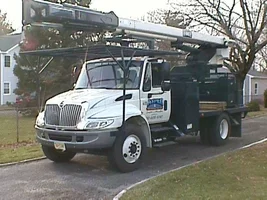
Cory , I guess I'm not familiar with the AL...is that a name brand tower ?...I have used Techo, Altech, and this new hi Ranger. To be honest with you , I dont care for the Hi Ranger only because the city got the fence line model.Piece of crap as far as I'm concernd. Sure it's fairly versital and all, but I would rather be using my old 75'techo then this thing.Olny nice thing about it is, it's nice riding and had twice the power my old Techo had.

It's unfortunate that that most towers are now built for line clearence with a side mount bucket.They dont seem to realize how valuble it is to have that old center mount back in place.

I dont really have anything against Hi Ranger, just this truck. If you want to spend the 200 grand for all the extras, Like a hi flow pump for the hydrolics, elevater, tilt bucket and so on it would be sweet. The hi flow pump and center mount bucket are the most important for me.

Anyway , sorry to Rant and rave guess I shoud have posted this else were. /forum/images/graemlins/laugh.gif

Greg
 
KF, what do you mean "the fence line model?"

Aerial Lift is made in CT. I have one and love it but it's the only brand I've used.
 
It means its just good enough to get by, but leaves you wanting more... it rides the fence so to speak.

KF, is it possible to have an over center boom with the bucket mounted on the end vrs the side? I know its possible but I havent seen many (perhaps any) that offer that. I really like the bucket mounted on the end myself in my rather limited flying experiance.

I also +1 the books dont teach everything, this world is strangled by pencil necks.
 
Cory

I'm unsure of your question, partner. However, as to how the pictures and or illustrations of undercuts used in my book goes, a lot of those where just representing styles.

Some timber fallers I've known over the years use a particular style in their Humboldt cuts. My friend John Ciro doesn't use the strick "Block-out" version. "Takes too much time," he says. His style is very narrow and quickly cut. Then snipe it and launch it. While John can get a tree on the ground faster that any man I've known he also breaks a lot more timber than any man I've known.

On the other side of the coin, my friend Ted Matilla will work on a Humboldt undercut for an hour, widen it out, block it out, chip and clean it out, and then meticulously calculate, measure and saw the snipe. And Ted will go through as much detail sawing in the backcut. Measuring and calculating to make sure everything is square and perfect. Ted has a much better average rate of saving his trees from breaking than John Ciro ever did. But John Ciro cuts way more trees that Ted does in the same amount of time, and by it John makes a heck of a lot more money than Ted does. There's a time and place to be meticulous as Ted, and, at rare times, like John too.

I've learned a lot from both those guys and kind of fell into middle ground with my style of cutting. I'll take my time on a tree that I know I could save and make more money on, than breaking it. On the other hand I'll cut quick and to the bone to get a tree on the ground I know will break no matter how meticulous I get with it. I've rolled my eyes over watching John break trees that I know could have done better if only he spent a little more time. And I've rolled my eyes over watching Ted spend hours on a tree that's going to end up breaking no matter what.

So on the same tree, depending on who's falling it, and their philosophy, you could see several different styles of Humboldt or conventional versions. Either way is going to get the tree on the ground. Out in the woods the faster you are the more money you are going to make. In town, for the customer, with all the obstacles to work around it definetly helps our reputation and pays a lot more to be like Ted.

Jerry B
 
Jerry, thanks for the reply. I think it is really cool how you work in the personalities of various fallers and show how the personality is reflected in the work, from specific techniques used, to the flow of the job. I think all treemen have a little John Ciro in them ....!

You pretty much have it laid out in black and white on pp306-309 in your book FGTW, re gaps/snipes vs. plain Humboldt...there's alot there to consider! So I think I get it now...

I was wondering, before the advent of chainsaws, how did the old timers get the blocks out of the gap??

Mark, that's a nice looking compact yet tall bucket!
 
Cory,

I can only guess on that one. Having just seen the old stumps with the snipe chopped from the bottom often left me standing there looking at them and wondering the same thing. Because the snipes on many of those old stumps hasn't always been full depth (running fully to the hinge) Lots of chopping needed to accomplish that, a full snipe.

The old timers may very well of chopped a narrow face (opening) over the undercut and then follow by hand chopping the snipe from the bottom. That could be accomplished easily. But even so, redwood generally splits easily, especially old growth, and a long steel wedge driven into the block, even without boring, could rendered the block out. Follow by using the peeling bar to chip the remainder out clean. The old peeling bars are still used today for cleaning out the biggest of undercuts. There's nothing better around. Along with a pick axe you've got the whole kit.

I've often wonder who come up with the foresight to snipe the bottom of the stump in the first place. It didn't necessarily save much on the work end of it, but it sure started saving a lot of timber from breaking. And you know, whenever someone breaks the old traditions others are generally quick to look at them oddly and critisize. It would be interesting to see where the earliest accounts could be found. That would be a good project for someone I think. Thanks for asking, Cory.

Jerry B
 
65 or 75' Mark?

My original question was a bucket mounted on the end of the boom, not the side of the boom, while it still being over center. It could be accomplished with the bucket mounted between the yoke, but I havent seen many.

If/when I get a bucket, I am thinking about your setup (75') to the T. Great minds think alike!

I wanna groundie for you, but that aint likely, the drive to work would be killer.


Carl
 
Hmmm CArl, Good point ... I guess I never really thought of the side mount for over center vs. Center mount not being able to go over center.

I'm starting to get used to this new boom. It's reletivly new to me. It's only the 65' model and I'm used to a 75'. That 10 feet makes a big difference and the little 55' is even different yet .

Oh well, I just told my supervisor, we'll be climbing more since they didnt sprint for the 75' elevator.

Greg
 
I may take you up on that Mark, helluva learnin experiance!

How much would that rear mount setup cost with the elevator. I have found its cheaper going first class the first time.
 
Status
Not open for further replies.

New threads New posts

Back
Top Bottom