Buckingham Tree Squeeze

I am thinking about getting a few for a few guys to try, It seems like a good product for many applications.
About $200 each, I want to get just a few and have certain guys try it. We have about 22 climbers so that would be expensive unless it is as useful as it seems.
Just wondering if any of you have used it or are using it and your opinions of it.
Thanks, Jeff
I know I'm very late to the party but would your insurance not permit you to simply configure lanyards in such a choker-configuration? I call mine my 'squeezer', I used 24' of folded-over 7/16" Mercury (8.5k ABS and 3.5% elast so it's solid if/when using it as a false crotch too) and an Ice Tail prussik on the other end.

I use a pair of rings because alum rings are so damn cheap and a single ring's ABS is lower than doubled-Mercury so figured using 2 would eliminate that weak-point, increase bend-radius at the fold, give redundancy etc.

Would suck to think insurance were so rigid as to not allow you to make 'squeezers' (or regular ole 'adjustable fliplines' where it's climb-line w/ a prussik on one end, hell IMO buck has as-strong a case for IP as someone would for a regular adj flipline IE about none because it's not a product but a configuration) Hope you're able to use this cool configuration w/o dropping $200 apiece when you could buy packs of o-rings, a hank of Mercury and Ice Tail and have a crazy-strong 'squeezer' for about as cheap-as-possible :) [Pics of some ideas of mine are in a thread I made on this subject recently, the one I use is doubled-rings on the bend and a hitch of Ice Tail where each end's eye has a big 1/2" steel thimble, increasing prussik-on-hardware strength which is surely the weak-point on any of these configs]
 
That's an adjustable false crotch...decades old technology and a solid performer. Get rid of the big ring and use a large HMS biner in place. This eliminates disconnecting and rethreading when its time to pass a branch union. Its a great use for pieces of climbing rope that have gotten spiked or cut.
Heh am meaning to get a 30kN or stronger steel biner to use on the prussik-end of mine for exactly this reason, want thread-lock just something simple like ISC oval but a bit bigger for half an anchor.

How is it different from a traditional AFS? I got a Rope Logic 5/8" AFS from Wesspur for less than half that price ($87.00). Not knocking it, just suggesting you might get similar performance for a bit less $.
gah hate hearing of nearly a hundo$ for a short rope, splice & prussik (and an o-ring maybe)

But...it's different because doubled-up line is way way stiffer, I only use hair-elastics folded into 3 (every few feet on my doubled Mercury 7/16 squeezer) and my Ice Tail prussiks slide over them like nothing and the entire body is just nice & stiff on the tree & in-hand, just superior to single-rope (and, if making your own which I can't see why one wouldn't, the extra rope for doubling-up costs next to nothing, so even for the peace-of-mind of a stronger anchor, when using it as false-crotch once you've ascended, makes doubled-up superior and you can just make a doubled-up 'squeezer' for less than you paid for your regular 'adj flipline') Would love seeing more people make them it is a good configuration, choking is cool, rigidity of doubled-line is cool, redundancy of a stronger false-crotch/anchoring point is cool....just makes-sense and it's not adding anything to your climb/belt just use your climb rope tail through it and your regular adj.flipline can sit on your hip where you used to hang a false-crotch, if not setting from the ground....I suck @ setting from ground so for me this is great, I've yet to really play w/ choking a spar and doing a quick verttical next-to-trunk bail - for instance if I found a hornet's nest which isn't an if but a when in FL summers in trees/shrubs - but even w/ a pretty uncomfortable descent it's still cool to be able to start descent almost immediately whenever you wanted (presuming you have your fig.8 handy & are precise enough in-panic, guess you could position it on the line while ascending to have it at-the-ready for redundancy if desired!
 
Why not just throw a prussic on an extra flipline? Seems cheaper and more versatile if you really wanted to flip your system up with you.
 
I use one on most all of my doug fir removals these days and like it a lot. The majority of my work is spur removals of dougs, and I find it to be an excellent tool for that. The important difference between it and a traditional adjustable friction saver is the stiffness of it, compared to a 'floppy' rope. That allows me to put it on the tree, tie in, and then easily grab it and move it and my steel-core flipline up the trunk together. When I reach the first cut, which may be 50+ feet up, I just leave it a bit lower than my flipline, make the cut, then grab it all again and move up. Keeps me tied in and able to rap to the ground at a moments notice, while giving me a second tie-in while cutting.

The rubber bands holding the two pieces together suck and did nothing but get in the way. Second tree I ever used it in, I grabbed the knife of my saddle and cut a few of em out. That part is a bad design in my opinion. It also struggles a little as the trunk gets less than 6". Overall I'm a fan, for single-stem removals at least.


DSCN2010 (Custom).JPG
 
Gasp - an actual video popped up between hours of incessant YouTube ads . . . saw this as a variation on treesqueeze/ squeezing trees - this guy has some clever stuff I think!
Maybe some winter projects?
Cheers
Great idea using Purcell prusik as the back, except adjusting when using might not be effortless in a squeeze application. Not sure I get the rope catcher prusik being so thin - wouldn’t that make hard to adjust?
 
I use one on most all of my doug fir removals these days and like it a lot. The majority of my work is spur removals of dougs, and I find it to be an excellent tool for that. The important difference between it and a traditional adjustable friction saver is the stiffness of it, compared to a 'floppy' rope. That allows me to put it on the tree, tie in, and then easily grab it and move it and my steel-core flipline up the trunk together. When I reach the first cut, which may be 50+ feet up, I just leave it a bit lower than my flipline, make the cut, then grab it all again and move up. Keeps me tied in and able to rap to the ground at a moments notice, while giving me a second tie-in while cutting.

The rubber bands holding the two pieces together suck and did nothing but get in the way. Second tree I ever used it in, I grabbed the knife of my saddle and cut a few of em out. That part is a bad design in my opinion. It also struggles a little as the trunk gets less than 6". Overall I'm a fan, for single-stem removals at least.


View attachment 70685
Thé small diameter application. Is what concerned me when I first saw the squeeze mentioned being the stiffness helps move the lanyard up down etc but is it to rigid for the small stuff.

And the rubber lugs as you say - would be better to have ropes stitched together at frequent intervals?
 
Thé small diameter application. Is what concerned me when I first saw the squeeze mentioned being the stiffness helps move the lanyard up down etc but is it to rigid for the small stuff.

And the rubber lugs as you say - would be better to have ropes stitched together at frequent intervals?

It's not the stiffness that affects the performance on small diameter stems, it's just the length of the whole system (rings, prussick, etc). That's not exactly a knock against it, the thing works great on pretty large stems and pretty small ones, just not on the extremes of either end and it would be somewhat unfair to expect a single tool to work perfectly in EVERY situation.

And yes, stiching the two pieces of rope together would seem to be an ideal situation to remove the obstruction caused by the rubber bands.
 
It's not the stiffness that affects the performance on small diameter stems, it's just the length of the whole system (rings, prussick, etc). That's not exactly a knock against it, the thing works great on pretty large stems and pretty small ones, just not on the extremes of either end and it would be somewhat unfair to expect a single tool to work perfectly in EVERY situation.

And yes, stiching the two pieces of rope together would seem to be an ideal situation to remove the obstruction caused by the rubber bands.
Thanks for the clarification on the construction. Hard to scrutinise details from images on the internet , so the clarification is helpful.
 
I made this immediately when I saw you post it, been climbing in it a few weeks now and I love it so much I'm having one professionally made. I'm having it made into a 6' loop with the small ring stitched in then I'll tie it into the Purcell prusik with that side capturing the large ring. What I'm trying to decide is how to tell them to sew it; both ends stitched into their own eye around the ring (so the cord passes through twice) or just sew it into a big continuous loop (so only one pass of cord through the ring)?
 
My only comment on sewn cord around rings might be that these will probably be higher wear points - consider maybe putting something like plastic hi-wall thimbles on the rope before sewing?
https:// www.wesspur.com/splicing/thimbles.html
I was going to toy around with this in the winter and also wondered about periodically sewing through both cords in the main loop (sort of like the ART snakeanchor but no loops) to make the thing stiffer (I'd be trying to use it on conifer spars). This gets away from the rubber loops like those on the TreeSqueeze that some have complained about.
Also, is the Purcell Prussik "safer" than a TreeSqueese type of design, by virtue of the fact that the prussik is holding only one half the weight due to the loop running through the ring? Don't know.
 
I was going to toy around with this in the winter and also wondered about periodically sewing through both cords in the main loop (sort of like the ART snakeanchor but no loops) to make the thing stiffer
I had the same thought and was planning on doing so myself after I have it. Professional sewing is expensive though and it's non life support so I was just gonna speedy stitch it once I had it.
 
Lots of info on sewing in the splicing forum here but maybe another comment - after the thing is made but before periodic speedy stitching (with round point needle not the leather needle that comes with it?) is to pull the rope out with some weight to get the fiber-ology aligned as it would be in use. Just a thought. Moss has way way more experience at the sewing thing than I do. I have mixed feelings about stitching if it's too big and too tight though because these might become wear points when using the thing on very different sized trunks - I'm hypothesizing the two rope strands may want to move back and forth a bit on each other on different sized stems over time (the commercial TreeSqueeze banding allows them to slip a bit). Conjecture on my part. But my birth-sign is the cringing chicken . . . . .
Cheers
 
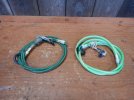
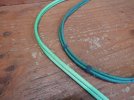
So a little update. Buckingham has made the 2.0 version of the Tree Squeeze that addresses the terrible and borderline unusable 'rubber-band' design of the original. I cut those bands off mine almost immediately to actually be able to move the prusik, but at times the two strands would separate and catch stubs between them, or worse, get my foot caught in the end while standing on spurs. The 2.0 uses the same two-strand design as the original for increased surface area, but has a sewn jacket around both strands which keeps them together while having nothing to obstruct the prusik. You know, how the thing should have been designed in the first place. The only other difference I noticed was the rings now have ratings stamped on them.

The truth is that the thing works great but it is stupid expensive. $240 for what amounts to a stiff adjustable friction saver is a lot, but it's a tool I use more days than not, didn't feel like trying to modify my '1.0' and for the tools I use most often, I like to have a backup. So now I have two, even if one is the 'lesser' version.

Other than the price, for the type of fir removals I usually do I'm a big fan.

DSCN7052 (Custom).JPG

DSCN7049 (Custom).JPG
 
So a little update. Buckingham has made the 2.0 version of the Tree Squeeze that addresses the terrible and borderline unusable 'rubber-band' design of the original. I cut those bands off mine almost immediately to actually be able to move the prusik, but at times the two strands would separate and catch stubs between them, or worse, get my foot caught in the end while standing on spurs. The 2.0 uses the same two-strand design as the original for increased surface area, but has a sewn jacket around both strands which keeps them together while having nothing to obstruct the prusik. You know, how the thing should have been designed in the first place. The only other difference I noticed was the rings now have ratings stamped on them.

The truth is that the thing works great but it is stupid expensive. $240 for what amounts to a stiff adjustable friction saver is a lot, but it's a tool I use more days than not, didn't feel like trying to modify my '1.0' and for the tools I use most often, I like to have a backup. So now I have two, even if one is the 'lesser' version.

Other than the price, for the type of fir removals I usually do I'm a big fan.

View attachment 74019

View attachment 74020
I like it! Out here in Hawaii we do a lot of palms (cocos mostly) and I use the “squeeze” all the time. On Leaners it gives quite a bit of lateral support too. Great for removals and trims. Nice to see a new version but damn that’s pricey! A rope friction saver is not the same. Have tried to make one with a wire core but it’s not the same either.
 
If you think about it. Spending $240 for a tool you find efficient and effective, and use a lot is not crazy. I spend close to that on rope, use it for a year or maybe a bit more full time, then replace it. This tool you should get many years of safe, reliable service out of it.

my.02

Tony
 
If you think about it. Spending $240 for a tool you find efficient and effective, and use a lot is not crazy. I spend close to that on rope, use it for a year or maybe a bit more full time, then replace it. This tool you should get many years of safe, reliable service out of it.

my.02

Tony

Oh I agree 100%. Break down the price-per-day of a frequently used tool that has the potential to last years and it comes out to practically nothing. That is why when buying tools I buy top-of-the line nearly every time, it works better each time you use it, and the cost is inconsequential over the long term. Perhaps I overemphasized it in the earlier post, I just feel $240 for a friction saver with no moving parts is a lot for what it is. But then again, zero regrets buying it and I would still recommend it.
 

New threads New posts

Kask Stihl NORTHEASTERN Arborists Wesspur TreeStuff.com Teufelberger Westminster X-Rigging Teufelberger
Back
Top Bottom