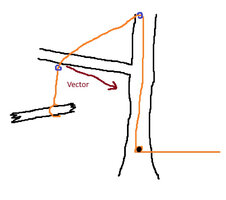
Broken rig point

Possibly some distinction here. Ring below the rig point branch like fishing pole helps vs rope from groundie to block on branch to load, but ring/block on spar above rig point branch, then rig point branch is is just a redirect is better IMO. Secondary function is "catch" rig point if primary rig point (@branch) fails - better to catch the piece even if suboptimal trajectory vs free fall. Watched a guy once without "rigging sense" excitedly do a fishing pole that was almost as bad of loading as branch to groundie - cringe.
 
I'll throw some analysis at the diagram. As drawn, vector creates "X" torque about branch attachment point. Now picture it as a fishing pole or to-groundie - vector points more toward the ground. Vector closest to 90 degrees from branch axis is the most (worst) torque loading at the branch attachment point. Avoid. Vector closest to axially down the branch is the least torque - try to achieve. But the load is moved elsewhere - now it's bending the trunk in the worst case right where the branch attaches - but you're ahead because the trunk is (presumably) bigger than the branch in diameter. For max benefit put the high point on a spar off to the right - voila that spar is mostly compression and less trunk torque than the as-drawn, even though the as drawn is pretty good.
 
Analysis part 2 - using a rigging ring or biner instead of a block at the branch redirect ADDS force and torque on the branch attachment point in the as-drawn - use a pulley if looking for more margin of safety. Ring at top point doesn't affect much because the reduced "down" rope leg is pretty much axial down the stem - yes, lower high tip force but torque is usually the boogeyman.
 

New threads New posts

Back
Top Bottom