broke a biner

[ QUOTE ]
rope- orange samson, 21,000 lbs min break
straightened biner- 50Kn
other biner- 40Kn
20000 pulley tied in tree with 50Kn biner
porta wrap connected to skid steer with 40Kn biner
rope was hard locked to porta wrap on skid steer. limb got caught in crotch so we used skid steer to raise/lower limb to free it from crotch. i assume shock load was too much, i was looking down so if anything broke (as it did) nothing would hit me in the face. broken branches did hit my helmet and broke pelton ear guards

[/ QUOTE ]
Not to get bogged down in semantics, but isn't this a situation of overload? Shockloading, in my mind, means something is free-falling and then gets snatched into a static rigging system, thus multiplying forces. Seems like when you pulled the branch out of the crotch, it would swing free, not drop and snatch.

Did the biner break while pulling the load up, or after it came free of the crotch it was stuck in?

maybe I'm way off here--set me straight.

k
 
Ekka-

You mean 2x-openness of angle-friction force?

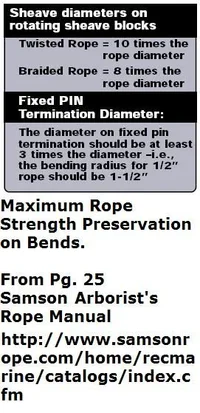
Are the quoted ratios for fixed termination bends, or rotating bends?? Which would only be a rule of thumb anyway, for medium lay braids; and increased for stiffer lines, 3 strand, aramids etc.
 
[ QUOTE ]
So all components of that system should now be thrown in the bin as all have exceeded their Safe Working Load limit which is in the USA 10% of the breaking strength.


[/ QUOTE ]

Just to clarify: although it is sometimes recommended that the Safe Working Load or SWL (also known as the Working Load Limit, or WLL) should be 10% of the breaking strength there is no standard that dictates this. Actually, 10% (which is a 10:1 safety factor) is usually recommended for gear that is used for life support, while 16.6%, 20%, or 25% (respectively, a 6:1, a 5:1, and a 4:1 safety factor) is (sometimes) used for rigging. This is true not only for tree work, but for other heavy industrial rigging as well.

In the 2005 Sherrill catalogue, p. 45 has a list of hardware products with a WLL of 10:1, except for two products, which show a WLL of 6:1. On p. 64 it is stated that "...a 10:1 ratio is more applicable in tree work...", but on p. 65 the products are listed with "manufacturer supplied ratings based on 5:1 ratio". The ropes on pages 12-18 aren't given any WLL--only the tensile strength is shown.

Yale's arborist catalogue shows XTC,XTC Plus, and XTC Spearmint listed as climbing lines with a 10:1 working load. Two pages later the catalogue shows the very same ropes listed as lowering ropes with a 5:1 working load.


My Tuflex slings have a rating on them for three different sling configurations. The ratings shown are 5:1, but I had to call the manufacturer to find this. The tensile strength isn't given anywhere on the slings, nor in the Tuflex catalogue, and without the tensile strength there isn't any way to know what the safety factor is.

I don't mean to disparage any of these companies. They all have great products that I often recommend to other people. It's up to the user to be able to understand and interpret what the ratings mean.

I agree that the ASPR video series is a great learning tool.
 
[ QUOTE ]
[ QUOTE ]
rope- orange samson, 21,000 lbs min break
straightened biner- 50Kn
other biner- 40Kn
20000 pulley tied in tree with 50Kn biner
porta wrap connected to skid steer with 40Kn biner
rope was hard locked to porta wrap on skid steer. limb got caught in crotch so we used skid steer to raise/lower limb to free it from crotch. i assume shock load was too much, i was looking down so if anything broke (as it did) nothing would hit me in the face. broken branches did hit my helmet and broke pelton ear guards

[/ QUOTE ]
Not to get bogged down in semantics, but isn't this a situation of overload? Shockloading, in my mind, means something is free-falling and then gets snatched into a static rigging system, thus multiplying forces. Seems like when you pulled the branch out of the crotch, it would swing free, not drop and snatch.

Did the biner break while pulling the load up, or after it came free of the crotch it was stuck in?

maybe I'm way off here--set me straight.

k

[/ QUOTE ]

what i remember is that we had the port a wrap hardlocked so that the rope would not give any. we backed up the skidsteer to raise the limb out of the crotch and bring the skidsteer foward to lower it. we did this a few times, slowly removing the limb from the crotch. somehow on the last raise/lower, i guess the skidsteer went too fast and losered the limb so much that when the skidsteer stopped there was too much downward force. thus breaking the biners.
i hope this helps explain
 
[ QUOTE ]
Ekka-

Are the quoted ratios for fixed termination bends, or rotating bends?? Which would only be a rule of thumb anyway, for medium lay braids; and increased for stiffer lines, 3 strand, aramids etc.

[/ QUOTE ]

They are for both, part of the reason why some knots are stronger than others.

Rope fibres only work in tension and not in compression, so as a rope is bent the inside fibres are being compressed and the outside fibres tensioned. When force is exerted upon this knot or bend the outside fibres are doing all the work whilst the inside are doing not much at all.

Our 5:1 bend radius is for 100% rope strength, so if you have a 5/8 rope running thru a block, you'd hope that the blocks pulley wheel is 3.125" dia, as you lessen the dia of that pulley wheel more of those inner fibres will be doing nothing.

Also our SWL for rope is 1:6 and our SWL for hardware is 1:5
 
i've always taken this to mean, that rotating a loaded line on a bend, is different than a static hold.
From Page 25 of Samson Arborist's Catalog

32913-RopeBendStrength.JPG
 

Attachments

  • 32913-RopeBendStrength.webp
    32913-RopeBendStrength.webp
    35.5 KB · Views: 31
This is a scenario where "cycles to failure" will apply. Everytime you use a piece of equipment, that is equal to 1 cycle. If a rope has an ABS (average breaking strength) of 20,000 pounds and you lift 20,000 lbs., you will get 1 or 2 lifts before the rope parts(breaks). 20,000 pounds is the "average" at which the rope parts. Sometimes lower, sometimes higher. If you take that same rope and lift 10,000 lbs., you will get approx. 100 cycles before the rope parts. The same rope lifting 5,000 lbs. will get 500 cycles, 3,330 lbs. will get 1,000 cycles and so on. The lower the #, the more cycles you will get out of your rope. But, you have to keep in mind how many times the rope was cycled at what load. Knowing the history of all your equipment is imperative. Being that this rope was cycled at high loads, how many more lifts or cycles are you going to get out of it? Document each cycle so you have it recorded. This is why the arborist industry has a 10 to 1 safety factor on software. Use a climbing line that has an ABS of 6,000 lbs. and a 180 lb. climber will get thousands of cycles out of it.
Carabiners and pulleys will have the same cycles to failure apply to them. Hardware has a 5-7 to 1 safety factor, depending on the manufacturer. A carabiner with an 11,240 lb. ABS cycled at high loads will only get a certain amount of lifts before failure. The same with the 20,000 lb. pulley. Carabiners are nice because of their ease of use. But, they are not desgned for the kind of abuse we as arborists put them through. A better choice for heavy rigging are screw pin shackles or 5/8" or 3/4" screw links.
As far as bend ratio in rope; a 1 to 1 bend ratio has 40% strength loss, 2 to 1 30%, 3 to 1 20%, 4 to 1 15%, 5 to 1 12%, 6 to 1 10% and 8 to 1 5%. You never mentioned what was anchoring the 50kN biner to the tree. This is for polyester and nylon rope only.
Like Mark Adams said, this equipment has been cycled beyond it's Safe Working Loads and should be discarded. Keep the links (carabiners) out of the system. Girth hitch the Port-a-wrap to the rope, and purchase an arborist block with a bushing for the eye sling and connect the eye sling to the bushing. No links involved. The life you save may be your own.
 
Tree Spyder wrote:

[ QUOTE ]
i've always taken this to mean, that rotating a loaded line on a bend, is different than a static hold.


[/ QUOTE ]

Don Blair, in Arborist Equipment, makes a similar distinction between rotating and fixed terminations:

"According to Dick Hildebrand at Yale Cordage, although further gains do occur beyond an 8:1 ratio, they are painfully small as the blocks grow increasingly large, heavy and expensive.

...there is only a 10 percent increase strength loss from an 8:1 to a 4:1 bend ratio. By compensating your rigging, working loads and lines...4:1 should provide adequate service..."

(pp. 182-183)

and

"Cordage Institute specifications recommend a 2.5 x diameter ratio of rope to termination."

(p. 187)


Ekka wrote

[ QUOTE ]
...5:1 bend radius ...

[/ QUOTE ]

I think its bend <u>ratio</u>, not bend <u>radius</u>. See Norm's post, above.
 
Well

What a myriad of numbers and certainly some differences between continents.

As far as bend ratio in rope; a 1 to 1 bend ratio has 40% strength loss, 2 to 1 30%, 3 to 1 20%, 4 to 1 15%, 5 to 1 12%, 6 to 1 10% and 8 to 1 5%.

Cordage Institute specifications recommend a 2.5 x diameter ratio of rope to termination."

Both of the above are valuable facts to keep in mind, thanks for the info, it is good to know this and is certainly different to what I was taught here. Thanks.
 
Lots of good stuff; thanks Norm for reminding us of the cycles to failure aspect!

i think fairly, the bend ratio of a cerain diameter line, gives the allowable bend radius(?).

Also, these are rules of thumb; there are even more factors you could consider sometimes, to split hairs further to the best choice. Two 1/2" lines would appear to have the same safe radius of bend, having the same ratio to said bend. But, if 1 line is stiffer construction; it would be leveraged more on the same bend. The leveraging takes place, like as in a lever itself; the resistance to bending X the size of the arc; gives the leveraging of the device. Whether that device in question is wood, steel, rope etc.

Also, a 3/8" hollow Tenex, might leverage less on the same bend as a 5/16" 'regular'/braid. The Tenex being so hollow, would resist bending less for less leveraging by that factor. But, also, the Tenex would flatten out; to offer less 'height'/length on the leverageable axis of the bend. The leveraging coming from the ease of bend arc X the length from bottom of the bend of the line to the top (usually the diameter, unless line flattens out, changing that number like the Tenex). Our lines are round for easier knotting, and rolling over branches (without gripping too much); not for strength!

Steel, Kevlar etc. have lots higher ratios; and take different shaped pulleys, to properly support/baby the line through a working/turning bend.
 
Tree Spyder wrote:

[ QUOTE ]
i think fairly, the bend ratio of a cerain diameter line, gives the allowable bend radius(?).


[/ QUOTE ]

If you are being absolutely precise about your terms, yes. But then you have to convert 'radius' to 'diameter'. Most often when someone says or writes 'bend radius' they mean 'bend ratio'.


When Ekka wrote

[ QUOTE ]
Our 5:1 bend radius...

[/ QUOTE ]

in a previous post 'radius' should be 'ratio'. "...5:1..." is a ratio and (I think) he meant the ratio of the diameter of the bend to the diameter of the rope.

Even the JPEG that you posted from Samson uses the terms incorrectly. One of the black headers reads:

"Fixed Pin Termination Diameter:"

and this is followed by:

"The diameter on fixed pin termination should be at least three times the diameter--i.e. the bending radius for 1/2" rope should be 1-1/2"...."

If the fixed pin bending <u>radius</u> for 1/2" rope is 1-1/2", then the fixed pin bending diameter would be 3". That means that the pin/bushing on a block where the eye of the sling is attached should be 3 inches in diameter. But I don't think this is what they meant.

I was one of the reviewers for the ASPR video/workbook and the first draft of the glossary had the following definition:

'Bend Radius: The ratio of the diameter of the line...' This was obviously wrong. How could the radius be the diameter? Someone had just written 'radius' instead of 'ratio'. Unfortunately the terms are sometimes published incorrectly (as in the Samson catalogue) and the mistake is then repeated by others.

[ QUOTE ]
...if 1 line is stiffer construction; it would be leveraged more on the same bend.

[/ QUOTE ]

Excellent point Spydey. Tenex is slightly stronger than double braid because Tenex flattens more under load. The downside is that, because Tenex has a looser weave, Tenex has poorer knotting ability (it can be more difficult to untie after heavy loading), and less abrasion resistance. Tenex is used only for rope tools, not for a running line.
 
Sir Justin introduced a topical point awhile back. That Tenex, as well as other hollow (ship maid Slevlages for rope grab/prusik mechanics?) constructions, do not have the internal friction forces (against line strength) that solid/non hollow lines have. This pairallells Ed Hayes "Evaluating Tree Defects" re-search that a 50% reduction in the core diameter of tree (with no crack or exterior diameter vioalation) has only a strength loss of 6%.

~Great discussion!
 

New threads New posts

Back
Top Bottom