Breaking dead ash limbs

dmonn

Branched out member
I've been mostly working on dead ash trees (EAB killed). I often like to break limbs from the ground where the limbs are too high for me to ever consider climbing to cut them. By breaking smallish limbs the tree becomes "skinnier" and easier to drop into a narrow opening without damaging nearby healthy trees.

I've been amazed at how much static force it often takes to break some of these limbs. I have mostly been pulling down away from the trunk, usually with a rope-to-ground angle of less than 45 degrees and the limb structure near vertical. From the geometry it would seem that setup should make it easiest to break the limb.

I work solo, and often use a rope puller (10:1 MA) and that's not enough to break a 3 inch limb. I've gone so far as to do a 4:1 added onto the rope puller to get the job done (theoretically a 40:1 MA). That's a huge force on a 3-inch branch! I've been wondering if pulling from a different angle would cause the limbs to break more easily. The way I'm pulling now lets the branch collar support the limb to the max. The limb might be 3 inches where it's tied, 4 or 5 inches near the trunk, and the tied point more than 5 feet away from the trunk (sometimes 10 feet).

Would pulling the limb from an angle that is more sideways from the direction of growth allow the branch to break more easily? The branch collar would give it less support that way. Any other suggestions? I know with a little MA (and a lot of rope) I could get some dynamic force from my trailer hitch and a running start, but that doesn't really reduce the applied force. It could also make things more unpredictable as well but maybe more entertaining.
 
Hello again! At some point you will be pulling over those trees instead of “fracture pruning”. I think EAB is somewhat fresh in your area but it won’t be long before the roots are mush. I’d prioritize the trees by targets first. Pull angle helps but it could be TIMBER! instead of snap. Stay safe
 
I like that phrase "fracture pruning"!

I HAVE had a whole tree come down thinking I was just breaking off a limb. That's why I try to pull downward at least a bit rather than nearly horizontally. When the whole tree came down I was pulling from a pretty good distance (twice the height of the tree) and using dynamic force. The big bang and whoosh was a shocker. It snapped about two or three feet above grade.

I also have read that EAB-kill reduces the strength of the trunk wood down to 1/5 of its healthy strength within a couple of years of calling it a dead tree. These guys can behave in some very unpredictable ways. I always try to think through all the possibilities, and if something looks sketchy, I find a better, safer way. I love this forum for getting advice from those who know more than I do.
 
I am also felling ash trees on the instructions of the forestry engineer. He has instructed me to fell them ALL. At first I was hesitant, partly because I have a lot, and in places the bush will be nearly “bald”, but also because so many look pretty healthy.

As I progress in this work I am developing a much better understanding of his guidance. The ash trees are extremely varied in their infirmary. Many look good yet crumble when felled. Just where they are deteriorating is not clear to me until they are on the ground. Some have their tops turn to “rain”. Other’s felling hinges break very short. Some lose large branches. One snapped its trunk when falling cantilevered over a stump.

Like @flushcut I would say keep up the good fight, but be extra careful.
 
Here in Detroit we have tons of Green Ash trees that re-grow as bushes when they're cut down to a stump. This gives me hope that as long as they can continue to produce seeds, there will always be Ash trees, just not mature ones, until we solve the Ash Borer problem.
 
Or the bushes just keep on feeding the bugs
What I've read and heard is that the bugs need a big tree to survive a Wisconsin winter. I would assume they can feed on the bushes, but don't survive. It seems like there are lots of healthy-looking green ash saplings around (2" or smaller dbh), but I don't see any mature ash in the woods that aren't dead (unless chemically treated). Very sad.
 
It’s just a matter of time before those 2 inches are killed as well. The ash is virtually all gone in Walworth county. I think 94% mortality was the last figure I have heard.
 
One of the main reasons why we are purchasing a spider lift this year. I just can't depend on the trees structure to safely climb it. Second being the added productivity over climbing. Our ash trees are all starting to go. Alittle over the years but I think we will be in peak EAB starting this year. Our area was in this bubble until recently. Western Massachusetts
 
Speaking of breaking out trees while putting a pull on them, I had it happen to me unexpectedly just last week.

It was a dead and rotten western hemlock, which I had no intention of climbing because I knew it was in very bad condition. Open drop zone, just wanted to ensure it went in the ideal direction. So I shot a line about 2/3 up with the Big Shot, then tried to get the line tight against the trunk to put on a little tension before starting my felling cuts. The line was on a Maasdam Rope Puller and I was tensioning it to break some 2" limbs in order to get the line into the trunk. Much to my surprise, the trunk simply broke, at around 12" in diameter and 40' up, rather than breaking the 2" limb. The broken top fell right in the direction I was going to fell the tree so it wasn't a safety problem, but the trunk failure really surprised me and I guess you could say was a 'failure of imagination' on my part as far as anticipating potential issues. Point is, be wary of problem tree-species and don't take anything for granted.
 
Limbs break off easier upward.


I've had success with breaking out high fir limbs by pulling up a rope over a limb (s), attaching one end to a ground anchor and the other is pulled. Most of 2:1 MA.
 
Today while felling two little (9”DBH x 65’) ash trees their variability of state was clearly illustrated. The two trees looked like “two peas in a pod” and were about 4’ apart. They were skinny vertical ash trees - very typical of an ash that has grown amongst other trees. They both appeared healthy.

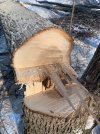
The first one’s hinge pulled apart with good resistance and left “ragged hinge hair” 3”-6” long just what I’d expect from healthy ash wood. (Not realizing I would wish to compare and contrast it to anything I cut it off as is my habit, so the photo I’ve included is actually of a tree I fell later, but is very representative of the twin.)

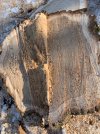
The second “twin” ash tree’s hinge snapped after a couple of degrees of movement. On inspection (see photo) it broke short - no “hair) at all.

The upper part of both trees held together pretty well after hitting the ground.
1AF3E948-773F-46C0-80C5-C329C7ED7F13.jpegFD25A481-E907-4763-8759-E4582F0EFC82.jpeg
 
Today while felling two little (9”DBH x 65’) ash trees their variability of state was clearly illustrated. The two trees looked like “two peas in a pod” and were about 4’ apart. They were skinny vertical ash trees - very typical of an ash that has grown amongst other trees. They both appeared healthy.

The first one’s hinge pulled apart with good resistance and left “ragged hinge hair” 3”-6” long just what I’d expect from healthy ash wood. (Not realizing I would wish to compare and contrast it to anything I cut it off as is my habit, so the photo I’ve included is actually of a tree I fell later, but is very representative of the twin.)

The second “twin” ash tree’s hinge snapped after a couple of degrees of movement. On inspection (see photo) it broke short - no “hair) at all.

The upper part of both trees held together pretty well after hitting the ground.
View attachment 80676View attachment 80677
And that is exactly why we do not climb dead ash. I’m not surprised to see that variability, those trees are quite unpredictable.
 
Do you know how vigorous the growth was last year? Or how bad the signs of EAB infestation were?
I have hundreds of ash trees. The majority are looking ill (we also have ash yellows). Many look healthy. Some are obviously dying. As I mentioned in a previous post the forestry engineer supervising my bush has directed me to fell them all.

I’m now convinced that not only is he right, but that ash that appear well may have severe internal deterioration, and it’s extremely difficult to anticipate exactly where or what that deterioration is until the tree’s on the ground.
 
Today while felling two little (9”DBH x 65’) ash trees their variability of state was clearly illustrated. The two trees looked like “two peas in a pod” and were about 4’ apart. They were skinny vertical ash trees - very typical of an ash that has grown amongst other trees. They both appeared healthy.

The first one’s hinge pulled apart with good resistance and left “ragged hinge hair” 3”-6” long just what I’d expect from healthy ash wood. (Not realizing I would wish to compare and contrast it to anything I cut it off as is my habit, so the photo I’ve included is actually of a tree I fell later, but is very representative of the twin.)

The second “twin” ash tree’s hinge snapped after a couple of degrees of movement. On inspection (see photo) it broke short - no “hair) at all.

The upper part of both trees held together pretty well after hitting the ground.
View attachment 80676View attachment 80677
yep... ash is by far the most unpredictable hinging wood I've dealt with... great control sometimes and almost nothing in other scenarios. To make matters worse I have no clue as to why.

And even before EAB my mentor would reprimand me for being in the tree with one ground man pulling a top or spar by hand. that's how much he didn't trust dead ash roots
 
Last edited:

New threads New posts

Back
Top Bottom