Break-testing HRC

Location
Maine
A few days ago I received a package of ropes from MooseHead to be tested. There were two e2e's made according to type 1 double-braid splicing procedures, one in 8mm HRC and one in 8mm Beeline. In addition there were 20 or 30 feet of HRC cover in 8mm and 16mm sizes.

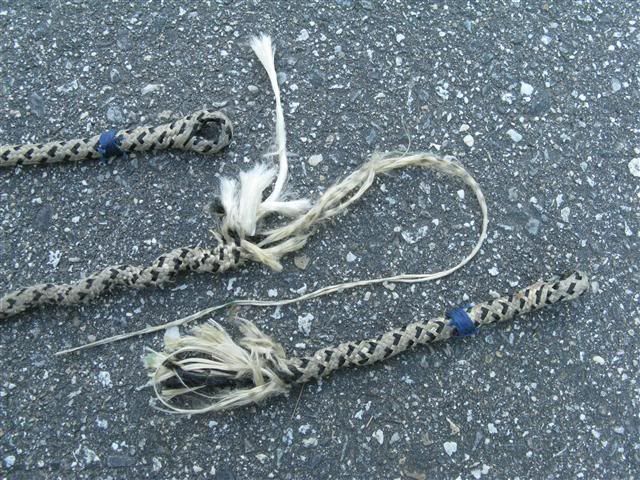
The first photo shows the HRC e2e as well as a cover-only splice I made up for testing. One eye of the test piece had a nice long bury that I was certain would not slip; the other eye had a 2-inch bury with no taper and no stitching. It slipped apart at 1392 lbs.
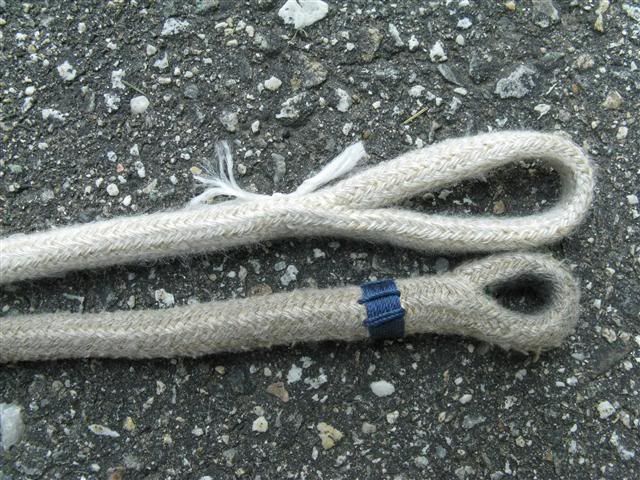
CoverOnly.jpg


The second test on the same rope involved a 3-inch bury. This time the splice held until the rope broke at 1874 lbs. The rupture occurred out in the middle of the rope far from either bury. Evidently 8mm HRC really is a core-dependent rope with relatively little strength in the cover. Interestingly, when I performed virtually the identical experiment on 8mm Beeline cover a year ago, the cover broke at 6000 lbs.
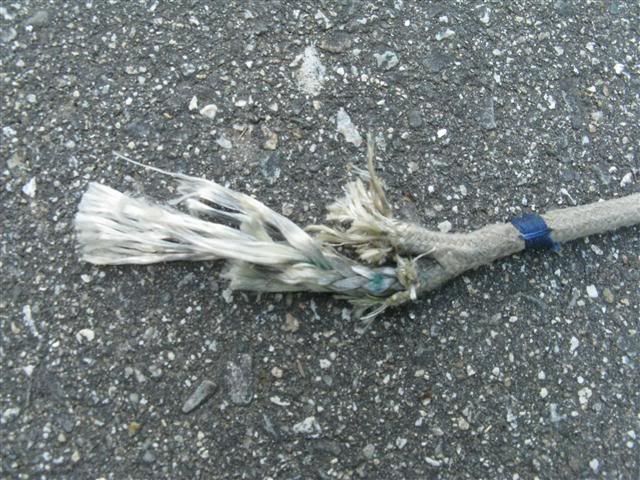
 
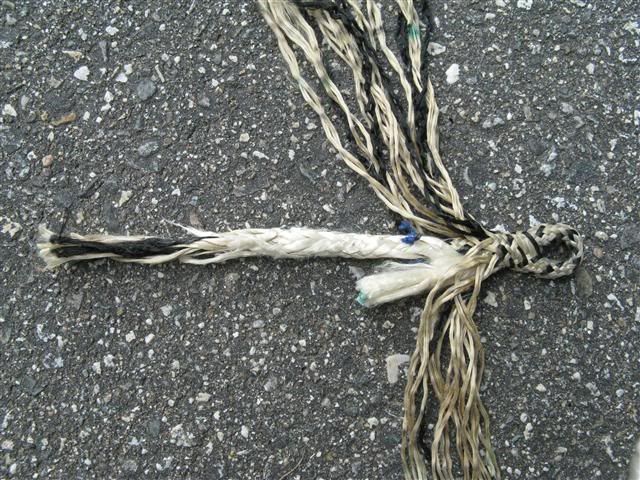
Next, I tested the HRC e2e with the double-braid splice. This failed at 3234 lbs. as shown in the photo.

hrcbreak.jpg


As you can see, the eye itself has failed. The short bit of core visible in the photo hasn't broken; it has slipped. Once it began to slip, all load in the eye would have been borne by the cover. The cover was already compromised because it was somewhat worn; the heat generated as the core slipped would have further weakened the cover in the eye until it failed as shown. The failure at 3234 lbs. is consistent with a cover tensile strength of roughly 1800 lbs. found in the previous experiment.

That little stub of core that fills the eye and terminates just a few inches from the eye has little importance in a non-core-dependent rope. The cover in that case would supply half or more of the total tensile strength, so even if the core slipped and the entire load in the eye was carried by the cover, it would still, because there are two legs in the eye, be as strong as the rope itself. The same slippage in this case proved catastrophic.
 
Next, I tested the Beeline e2e with the double-braid splice. This failed at 5016 lbs. as shown in the photo.

beelinebreak.jpg


Here the rope broke more or less in the middle of the splice. Oddly enough, the cover strands broke at one spot, but the technora core broke a couple of inches closer to the eye. I removed the cover from the failed splice to expose the internals of the failed splice (next photo).

dissected.jpg


Clearly the technora core did not fail at the end of the buried cover, which can be seen protruding a couple of inches beyond the rupture point. Whatever the explanation for these peculiarities in the rupture pattern, at least the splice did not come apart as in the previous case and the strength was more than adequate for the application. if the white stub of the core at lower right had begun to slip causing the cover of the eye to carry the entire load, there should be no noticeable consequences because the Beeline cover is far stronger than the HRC cover and would not fail at a load of 5016 lbs.

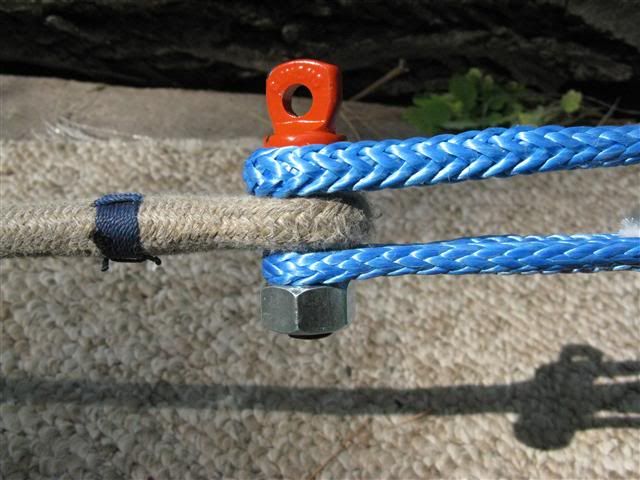
The eyes on both e2e's were very tight--the 7/16-inch pin from my smallest shackle would barely fit through. The WLL for the shackle is only 3000 lbs., so I chose not to use it for pulling. I did use the pin, though, rigged up with loop of 3/16-inch Amsteel Blue in a basket configuration, as shown below.


pulling.jpg
 
The 16mm HRC cover was next. As MooseHead pointed out to me, when you treat the rope like a hollow braid and splice an eye, the thick spliced part is almost exactly the same size as if it were made of 3/8-inch Tenex. It is a bit more pliable, much flatter, and has a very different feel.

I wanted to test successively longer buries to see how bury length corresponded with holding strength.

Here are the results:

3-inch bury: slipped apart at 1686 lbs.
4-inch bury: slipped apart at 3282 lbs.
5-inch bury: rope broke at 4532 lbs.

All these tests were on the same piece of rope, untapered, no stitching, no Brummel. When the rope broke in the last test the break was way out in the middle of the rope, far from the splice. In fact it was right at the entry point for the splicing wand. I had used this same entry point for all 3 splices, but the disturbance to the rope was absolutely minimal so I doubt that the rope was actually weakened because of it.

I plan to make an e2e of this stuff and test it in the tree. A 6-inch bury with slight tapering, good stitching, and no Brummel sounds like a good formula. If it works really well, better than my Icetail, I'll probably use it for awhile and then break it just to be sure the strength stays where it should.

Many thanks to MooseHead for generously supplying all this interesting material to work with!
 
Just a thought i had Alan was to use the 16mm hrc cover and slip it over some icetail since it's a touch smaller than tenex I think it would be nice especially seeing as how both the core and cover would be heat tolerant. Just a thought. I plan on making an e2e out of the 16mm cover but I'm thinking of a full bury (that's how I splice tenex as well) let me know how the 6" bury works out for.

Big thanks again Alan for testing the splices and other ropes for me. I'll let you know as soon as I come up with some more specimens.
 
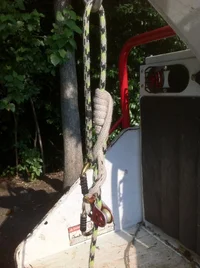
I made an e2e out of the HRC cover last night (it ended up longer than i wanted 40") I figured it would ok to try it out anyways. I used a 6 wrap 2 braid VT on a hitchclimber setup. I was in a smaller 20"-25" water oak and i kept a very close eye on it. I really like it so far. Not once did it seize up and it was really easy to work the VT. I was able to jump to lower limbs while rapidly descending (dispersed the heat very well during the descent).

Alan i can't wait to see the results on your break test after you make one and use it for a while. I might even send mine to you since it has a full bury with the tails tapered and crossed. Here is a picture of the setup with the VT tied.
 

Attachments

  • 284715-photo(2).webp
    284715-photo(2).webp
    208 KB · Views: 130

New threads New posts

Back
Top Bottom