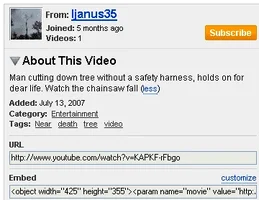
Blowing the top out of a tree!

[ QUOTE ]
How bout; cut the open face notch, bore cut to set up the hinge, leave a 'strap' to cut with your handsaw, put the chainsaw on your harness and cut the strap with your handsaw?


[/ QUOTE ]

I like that suggestion too Norm. But, most of my tops aren't that big either.
frown.gif


Nevertheless, it would be a safe habit to have when they are that big.
 
If you go over to the right a little you'll see this frame
110357-videosaving.PNG


put the mouse on the image, right click and save it.
 

Attachments

  • 110357-videosaving.webp
    110357-videosaving.webp
    15.9 KB · Views: 52
When I was more of a beginner I didn't have good timing with the whole event of "blowing out" the top. So, I wonder how new these guys are we see on the internet too.--To give them the benefit of the doubt that some day they will learn from their mistakes.
smirk.gif
 
I like the 3' lanyard as well. Also I clip the lanyard on the D-rings my climbing rope is in. That way the weight of the saw is supported by my climbing line, not hanging from the side of my saddle pulling it all out of whack, I hate having a saw hanging from the side of my saddle! I've never been hit by the saw swinging on the lanyard but the saw has been slammed around a bit. The MS200T take the abuse well.
 
Years ago I worked with a climber who spiked a little more than half way up a 12" or so diameter Walnut. It was prety tall despite being skinny and also had a slight lean to it. He ties in and cuts a notch in the direction of the lean and makes his back cut. The notch closes but the hinge holds and the momentum of the moving top bends the tree over. The hinge finally breaks when the stalk couldn't bend anymore and the stalk whips back really hard. He wasn't ready of course and man did he take a beating. Broken nose, facial lacerations, black eye.
 
And that there is a perfect example of the catapult effect and why you DON'T back off cutting at the last moment.
 
[ QUOTE ]
Can I download videos to watch later?

No, currently you can't download our videos to your computer. YouTube's video player is designed to be used within your browser as an Internet experience. As an alternative to downloading, you can temporarily save videos to watch later by adding them to your QuickList. If you'd like to save them more permanently, login and click "Save to Favorites" under the videos you'd like to keep.


[/ QUOTE ]

No can do Mahk.

I agree MB, use an under cut and get the tops off quick to reduce the bending moment.
 
that was the hinge holding, then starting to split upwards a little due to a knot that I did not see. It was a very wide gob as the head had to be swung sideways as well as back below me. If I had cut any further out it would not have had the weight to pull it all the way accross. I did have some concerns about the stem splitting, so secured myself accordingly.
 
The groundsmen is key. If he handles the ropes well then there is very little jerking. I've used an open-faced notch as well. Whenever I can bore cut I do. As mentioned above it takes the chainsaw out of the picture and allows you to prepare. I'll mismatch cut the strap, put the handsaw away then push or have the groundie pull. No ragdoll!
 
Jamin,

i agree with everything except these words, <font color="red">turn off the saw, hit the brake, and" </font>

I'm glad you said this, cause I've been meaning to discuss this for a long time.

Everyone seems to think that the chain brake ON is ALWAYS the safest thing, no matter if the saw is running or not.

But think about it. If the saw is not running.... do you think it's safer with the chain brake on or off?

I say, if it's NOT running, it's much safer with that brake OFF.

With the brake on, that chain is held tight in it's position. If a tooth catches on something, it is more likely to cut.

I had a non-running 020 take a little cut out of me when fighting threw some thick branches once, I used to always put the brake on.

and about 4 years ago, I went running down a laying Tulip Poplar log with a non running 046. I slipped on a spot that was missing some bark. The saw had it's chain brake on. I slipped so hard, that I basically did a flip. One tooth on the non-running, but brake activated chain took a little chunk out of my shin.

Given the choice of two terrible options, what would you rather me do to you:
1. take a NON-running chainsaw, put the brake ON and drag it across your neck?
or
2. take that non-running chainsaw, release the brake so the chain can slip around the bar, and then drag that across your neck?

I don't think a brake is always the safest.

also, when trimming trees, your trees will appreciate it too if that brake is off.
 
[ QUOTE ]
Jamin,

i agree with everything except these words, <font color="red">turn off the saw, hit the brake, and" </font>

But think about it. If the saw is not running.... do you think it's safer with the chain brake on or off?

I don't think a brake is always the safest.


[/ QUOTE ]

I see your point with the chain brake not allowing the chain to move then the saw is off. It could be a cutting hazard.

My purpose of the brake being engaged is not for the stowage of the saw, but for when I re-start the saw.

When the brake is on and I re-start the saw, I don't have the added risk of a throttled saw. Especially, if I have my MS460 (with a 28" bar)in the tree with me.
smirk.gif
 
It makes sense to allow the chain to rotate when the saw is not running. What needs to be done is developing the habit of engaging the brake before starting again. Once that habitat is established then and only then will it be safer overall.
 
[ QUOTE ]
Having an experienced roper can 'make ya or break ya'.

[/ QUOTE ]

No doubt!

About two months ago the boys and I were doing some medium sized (in calgary, canada that means roughly 16" diameter, 60') northwestern pop's in a backyard. Two trees were coming out, and we pretty much had to lower every piece as it was an awful tight spot. I was had just blown the top out of the last tree, which was roughly 60' plus, with the more experienced groundman running the ropes. This tree had a good lean to it, probably 60 to 70 degrees, so the top sent me for a ride...but that wasn't the worst of it. Couldn't really let anything with brush run because there were lines directly below. So now im starting to spar pole rig the rest of the wood down...im sitting about 50' up, and the experienced groundman is hauling some of the brush away so i holler at the closest guy around. Don't get me wrong, hes a great worker but he takes an odd sort of pride in being able to hold the the piece rather than letting it run, aka SHOCKLOAD. I cut my notch, tie the piece off and tell him to let it run. He seems to think that the 12" 3' long piece of poplar requires 3 wraps...and the lean of the tree means that i cant see how many wraps hes got. i cut, the piece drops and then stops. i swear the spar dropped at least five feet. the worst part was that because he had put too many wraps on the piece, I had to fight with the rope to pull the piece down, yankin on the loaded end to help lower it. i was none too happy. he said he thought i was going down for sure, i said next time LET IT RUN!

the moral: groundmen and climbers need to effectively communicate during rigging procedures, AND groundmen need to understand the forces and correct rigging procedures in order to make sure no one almost craps their pants!
 

New threads New posts

Kask Stihl NORTHEASTERN Arborists Wesspur TreeStuff.com Teufelberger Westminster X-Rigging Teufelberger
Back
Top Bottom