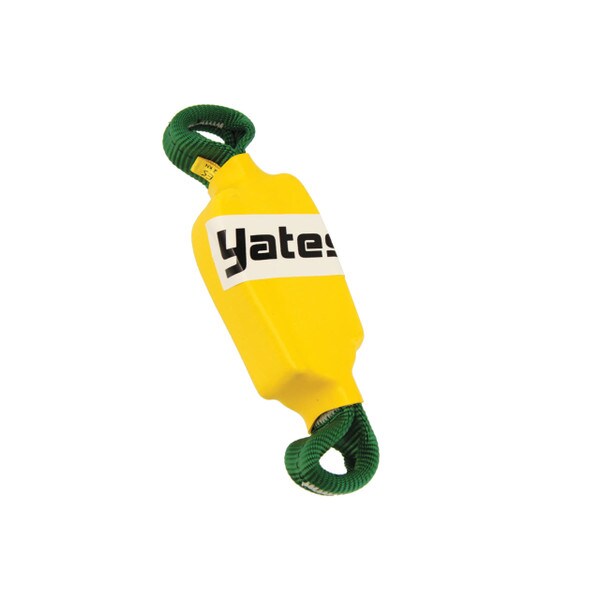
Best $25. I spent in a long time.

Years ago when I was using a screamer I read an article on the Yates site about the Screamers they made to anchor rocket motors in their mounts.The dynamic energy release of the screamers kept the rocket motors from tearing themselves apart if they had just plain flexible motor mounts. It was a super interesting article.
 
Sorry to hear about your injuries. I'm a bit surprised on the severity of your falls impact with over 100' of rope in the system. What rope were you using?
Had about 120' of Bifrost (Kernmaster - 1.5% elongation) as an anchor. MRS line was two lengths of only about 20' of Hyperclimb at that point. Bifrost was over the branch.
 
@Shadowscape so sorry to hear about your fall and injury. I’m glad it wasn’t more severe, but still, yikes.

Could someone give me a quick screamer 101? I’ve only heard very peripherally about what it is and why to use it.
Screamers are mainly used for teaching newbie ground people on letting neg, rigging run. They are also used as fall arrests, but are called fall arrests instead of screamers. Basically it is webbing that is stitched up in a folded pattern that strips the stitching when a large force is applied so it absorbs the force and lowers the load. This is the one I had used:
 
Thinking back on the whole thing, I can't recall any feeling perse about the fall impact. It probably was integrated with the smacking of the trunk, which had my attention at the moment. My face is happy I had my head turned to the side however.
Going to swap out my bridge to be on the safe side before the next climb. Got a very sore jaw today. Guessing my ear muff got smashed into it.
 
Man, just this week I had a first experience of a similar nature, wherein the branch I was going out on, positioning lanyard hooked on, getting ready to make a cut, and I let out a little more length on my main climb line putting too much weight on the branch and having it totally break off. It was 4-5" at the base, Sycamore, and totally healthy and solid. It must have weighed a little under 200 lbs. and stayed hung up on my lanyard. I didn't have time to feel scared; it just kinda happened and was over. I was glad I hadn't tied in the one fork higher; I don't think it would have held all that force. Scary stuff man, I'm glad you're in good enough shape to tell us about it.
I had a similar experience in sycamore. The tree is historically topped for overhead power lines. The angle of my climb line was pretty flat climbing out to clear limbs over a house. I lanyarded into a smaller branch above me for stability, changed the angle and put to much weight on it and it broke. I fell about six feet before the main line stopped me. It happened quick, like you said. I was uninjured except for a big rope burn on my hand.
 
I'm glad you didn't get hurt worse, and I hope you have a quick recovery.

A quick question, if you fell 5-7 feet, how much of that was the screamer? If deployed it is 6' (just a guess, i haven't found a deployed lemgth stat) and you fell 7' total, I'd be inclined to think a 1' fall without the screamer might have been safer and less impact.

Sent from my SM-S908U1 using Tapatalk
 
I'm glad you didn't get hurt worse, and I hope you have a quick recovery.

A quick question, if you fell 5-7 feet, how much of that was the screamer? If deployed it is 6' (just a guess, i haven't found a deployed lemgth stat) and you fell 7' total, I'd be inclined to think a 1' fall without the screamer might have been safer and less impact.

Sent from my SM-S908U1 using Tapatalk
If it popped, it saw at least 500# of force. Very static ropes can be a wicked mistress- great for ascent, but as always, don't fall. I would rather get a soft catch and fall a few extra feet in most cases.
 
Ultra static ropes suck for tree work! Climbers are far too easily seduced by their ability to reduce bounce, gladly forfeiting the safety a more dynamic rope will have on the flip side.
 
I'm glad you didn't get hurt worse, and I hope you have a quick recovery.

A quick question, if you fell 5-7 feet, how much of that was the screamer? If deployed it is 6' (just a guess, i haven't found a deployed lemgth stat) and you fell 7' total, I'd be inclined to think a 1' fall without the screamer might have been safer and less impact.

Sent from my SM-S908U1 using Tapatalk
The screamer I had opened all the way. It isn't all that long when fully deployed. Maybe 2 foot at most, and probably not quite that long. Low 20 inch range, so my actual fall was in the 6 foot range before the screamer would have been impacted and started to strip open.
I wouldn't have wanted to experience that kind of impact. You are probably talking somewhere above 1,000 lbs of impact force in a six foot drop for someone my size (w/gear on-160 lbs). @Muggs probably knows as he has done some testing along those lines in the past.
 
Last edited:
If it popped, it saw at least 500# of force. Very static ropes can be a wicked mistress- great for ascent, but as always, don't fall. I would rather get a soft catch and fall a few extra feet in most cases.
I get your concern with that, but 500 lbs really isn't that much. Sounds like a lot, but an easily attainable number when calculating force. A 200lb climber & gear falling 2 feet creates almost 600lbs of force.

If you happen to be a climber who does quick moves aloft or bombs out on descent, you probably create more than 500lbs of force more often than you realize.

Sent from my SM-S908U1 using Tapatalk
 
I get your concern with that, but 500 lbs really isn't that much. Sounds like a lot, but an easily attainable number when calculating force. A 200lb climber & gear falling 2 feet creates almost 600lbs of force.

If you happen to be a climber who does quick moves aloft or bombs out on descent, you probably create more than 500lbs of force more often than you realize.

Sent from my SM-S908U1 using Tapatalk
Also remember, my screamer was on the base anchor. Quite a lot less force to the system down there as it has to travel over the limb the rope finally caught on. My guess, and only a guess is it was around half the force at my end.
I also have fallen around a foot a few times in the past. That in itself is absolutely no fun to experience. Sort of like going to sit down in a chair and someone pulls it out from under you without you knowing. Hurts.
When you bomb out of a tree you decelerate over a time frame. The force is there but spread out. Like a rock climber falling on a dynamic rope. Same force, but absorbed over a time span. If you bombed out of a tree and came to a sudden stop, you would probably die from a torn aortic arch when your heart slammed to the bottom of your chest cavity.
 
Last edited:
I propose a little physics CSI. You should read the HSE report section on -ve rigging where the peak force generated catching a spar section is when the rope goes tight and converts the fall motion into arc motion - towards the trunk. Then a large portion of the fall energy ( normally all used in the rock climber calculation of fall factor stop force) is converted into horizontal velocity - slamming to a stop into the trunk. Sort of like your body slam experience.

A little damping and stretch goes a long way to reducing the force spike. I think I had x1.5 or x2 spike reduction just by setting my rig block timber hitch so it could skid/set in for each data run. Running DRT on your up rope side doubles the rope stiffness there. The tension ratio over the tip crotch is 1.5 to 2.5 roughly depending on the bark and crotch V so the down/anchor rope has reduced tension but the rope stretch during the force spike also uses the tip crotch as a small damper to help. A keener could calculate how much but I've never done so. Might be a surprising effect like the rig tip slippage was.

Hope you're feeling better soon.
 
I propose a little physics CSI. You should read the HSE report section on -ve rigging where the peak force generated catching a spar section is when the rope goes tight and converts the fall motion into arc motion - towards the trunk. Then a large portion of the fall energy ( normally all used in the rock climber calculation of fall factor stop force) is converted into horizontal velocity - slamming to a stop into the trunk. Sort of like your body slam experience.

A little damping and stretch goes a long way to reducing the force spike. I think I had x1.5 or x2 spike reduction just by setting my rig block timber hitch so it could skid/set in for each data run. Running DRT on your up rope side doubles the rope stiffness there. The tension ratio over the tip crotch is 1.5 to 2.5 roughly depending on the bark and crotch V so the down/anchor rope has reduced tension but the rope stretch during the force spike also uses the tip crotch as a small damper to help. A keener could calculate how much but I've never done so. Might be a surprising effect like the rig tip slippage was.

Hope you're feeling better soon.
Thanks all! Might be able to get horizontal tonight with some effort. I can sit, but getting all the way flat seems to be an obstacle. But I will heal. Thanks again everyone.

 
Thanks for sharing this @Shadowscape, after reading about it I had a nice chat with my beginning climber about the issue as I was setting my own climb line in a big fir from the ground. I hope your recovery goes well, and certainly appreciate the discussion it is generating.
 
Thanks for sharing this @Shadowscape, after reading about it I had a nice chat with my beginning climber about the issue as I was setting my own climb line in a big fir from the ground. I hope your recovery goes well, and certainly appreciate the discussion it is generating.
Thank you, kind sir. Hopefully it may help someone else down the line. I don't know how I could have avoided what happened, other than not have climbed that tree. Thinking I should have brought my drone with me, and maybe I could have gotten a better view as to what the situation up there was before I began my ascent. Water under the bridge for this one though.
 
Last edited:
Further pondering. Say average bark, tension ratio 2. If the down leg saw 500 lbs, at a ratio of 2 your side of the rope would have seen 1000 lbs to make the 500 lbs. If 1.5 it would have taken 750 lbs on your side of the rope. Corollary effect of skidding the rope over the branch/tip is that the force vs tear characteristic of the basal screamer shows up as higher force profile on your side of the rope. Perhaps the tech lesson from this is to get a bigger softer longer stop screamer into the basal position. Shadowscape, you may have just caused an industry innovation. :)


edit - in theory you could stretch the stop distance and keep the force low (vs "bottoming out" the screamer at the end of its travel) by using a few in series. Yates ok's series or parallel use. I found no data yet on how much "stop" before a single screamer is used up, just claims of force reductions. Will keep looking.
 
Last edited:

New threads New posts

Kask Stihl NORTHEASTERN Arborists Wesspur TreeStuff.com Teufelberger Westminster X-Rigging Teufelberger
Back
Top Bottom