Bend ratio lower than one on bull rope with a static load - thimble required ?

Good evening!

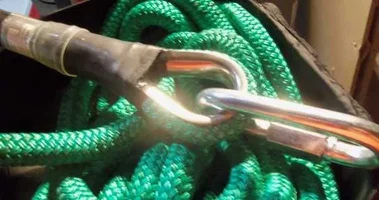
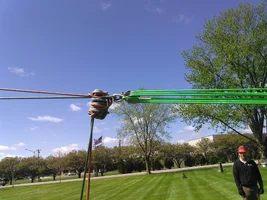
I want to fell some trees by pulling them down with my 5/8" (16mm) polyester bull rope (14000 lb / 6300kg). Since my rope is not spliced, I'm gonna use a figure nine knot or butterfly knot to attach it with a steel biner to the wire core of my wire core pulling system. The wire core puller stops pulling (security mechanism) at 1600kg which equals about 1/4 of my rope strength.

Now I'm worried that eventhough
  • my loads will be fairly static and
  • usually only about 1/6 of the polyester rope strength,
  • the bend ratio of about 0.6 (rope 16mm vs biner 10mm?)
  • on always the same knot at the rope end
might significantly decrease its life span (I might need it for about 100-200 pulls).

Questions:
  1. Are my concerns justified?
  2. Would a Steel thimble help or are there better alternatives?
Thank you very much!
miniwald

Relevant answers for increasing bend ratio from this thread (inserted on Jan. 30th 2020)
  • use more than one biner in parallel
  • use big bow shackles - 10-30$ for 1" to 1 1/2"
  • know about "tensionless hitches" for attaching ropes to e.g. trees
  • use a portawrap for attaching the rope ends
  • use a bowline on a bight or even triple bowline to share load, if you are worried that the bend ratio is the weakest link (doubtful)
  • when using a safety factor as you should, the bend ratio might not matter that much
  • some good reading can be found in this free rope rescue book (replace number for parts 2 and 3)
 
Last edited:
I’m not familiar with the figure 9 knot... are gonna be able to untie it after loading like that?
 
You can find stainless steel thimbles for most rope diameters on eBay and Amazon... they will greatly improve the lifespan of the rope.

YalePolydyne.jpg

This is 3/4" Yale Polydyne, and I spliced the thimble in, but this can be done with knots, too.

Using a 7 coil hangman's noose knot will work best, and the knot has a very high retention of strength... it's a great termination knot, but is unpopular because it cannot be untied after being heavily loaded. On a long rope, cutting it off isn't really a problem.

I use a big, 5/8" QuickLink (SS) and a webbing sling for pulling... that really helps with saving wear and tear on the rope. The sling can be covered with chafe sleeve, and let it handle the abrasion from the tree bark. The rope will last much longer.

An alpine butterfly knot is the same way... if you pull trees with it, you're not going to get it untied. Splicing doublebraid rigging ropes is not particularly difficult, and would be worth learning to do. These ropes are much looser braid than climbing lines, and easier to splice.
 
Can always use lifting bow shackles. I keep two in my rigging gear for redirects and connections. Has much larger radius than a carabiner, and smooth finish for ropes to tie to.

Any knot you are pulling heavy with, you can slip in a makeshift fid into the centre of the knot (I use an approx 1” smooth dead branch/twig, or a pointed 1” short dowel (but that always gets lost). Even after pulling with tonnes of load, you can slip out the smooth fid, and provide room in the knot to loosen the knot.

I tend to use bowline on the bight as go to knot for winching, but if I know it’s gonna be heavy, or pulling against obstacles, I use the fid as it saves hours of time trying to undo knots, and saves damage by makeshift tools attempting to loosen the turns of an over-tightened knot...
 
So I use a bowline

Bowline on or with a bight

Rigging prussic with a butterfly stopper (built in overload indicator)

Or a big ass bow shackle.

For smaller loads and running rope I will sometimes use a pair of HMS biners opposite and apposed
 
Thank you all very much for your helpful replies. I learned a lot.

@Jonny
Thanks! The thought of using two biners didn't even cross my mind, eventhough it is such a simple solution which I'll keep in mind.

Since I don't own two identical steel biners or a portawrap, I'm gonna buy me some big bow shackles.
I looked at them before, but our local hardware store had only small ones. After reading your replies I found some online, with a bolt diameter of almost two times the rope thickness (10$/€ for 28mm or 30$/€ for 35mm). They will have enough space on the bolt to accomodate both rope ends, thus saving on biners.

@JeffGu
I found out that I would probably need a closed throat thimble (so that the thimble isn't forced into the rope by a tightening knot).

@JeffGu , @Chaplain242
Thanks for pointing out the difficulties of untying the knots. Since I don't have any experience with my rope and heavy loads yet, I might have dodged a bullet there. My experience with climbing rope and wire core didn't prepare me for that.

@evo
I'll keep the prusik in mind, since it will allow me to shorten the rope as needed (keeping in mind the stopper knot in case it slips).

I wonder if I could also use a rope sleeve (conduct / Dan House style) with heavy loads, because it can be installed from the ground. Should the metal conduct get damaged, it might cut into the rope though ...
 
Can always use lifting bow shackles. I keep two in my rigging gear for redirects and connections. Has much larger radius than a carabiner, and smooth finish for ropes to tie to.

Any knot you are pulling heavy with, you can slip in a makeshift fid into the centre of the knot (I use an approx 1” smooth dead branch/twig, or a pointed 1” short dowel (but that always gets lost). Even after pulling with tonnes of load, you can slip out the smooth fid, and provide room in the knot to loosen the knot.

I tend to use bowline on the bight as go to knot for winching, but if I know it’s gonna be heavy, or pulling against obstacles, I use the fid as it saves hours of time trying to undo knots, and saves damage by makeshift tools attempting to loosen the turns of an over-tightened knot...
You can break the branch out of the knot, allowing you to be less particular about the branch.
 
Questions:
  1. Are my concerns justified?
  2. Would a Steel thimble help or are there better alternatives?
No, your concerns are not much to worry about. First of all, you will probably not be maxing out the pull on every cut, so unless you are dealing with heavy backleaners or poor cuts, there will be a lot less than 1,600 lbs on each cut.

Secondly, as long as the knot is static, the bend ratio is not that much of a concern. Though I would probably go with a doubled bowline for even less bend ratio. This leaves you three loops to hook with the biner, and you can double up the "hole" for more strength. Bend ratio is more of a concern when the rope is getting pulled over a small diameter anchor. If you are concerned with stressing one small area of the rope repeatedly, just retie the knot from time to time. Setting a high pull line will also make a big difference.
 
@miniwald

Are you using a Tirfor/ Griphoist?


Sounds like your safety-mechanism (shear pin?) activates around 25% MBS, which is well beyond the 10:1 SWL of most textiles. You want to knot the rope, thereby greatly reducing your capacity. Wind could happen during pulling, bouncing your tree on your system.

If you want to preserve your rope and rope-strength, can you hook the end of your puller's cable (presuming there is an eye) onto an appropriately-sized Portawrap with appropriate hardware?

A portawrap tie-off is effectively a tensionless anchor. This tensionless anchor can be used on the tree as well.
The strength loss is based on a very gentle bend radius, presumably with the POW radius as your smaller diameter.


Sounds like your safety-mechanism (shear pin?) activates around 25% MBS, which is well beyond the 10:1 SWL of most textiles. You want to knot the rope, thereby greatly reducing your capacity. Wind could happen during pulling, bouncing your tree on your system.
 
Last edited:
Thank you both for your advice.

I'll be setting a high pull line. I'm actually switching from steel wire to bull rope, because the lighter rope will be easier to place above crotches in the tree (the cable clams got stuck to often).

And yes, I'm using a griphoist with a shear pin. My loads will usually be a lot lighter than mentioned, but considering your advice on safety ratios, I might be using a pulley on the wire rope (using a bight to get 3200kg instead of 1600kg) before I'll attach it to the bull rope using large bow shackles.

Thank you also for telling me about tensionless anchors, which I didn't know at all.

Since I won't be lowering branches from the trees (there will usually be space to just drop them), I wasn't thinking of investing in a portawrap. Also when using a bight of my bullrope for pulling, I don't see a way of attaching both ends to a portawrap. Two knots will fit quite well on a large bow shackle and the griphoist will anyway be weaker than the doubled 5/8" bull rope at half strength (knots). <- This is me asking for a nice enough reason, to justify buying some new gadget, considering I'm not experienced enough for doing actual rigging.

I will read up on rigging techniques though, since it seems very interesting.
 
Don’t over think it. Use a Prussic as evo mentioned. You will have two points of overload protection, adjustability for set up and flexibility, if you use an anchor such as a Port a wrap to reset your mechanical advantage, when and if you two block.

Tony
 
Overhand to fig.8 and likewise to fig.9 even another turn to fig.10 increased strength return growing more minimal as go tho. To me, Overhand wrenches more from column type support, fig.8 etc. longer, softer arcs to same end AND some force pass thru passing/traded frictions and therefore less thru deformed pipe to same cumulative sum.
Very Nice old, lost, freebie: LIfe on a Line
.
Don't dictate, observe;
check rope for chafing after a few pulls and later too.
i'm pretty much a DBY termination believer , end brightly taped down to Standing Part (SPart) for something like this long term usage of pulls. Tape secures, brightens(contrasting colors to rope and different on each end if DBY both), and would flag if any creep. i think really tape well as a stabilizing back end / tail end ballast fighting deformation thru the whole knot carriage like the siezing rather than Half Hitches(HH) seen in some ABoK knots that doesn't allow freebird end or HH to ram/deform rear of knot carriage.
.
Taking further :
Turns around cylinder, then securing w/o bending in/out of SParts cylinder probably strongest. Would do be sieze off of SParts or with non slip friction hitches that secure to SPart w/o bending it. On small host mounts ABoK offers several turns to spread out chafe wear, but then reduces force to hold of friction hitch etc. Really, security is king, and don't want it to give before strength. Could go with Triple Scaffold and slip off open end of connector or even leave alone until cut that last foot off after 200 pulls, if not slipped or can't slip off mount. In any case, might consider that last foot compromised compared to rest of rope after all that, thus the weakest link re-defining rope's total strength. Rope, like fan belt is meant to be less durable than rigids etc.
.
Disposition:Are you pulling backleaners, or more neutrals or even already leans to target? Pulling against side lean?
.
To me, vertical or forward lean rope pull x length to hinge pivot gives added pressure on hinge for something that is neutral or already leaning partially towards target.
So 3000#pull X 70'hitch point = 210,000 foot pounds added to hinge pull tensions(and reciprocally the compressed part of hinge as real pivot). Can see neutral as half of weight wants to come home, half is holding it back, so only fighting half of load. Try to psyche self similarily for large round cylinder needing rolled, ground contact is pivot, half of weight is already pulling to target, focus on other half pulling away..
.
That is playing with a lot of force, that tests a lot of things in chain. Ample availability of power band is one thing, actual application more scary; actual usage perhaps more judicious.
.
i would use this to force a stronger hinge, make it think had more leveraged load than had at start, so folds earlier w/thicker, stronger hinge. This would be for steering and softer hit. Also i think if trying to soften ground concussion (besides adding padding) felling to side of lean purposefully not to the hardest pull of lean. Also allowing hinge to work, instead of slicing most thru, find it's powerband, and once it is committed to facing, walk away.
.
Backlean different class to me, mostly draw CoG uphill to peak/standing just over pivot, to then more fall downhill target side. Takes thinner hinge to flex that range i think, so less control. More apt for later adjustment of Dutchman on splashdown side mite be needed adjustment to side load or push away from obstruction; as Tapered Hinge harder to use so thinned to allow more rotation from backlean.
.
Any sidelean for neutral or forward favor Tapered Hinge as offside ballast against sidelean, Tapered Hinge stays with tree embedded in system until tear off, much longer than rope pull. Favor pull to target, let added pulls force extra thick/powerfull Tapered Hinge; and let that fight side battle, more than pull direction input in most cases.
.
On tree side i like over the top lacing down backspine of tree tying off above cut, knot on back so won't be buried under tree, release and pull out of opposite end going EASY with truck. i think over the top can give higher, more confident leverage, and if any arc to tree top from pull is softer, more Natural, less sharp than if Running Bowline to top spar for more linear , less arc pull; it feels better to me if inducing arc input of over the top to get arc output of tree, rather than linear rope pull for arc tree?
 
if you don't have a good system for setting lines, get one. That will give you a lot of bang for your buck. 2 or three 180' 1.75 mm zing it lines with 10-12 oz throw bags on each end and make your life easier and get a throw cube or two. Then if you are not an expert at throwing by hand, get a slingshot or APTA air gun to set the lines. High lines should get you the leverage needed to pull these trees over without overloading your lines much. That makes most of the discussion on what kind of knot to use somewhat irrelevant, though IMO we should always strive to throw everything to our advantage.

ps.. using a prussic for capture is a nice trick to have in the bag, but rarely needed, depending on your pulling equipment. If you're pulling by hand with a MA set up, it's nice. I haven't done that in years. You shouldn't need it with a wire rope puller.
 
Last edited:
Just keep wrapping the porty this is two 3/4" lines. The bollard had four wraps each nice and neat on the inside and the rest was just extra. Untied ever so sweet after the mega pull 7:1 with the mini. View attachment 64961
What the hell are you pulling that takes two 3/4" lines and a 7:1 with a mini?
I hadn't thought about how nice the portawrap is for sharing load between multiple pull lines. I like it.
 
Big back leaning silver maple 40" DBH no good central lead so I rigged two spars either side of the tree. The tree was over a three fences, two sheds, two gardens, and a yard that looked like Disney Land with targets everywhere. And on the other side was a nice open field. The tree had 40 yards of chips and five 18' trailers of wood. Poor thing had no choice but to go my way. LOL
 
On a spread Y looping both legs is good strong balanced pull
>>unless one fails
>>always check for co-dom etc. on this move i think...
 

New threads New posts

Back
Top Bottom