Merle Nelson
Been here much more than a while
- Location
- SF Bay Area, CA
Anyone doing similar work on a taller hedge or a bunch of 1 to 1.5 inch pruning cuts the Milwaukee M18 extendable pole pruner is pretty incredible.

Follow along with the video below to see how to install our site as a web app on your home screen.
Note: This feature may not be available in some browsers.

Fawk…. What kind of space do they have? Are you planning on turning them into a formal hedge? If so start em off young and let them grow into size.I am following this closely, as I wanna have a lot of this in memory when the time comes. I planted a row of leyland cypress- I know, I know- and they are 4'-7' tall, and I will soon start a thread seeking to understand different folks approach to starting them down a good path.

They are 10' on center, and I definitely am planning a formal hedge, which is not something I have ever done. As a tree, I know what to do for sure, but for now I have only trimmed back a few little tips from the lower branches that are growing into what will be the "front" and "back" of the hedge. I need a solid privacy hedge on that fenceline, and they are about 6' from it. my long term plan is to plant rosemary right up against the fenceline, so that as the hedge gets too wide, I can get rid of the lower branches up to about 6' high, and have the rosemary to keep the greenery thick down low since the hedge will have to recover from the opposite side back into itself. My thinking thusfar has been to only make tiny strategic cuts to start creating the boxy sides, and letting them go hard towards eachother to fill in. they have fairly tight branching in the lower 2'-3', so I thought maybe I should thin them a tiny bit at a time. I removed the bottom 2" of branching last year, as well as any codoms.Fawk…. What kind of space do they have? Are you planning on turning them into a formal hedge? If so start em off young and let them grow into size.
Make sure the bottom is wider than the top.
If they have space to be trees, make sure to maintain a single lead, every once in a while I’ll spot a leyland and say ‘that’s a damn fine tree’ but those are open grown single stemmed with plenty of space.

If you are planning ahead, you probably shouldn't need this thread...right? Start shearing at an appropriate size and keep it from getting out of hand, so you don't need to cut it back hard. I'm looking at a hedge that was let go and got bigger than they are willing to keep it. Right? (I'm not claiming hedge expertise. I've never planned ahead that far so maybe not)They are 10' on center, and I definitely am planning a formal hedge, which is not something I have ever done. As a tree, I know what to do for sure, but for now I have only trimmed back a few little tips from the lower branches that are growing into what will be the "front" and "back" of the hedge. I need a solid privacy hedge on that fenceline, and they are about 6' from it. my long term plan is to plant rosemary right up against the fenceline, so that as the hedge gets too wide, I can get rid of the lower branches up to about 6' high, and have the rosemary to keep the greenery thick down low since the hedge will have to recover from the opposite side back into itself. My thinking thusfar has been to only make tiny strategic cuts to start creating the boxy sides, and letting them go hard towards eachother to fill in. they have fairly tight branching in the lower 2'-3', so I thpught maybe I should thin them a tiny bit at a time. I removed the botton 2" of branching last year, as well as any codoms.

Yeah not saying they aren't filling in. Just that clients expectations can often be for continually solid green hedge, and it's possible to with enough thinningThere is some decent green starting on the inside. I'd probably rather keep poking away for anoth
Funny thing here is it was my expectation and plan was to keep it green. He wanted it hacked 3 years ago.Yeah not saying they aren't filling in. Just that clients expectations can often be for continually solid green hedge, and it's possible to with enough thinning
how long? How tall is the goal? How wide?They are 10' on center, and I definitely am planning a formal hedge, which is not something I have ever done. As a tree, I know what to do for sure, but for now I have only trimmed back a few little tips from the lower branches that are growing into what will be the "front" and "back" of the hedge. I need a solid privacy hedge on that fenceline, and they are about 6' from it. my long term plan is to plant rosemary right up against the fenceline, so that as the hedge gets too wide, I can get rid of the lower branches up to about 6' high, and have the rosemary to keep the greenery thick down low since the hedge will have to recover from the opposite side back into itself. My thinking thusfar has been to only make tiny strategic cuts to start creating the boxy sides, and letting them go hard towards eachother to fill in. they have fairly tight branching in the lower 2'-3', so I thpught maybe I should thin them a tiny bit at a time. I removed the botton 2" of branching last year, as well as any codoms.

I think then that I will start topping the tallest ones soon, as I would like to keep them ladder accessible for as long as possible. I guess I may need to fill in to 5' on center sooner than later to keep it looking uniform. I am trying to start them fairly thin to give myself time to get the lower growing rosemary hedge established on the other side. I have been making tiny snips in the newest growth only, so I may start with a thicker cuts this spring. I just did a round in Dec, but they recover almost instantly. Thanks!how long? How tall is the goal? How wide?
Denser spacing will make for much easier maintenance! More so if they are to be of any height over a comfortable orchard ladder size. Think walking the tops, srt. I’ll climb the one end the end choke my climbing line and stand on the tops, step over to the next stem and repeat.. when needed take a bight of rope and tie to a mid tree as needed.
This also works great for getting the upper sides.
Say you want a 15’ t by 8’ w start reducing the top with small pencil sized cuts at 10-12’ tall. Work the sides a lot sooner which may even mean bending and tying the limbs together with small pencil sized heading cuts. The shears come later as it becomes more established.
In time cleaning out the interior of dead is also important as the thin outter edge starts forming. This allows for some light penetration and a healthier exterior ’shell’ to dry out avoiding blights and needle cankers.
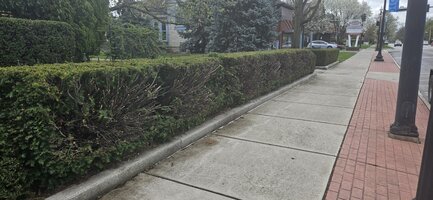
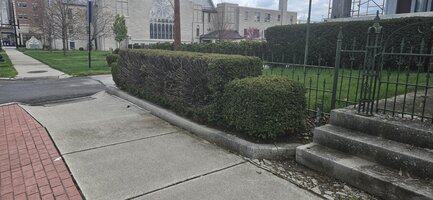
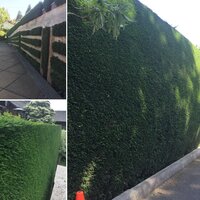
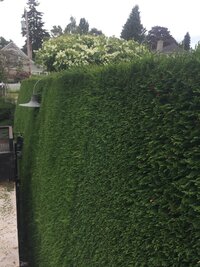
The photos of the handrail and one with the lamp post shows poor planning and trying to allow the hedge to grow to the maximum size before starting the form. Years later it still has to grow so it’s really challenging to work as it’s swallowed so much.
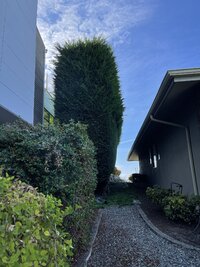
The tall one was better trained and only accessible by climbing. The top wasn’t worked soon enough or it was brought down. So the top gets holes and there are 3-4” topping cuts. This actually makes it pretty ok to climb and gives plenty of diameter to ‘walk’
View attachment 97188
View attachment 97190View attachment 97192
I know that I will get it eventually, but I was just hoping for a few pointers. They've never hurt before. I have never seen how one starts, or how far people let them go before starting. My goal is not have to "fix" them later.If you are planning ahead, you probably shouldn't need this thread...right? Start shearing at an appropriate size and keep it from getting out of hand, so you don't need to cut it back hard. I'm looking at a hedge that was let go and got bigger than they are willing to keep it. Right? (I'm not claiming hedge expertise. I've never planned ahead that far so maybe not)