Beech drying / checking

GregManning

Super Moderator
Staff member
Location
Chardon, OH
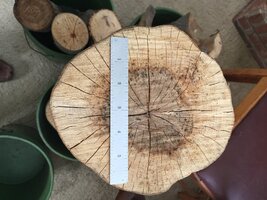
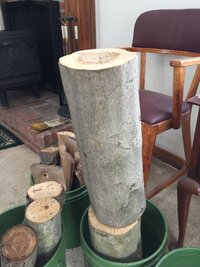
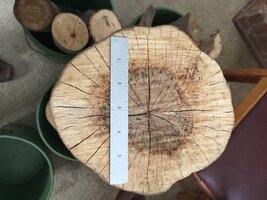
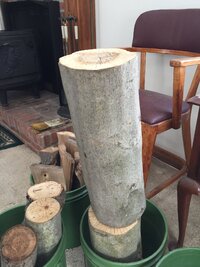
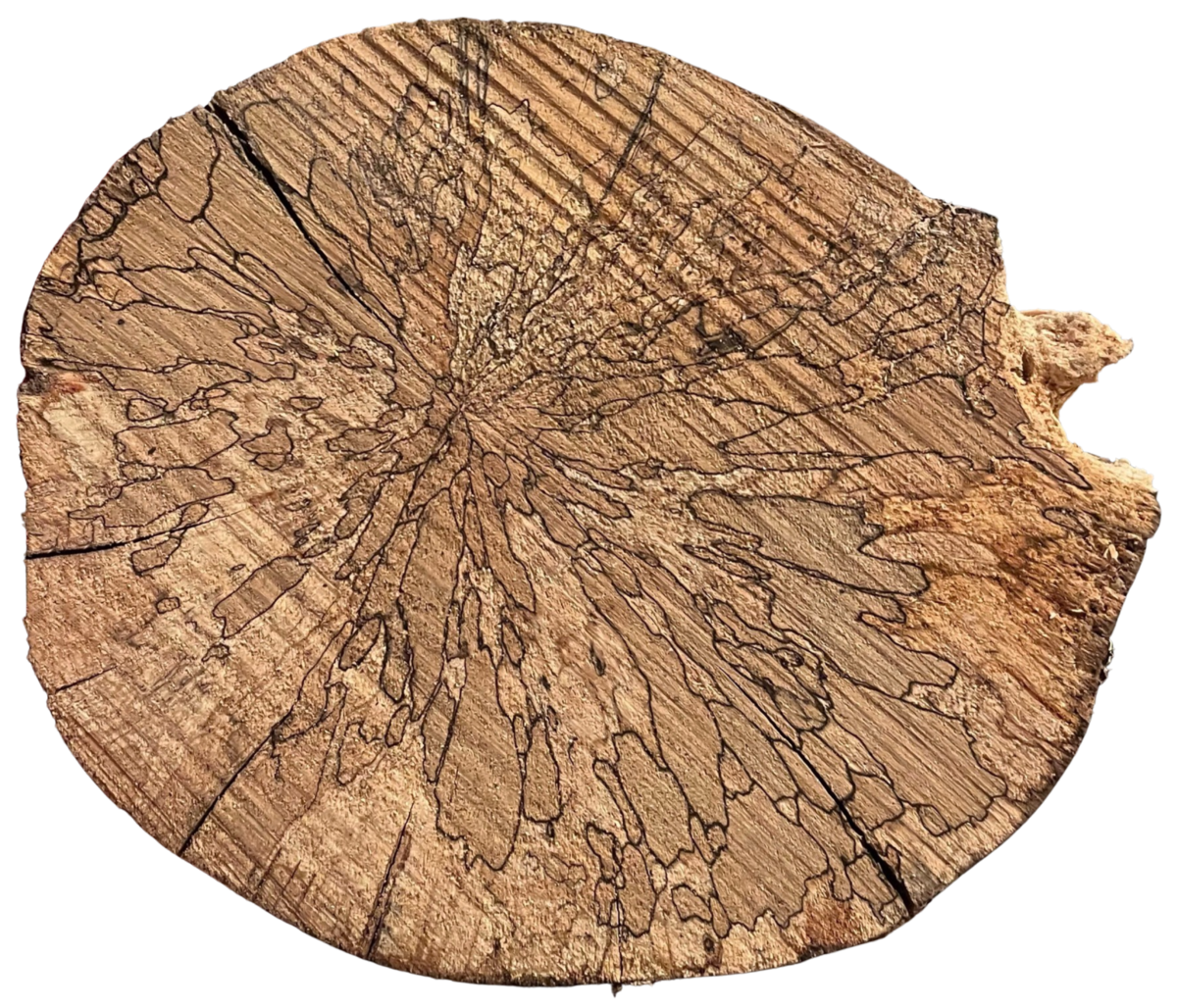
This is a 6” OD X 18” L Beech limb, cut live & bucked 6 months ago. Moderate Beech Leaf Disease.
Cured outside w/ only w/ a top cover on woodpile (no side covers); in NE Ohio. (Sept - Mar)
I am struck by how uniform, and radial the dry checking is. I think it is quite attractive.

I dried for firewood; but other uses ?
Comments ?
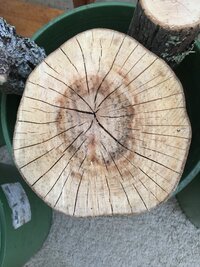
230315 Beech Checking -IMG_1031.JPG
 
Last edited:

Seems like too much checking/cracking to make a bowl from this piece ? ? ? No ?
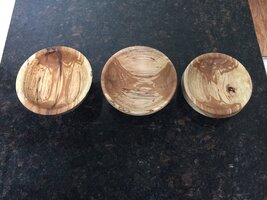
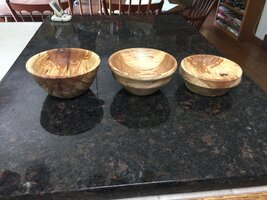
Usually the checking only goes in a short distance from the end at this stage in the drying. Also, I have made lots of bowls with cracks, voids and other flaws in them and as long as you aren't dead set on using them for cereal bowls or holding liquid, they are great to look at or for other things like displaying rocks, holding change or keys, nuts and other dry stuff.
 
Usually the checking only goes in a short distance from the end at this stage in the drying. Also, I have made lots of bowls with cracks, voids and other flaws in them and as long as you aren't dead set on using them for cereal bowls or holding liquid, they are great to look at or for other things like displaying rocks, holding change or keys, nuts and other dry stuff.
I have some larger diameters on the porch; I'll have to check them. What do you charge ? per hour, etc ?
 
I’ve mentioned this in an other thread, but will be so bold as to reiterate - reducing checking or cracking of the ends of valuable logs is, in my experience, most effectively done by coating the end with liquid (melted) paraffin wax immediately after they’ve been bucked.

Paraffin is very impervious to water vapour, somewhat flexible (to accommodate shrinkage as the log dries) and transparent (in a thin layer).

I presume that large lumber companies use a paint formulation instead of paraffin because it’s simpler to handle than rather dangerous, tricky, hot paraffin, and the paint colour may help identify batches, but having tried both approaches I’ve found the wax superior.
 
I’ve mentioned this in an other thread, but will be so bold as to reiterate - reducing checking or cracking of the ends of valuable logs is, in my experience, most effectively done by coating the end with liquid (melted) paraffin wax immediately after they’ve been bucked.

Paraffin is very impervious to water vapour, somewhat flexible (to accommodate shrinkage as the log dries) and transparent (in a thin layer).

I presume that large lumber companies use a paint formulation instead of paraffin because it’s simpler to handle than rather dangerous, tricky, hot paraffin, and the paint colour may help identify batches, but having tried both approaches I’ve found the wax superior.
I did not realize that this was going to be a "bowl-worthy" piece of firewood ! ;)
Thanks

Actually, I burned a 8" W X 3" H burl this year; I didn't know anyone that would want it. :(
 
The way I got the spalting on your bowls was to seal one end of the log and then set the unsealed other end on the dirt in my garden in a nice wet shady spot. The fungus takes it from there!
I have never looked into it, but I never suspected that it was ever done so intentionally. I would have thought it'd rot too unevenly to get reliable results. Super cool.
 
The way I got the spalting on your bowls was to seal one end of the log and then set the unsealed other end on the dirt in my garden in a nice wet shady spot. The fungus takes it from there!
Actually, I had thought that the spalting was in the wood originally.

Did you cut the blanks prior to treating in the garden soil ?
How much was in the wood prior to your treating ?
 

New threads New posts

Kask Stihl NORTHEASTERN Arborists Wesspur TreeStuff.com Teufelberger Westminster X-Rigging Teufelberger
Back
Top Bottom