Basics of Pruning and Removal for Beginners.

Know your location. Trees grow and behave differently in different climates.. I wouldn't prune a mature oak gilman style in the PNW. He is from Florida and they have a much longer growing season!


That is certainly one of the challenges of writing anything on pruning.. different climates, different species..
 
main failure is he is afraid to hurt the tree. Trees need us to be bold and make the important cuts sometimes big and bold to afford a faster and healthier crown well into full maturity.
 
you could do better Dan. you underestimated or failed to address the
importance of crown clean.

Really??? I despise the term crown cleaning... unless it refers to deadwood.... I like structural pruning on young trees per Gilman... reduction pruning on overextended (long heavy reaching) lateral and near lateral limbs. And subordination of co-doms.. here's a 750 words I wrote on pruning last time the subject came up:

tree pruning primer

no live cuts on the main stem(s), or if the client insists only smaller cuts on the main stem(s), absolutely no live cuts over 4", even if you have to leave a stub, leave most epicormic shoots (sprouts), they are especially important to leave if they are near an existing wound, and if the client insists, then rather than remove all sprouts, just thin and shape, with the long term goal of having the sprouts develop into small limbs. It's also possible to leave a few stub on an initial heavy prune with the goal of letting those stub fill up with sprouts, rather than the trunk. Then 1-3 years later, the tree will have normalized its growth, the stubs that are loaded with sprouts can be removed with a clean target cut (or close to a target cut), without worrying about the tree filling up with new sprouts (this is especially helpful on ornamental fruit trees that require sever reduction in size). That is the best way to prevent an ornamental tree from filling up with sprouts after a hard prune.

and reduce mature hardwoods by making smaller cuts at the branch tips, especially on long, heavy over -extended laterals. If the limbs are over-extended heavily, or have structural defects they can be reduced as needed, up to 90% (leaving only a stub) on any individual limb, with the goal of minimizing overall loss of leaves, so that you can hit several lateral branches very hard, if needed, but then go light on the rest of the tree. In general leave the center of the tree and the uprights alone NO "CLEANING". Unless there are structural defects, let the tree grow up, just bring in the sides. If a tree has structural defects, it may be necessary to make large reduction cuts on the uprights, but in general try to avoid it, especially on certain species. When pruning to reduce stress on structural compromised trees, take the weight from the most leveraged place possible, which are the branch tips, especially the tops. Depending on the degree of the structural issue, and the risk of damage should the tree fail, you may need to go very heavy on the reduction cuts. Knowing how sensitive the species is is important, so you don't kill the tree. There are many species that can handle the European style 20' reductions, but many can't. So only take off as much as the tree can handle. No formula, just experience and instincts..

And NO ELEVATION except as absolutely required for human needs, The goal is to keep shade on the trunk and roots. So it is especially important to leave shade on the western and southwestern sides of the tree. if there are no other trees shading the trunk and roots, its very important to keep as much shade on the root and trunk as possible, with certain species being more sensitive than others.

And NO target cuts on anything big (roughly 3" or more), unless the target is perfectly clear. Always leave a stub long enough to be absolutely certain the branch protection zone is not violated. And if you know you'll be back to prune the tree again in the next few years, you can leave a sizable stub, 6 or 8 long, or even longer. If the stub sprouts, it can be pruned to train the new growth. if not, finish the cut once the limb is visibly dead and easily distinguished from the live collar on the trunk.

When making small cuts on the branch tips, 1" and under, target pruning really makes no difference. It's just quicker and easier to make the cuts some distance away from the branch union, and leave a small stub. this will have zero effect on the tree's health.

I always think it's better to bring back the big lateral limbs and leave the uprights growing unmolested. Each lateral is treated individually, with the amount of reduction to depend on multiple factors, including how far overextended it is, how big and heavy is the limb, how is it joined to the parent stem, how is the rest of the limb structurally, how sensitive the species is to pruning, what is the potential for property damage should the limb fail, and what is the clients tolerance for risk, when is the tree likely to get pruned again, and last but not least, how healthy and vital is the tree, meaning is taking a lot of weight and therefore leaves off going to significantly hurt the trees health.

 
I agree with most of what Daniel said on his last post. I Especially like the details. One thing I disagree with is leaving verticals alone, at least in certain species, such as the soft hardwoods, which dominate my practice here in Ontario. Silver Maple, in particular, failed uprights more than reaching limbs, in the ice of 2013, and not exempt from wind either. Perhaps laterals need more reduction than uprights but many trees are better off after complete crown reduction.
I also agree that crown cleaning is a questionable procedure. It seems like a landscaping application, used for safety and aesthetics to people, not benefiting the tree. But crown cleaning is still a necessary approach for trees and people to be more symbiotic. In reality, most tree work is landscaping, not tree care.
Removing rubbing branches (part of crown cleaning) can cause failures or otherwise create a wound that is far worse than the initial rubbing point. Reduction, and proper thinning (at the crown periphery) is under practiced while landscaping trees is overpracticed. try to be more gentle and progressive when managing trees in the landscape


Sent from my SM-G930W8 using Tapatalk
 
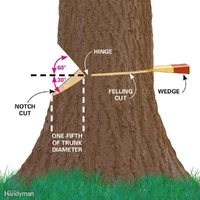
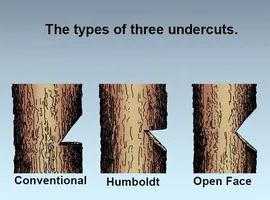
good basics. stepping up a bit with the back cut can and is very important. I even do so sometimes on a open face (even if it's harder to gauge hinge thickness. This is were it is difficult for beginners, every tree is different, and each situation calls for different cuts. Knowing what to use when is the most important aspect of felling. The beginner should stick with easy easy trees, and learn to recognize limitations of knowledge quickly and accurately.
 
stepping up a bit with the back cut can and is very important.

Simply not true..... "Stump shot" as it was called by Dent is only needed in situations where there is a chance the stump could come back off the stump, which generally does not apply to falling trees in suburban situations... Uphill, any chance of brushing or hitting other trees on the way down, or extremely massive trees that are so big just their weight when it starts to lean will cause back-push at the stump, then YES use stump shot.. otherwise perfectly at level or just above (1/2") is better when accuracy is the primary concern.

Evo you're statement shows that you are simply regurgitating the training you received from loggers without a complete understanding of the physics involved...

ps... this thread was supposed to be about pruning anyhow!
 
Physics PhD in the house.

Wax philosophic for us about String Theory and the uncertainty Principle please.
 
Last edited:
Oh shit, here we go again!
Loggers don't know shit about falling trees Evo. Albert Einstein? Now that mofo could get some wood on the ground!
 
Last edited:
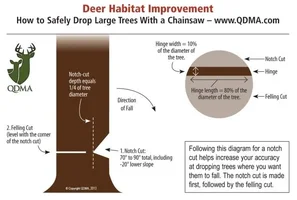
And if you were going to critique the above posting about basics falling for deer habitat, the 80% and 10% are much more suspect than the lack of stump shot.. while they may be fair guidelines for beginners, not too many folks could tell you why and get the answers right.. Yet so many individuals I have run across online get all bent out shape when someone cuts outside the box. Bottom line, they get all critical but don;t know what they are talking about

That includes you Rico... you can climb big trees so that has my respect, but you start pointing fingers and getting all mouthy at things that are clearly beyond your understanding... Your last post about bridging sidewalks was a real tell...
 
Simply not true..... "Stump shot" as it was called by Dent is only needed in situations where there is a chance the stump could come back off the stump, which generally does not apply to falling trees in suburban situations... Uphill, any chance of brushing or hitting other trees on the way down, or extremely massive trees that are so big just their weight when it starts to lean will cause back-push at the stump, then YES use stump shot.. otherwise perfectly at level or just above (1/2") is better when accuracy is the primary concern.

Evo you're statement shows that you are simply regurgitating the training you received from loggers without a complete understanding of the physics involved...

ps... this thread was supposed to be about pruning anyhow!
Oh piss off.. Did I say always? and what else did I say afterwards? It's safer until you learn the differences.. It for the freakin newbies. Look at the freakin thread title man! Also you know very little of my training, so please don't attempt to speak to it.
 
Last edited:

New threads New posts

Kask Stihl NORTHEASTERN Arborists Wesspur TreeStuff.com Teufelberger Westminster X-Rigging Teufelberger
Back
Top Bottom