

Richard Mumford-yoyoman
Been here a while
- Location
- Atlanta GA
I use this technique when ascending tall trees to get a second climb line established as soon as possible for other climbers and to have a second line for rescue.
It also lets the climber become independent of the base leg of the anchor when using a saw or when he/she is concerned with ground crew contact.
In essence, for SRT it gives me another option between a pure base anchor and cinched canopy anchor for redirects.
Also I find it is not worth my effort to create recoverable redirects with a cinched canopy anchor SRT. They can be very temperamental and unpredictable and difficult for retrieval. This is a technique I use to access the tree with multiple redirects.
Redirects:
Same as above to establish the canopy anchor. The climb side of the line is then used for access to the tree with numerous redirects just as you would if it was still a base tie. After you have worked the tree and redirected your line numerous times, return to the trunk where the other side of your now two line canopy anchor is hanging. Reconnect to this line, ascend to the canopy anchor, recover the redirects and work the other side of the tree or remove the bunny ears returning it to a base tie anchor. Reconnect to the primary side of the climbing line and verify the base anchor is secure and you are connected to the proper side of the line. Descend and recover the canopy anchor.
Tall tree access:
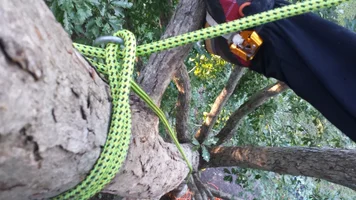
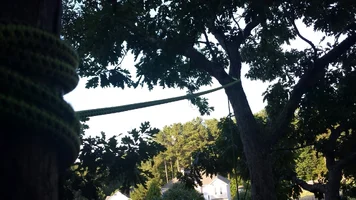
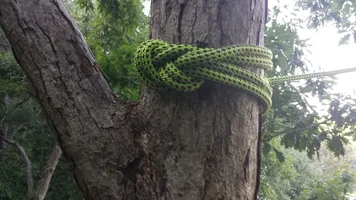
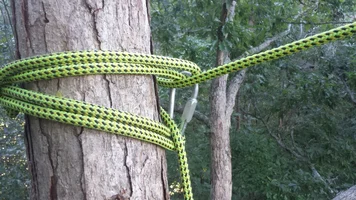
Usually a base anchor is set with the line entering the canopy as high as possible. The first climber reaches this canopy anchor and then advances it. One way to do that is to use a long lanyard or the tail of the climbing line. A pulley such as an Omni Block or Hitch Climber pulley can be used to establish a new temporary anchor at each pitch advancement. The climber never disconnects from this line and each time the pulley is set, this allows the climber to disconnect his lanyard and advanced to the next pitch. Once the final desired anchor is reached the tail of the climbing line is pulled up and over the new anchor. Again, the climber never disconnects from the line and is still supported by the pulley. Enough slack is placed in the line, a double figure 8 (bunny ears) is tied and a screw link is used to cinch both legs of the climbing line to this new anchor. Now both sides can be access by two climbers at the same time and the load has not increased at this anchor. The base anchor may remain tied but is loose and should be examined before used again as a base anchor. Removal requires the bunny ears to be released and care must be taken to descend on the correct side of the base anchor.
Richard
It also lets the climber become independent of the base leg of the anchor when using a saw or when he/she is concerned with ground crew contact.
In essence, for SRT it gives me another option between a pure base anchor and cinched canopy anchor for redirects.
Also I find it is not worth my effort to create recoverable redirects with a cinched canopy anchor SRT. They can be very temperamental and unpredictable and difficult for retrieval. This is a technique I use to access the tree with multiple redirects.
Redirects:
Same as above to establish the canopy anchor. The climb side of the line is then used for access to the tree with numerous redirects just as you would if it was still a base tie. After you have worked the tree and redirected your line numerous times, return to the trunk where the other side of your now two line canopy anchor is hanging. Reconnect to this line, ascend to the canopy anchor, recover the redirects and work the other side of the tree or remove the bunny ears returning it to a base tie anchor. Reconnect to the primary side of the climbing line and verify the base anchor is secure and you are connected to the proper side of the line. Descend and recover the canopy anchor.
Tall tree access:
Usually a base anchor is set with the line entering the canopy as high as possible. The first climber reaches this canopy anchor and then advances it. One way to do that is to use a long lanyard or the tail of the climbing line. A pulley such as an Omni Block or Hitch Climber pulley can be used to establish a new temporary anchor at each pitch advancement. The climber never disconnects from this line and each time the pulley is set, this allows the climber to disconnect his lanyard and advanced to the next pitch. Once the final desired anchor is reached the tail of the climbing line is pulled up and over the new anchor. Again, the climber never disconnects from the line and is still supported by the pulley. Enough slack is placed in the line, a double figure 8 (bunny ears) is tied and a screw link is used to cinch both legs of the climbing line to this new anchor. Now both sides can be access by two climbers at the same time and the load has not increased at this anchor. The base anchor may remain tied but is loose and should be examined before used again as a base anchor. Removal requires the bunny ears to be released and care must be taken to descend on the correct side of the base anchor.
Richard


