Basal Anchors

Has anyone ever heard of or rescued someone from a basetie? And if so did a climber go in the tree to assist?
 
Has anyone ever heard of or rescued someone from a basetie? And if so did a climber go in the tree to assist?
http://www.treebuzz.com/forum/threa...ce-hornets-broken-back-a-few-years-ago.38024/

This is the only one I know of... I am sure there has to be others! Tom's point where a base tie can assist a climber while rescuing a victim is a very good solid point. I'd like to here more stories of any kind of rescue, perhaps from first hand accounts. Been doing this for close to 12 years, and I don't know of any in my area.

 
I've been letting the question of rescues simmer for a couple of days. I can't recall ever hearing a first hand report of a tree rescue. Certainly annecdotal stories

I did a rescue of a homeowner who got bopped and was downclimbing a ladder on their own. Not a rope rescue. All I could do was keep him on a stable position as he stepped down
 
I've participated in a couple self rescues from bucket trucks do to failed hydraulics for one reason or other.

I have also done a rescue back when I was a boy scout that invoiced casting someone 3 miles out of the woods in a stretcher made from a tarp and some small saplings.

But never anything involving climbing
 
http://www.treebuzz.com/forum/threa...ce-hornets-broken-back-a-few-years-ago.38024/

This is the only one I know of... I am sure there has to be others! Tom's point where a base tie can assist a climber while rescuing a victim is a very good solid point. I'd like to here more stories of any kind of rescue, perhaps from first hand accounts. Been doing this for close to 12 years, and I don't know of any in my area.
Yea with another climber in the air it definitely is a good idea to assist him. They really have to have some solid communication going though. Not a deterrent but if your the second climber, going up, hoping your (maybe greenhorn) groundie is gonna be smooth lowering while your maneuvering, you could run into problems. I realize everyone should be trained on everyone’s base rescue system but in reality their not.
 
Yea with another climber in the air it definitely is a good idea to assist him. They really have to have some solid communication going though. Not a deterrent but if your the second climber, going up, hoping your (maybe greenhorn) groundie is gonna be smooth lowering while your maneuvering, you could run into problems. I realize everyone should be trained on everyone’s base rescue system but in reality their not.

You're right.

I don't know if everyine else kind of has a 15-30 minute session of sitting around bullshitting before work starts, but we do. That could be time that could really make a difference if I ever do cut the piss out of myself with a saw at height.
I should go in early and set up the one I'm using at the moment and have everyone operate it before work Tuesday. We talk about them, but my ground guy has never lowered me.
 
You're right.

I don't know if everyine else kind of has a 15-30 minute session of sitting around bullshitting before work starts, but we do. That could be time that could really make a difference if I ever do cut the piss out of myself with a saw at height.
I should go in early and set up the one I'm using at the moment and have everyone operate it before work Tuesday. We talk about them, but my ground guy has never lowered me.
Im like the unofficial assistant saftey guy for four to five crews( depending on two and one man routes). We dedicate a great deal of time to saftey and training. There is just so much material to cover and each one of our climbers are extremely custom so it would be exhaustive to keep up with everyone’s rescue systems and gear. A complacent excuse but a reality none the less.
 
You're right.

I don't know if everyine else kind of has a 15-30 minute session of sitting around bullshitting before work starts, but we do. That could be time that could really make a difference if I ever do cut the piss out of myself with a saw at height.
I should go in early and set up the one I'm using at the moment and have everyone operate it before work Tuesday. We talk about them, but my ground guy has never lowered me.
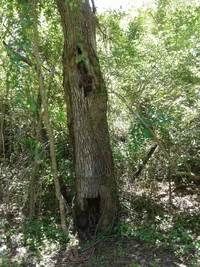
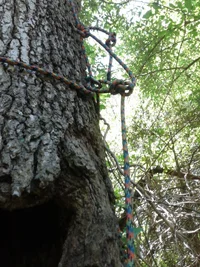
We practiced lowering myself as the dummy , from the base anchor I pictured that day. My groundy is my cousin and a climber on a Blake's hitch for years , so he's awfully familiar with what needed to happen in that system. I was over a large fatty union so there was good friction at t.i.p. that allowed excellent control for him to lower me the
Last ten feet from ground. A half wrap on bole may be needed to relieve friction on hitch. There's another variation which is better using ROPE wrench over eye to eye hitch on base anchor, skip the bullshit. Of course there is extra cost , but Wrench it for ease of use.
 
Im like the unofficial assistant saftey guy for four to five crews( depending on two and one man routes). We dedicate a great deal of time to saftey and training. There is just so much material to cover and each one of our climbers are extremely custom so it would be exhaustive to keep up with everyone’s rescue systems and gear. A complacent excuse but a reality none the less.
I think that is a very realistic set of circumstances for a lot of crews though: everyone doing things a little differently. So do we then have to train for every individual climbers worst case scenario? Where do you draw the line? I think you gota just hope that if you really need rescue that there's another good climber on the crew who will figure it the f out in a hurry, or give the groundie the best run down on how to bail you out before your climb each time.
 
I think that is a very realistic set of circumstances for a lot of crews though: everyone doing things a little differently. So do we then have to train for every individual climbers worst case scenario? Where do you draw the line? I think you gota just hope that if you really need rescue that there's another good climber on the crew who will figure it the f out in a hurry, or give the groundie the best run down on how to bail you out before your climb each time.
That is the likely scenario. But the hurrying part is where an accident will happen. I’ve heard (maybe fake news) that more people get hurt practicing rescues then they are rescued. Not to take away from practicing but it Kinda shows that if practicing one day a year, in a non Live scenario , rescuing proves way trickier and difficult than it seems. When Pete’s arm is dangling from a saw cut and your trying to keep him calm, maneuver him through a canopy, and yell down to the groundie how to work his base tie, it gets dangerous. I typically just use trunk wraps tied off. It may not pass the whistle test but it’s “practiced” by almost everyone rigging everyday
 
I'll take a simply, effective, real world based wrap that doesn't pass the whistle test UNLESS it does. When it pass the whistle test, it becomes cumbersome. If you take three wraps on a big tree, it's going to lock-up.


I'll still take a single wrap, and prefer it over DdRT' s ground rescuing capability.


AND

Focus on why rescues are needed a TON more, and focus on that mitigation.


Quick survey...#1 reason for a climber to need ASSISTANCE?

#1 reason that climbers' don't self-rescue?
 
Last edited:
Just going to point out/rehash that, presumably, in real rescues one cuts the rope and/or the tree to get the person rescued, so these trainings are a little odd...
 
I think cutting ropes is a terrible idea!!!

Use a releasable-under-load system.

The hornet thread/ cut rope resulted in more injury from the 'Rescue' than the hornets
 
And if the climber can't self rescue and was presumably injured from cutting, who's going to unclip his flip line? I tell myself that in the event of a bad cut, I'm bailing myself out no matter what. If I can't even self rescue then I probably have far worse things to worry about than my groundie safely lowering me from the tree. There's a video of a climber blowing out a top and almost cutting his hand off, and he's on the ground yelling for help in a matter of seconds from his own reactivity. That's pretty realistic I think. Every time I've ever been in or seen a climber in a "need to bail NOW" situation, they're on the ground before anyone even knows what's happened. Not arguing the need for training and preparedness, just talking real world.
 
I'll take a simply, effective, real world based wrap that doesn't pass the whistle test UNLESS it does. When it pass the whistle test, it becomes cumbersome. If you take three wraps on a big tree, it's going to lock-up.


I'll still take a single wrap, and prefer it over DdRT' s ground rescuing capability.


AND

Focus on why rescues are needed a TON more, and focus on that mitigation.


Quick survey...#1 reason for a climber to need ASSISTANCE?

#1 reason that climbers' don't self-rescue?
I'll take a simply, effective, real world based wrap that doesn't pass the whistle test UNLESS it does. When it pass the whistle test, it becomes cumbersome. If you take three wraps on a big tree, it's going to lock-up.


I'll still take a single wrap, and prefer it over DdRT' s ground rescuing capability.


AND

Focus on why rescues are needed a TON more, and focus on that mitigation.


Quick survey...#1 reason for a climber to need ASSISTANCE?

#1 reason that climbers' don't self-rescue?


I appreciate the amazing and insightful thoughts and opinioms on the topic. It just goes to show something perceivably simple can be extremely complex.

I come from a technical rescue background prior to my tree days. That is why my initial thoughts were to go with the tensionless hitch...which is 3 wraps around an anchor then binered back onto the standing part. In my experience I have never had that hitch tension up. I don't believe that on a base anchor the hitch would bind...especially on larger trees. The greater the circumference means less tension would extend towards the biner
 

New threads New posts

Kask Stihl NORTHEASTERN Arborists Wesspur TreeStuff.com Teufelberger Westminster X-Rigging Teufelberger
Back
Top Bottom