












Navigation
Install the app
How to install the app on iOS
Follow along with the video below to see how to install our site as a web app on your home screen.
Note: This feature may not be available in some browsers.
More options
You are using an out of date browser. It may not display this or other websites correctly.
You should upgrade or use an alternative browser.
You should upgrade or use an alternative browser.
Balancing long limbs parallel to ground (crane slings)
- Thread starter JJM IV
- Start date


evo
Been here much more than a while
- Location
- My Island, WA
Are you using two slings? Three?I have been miscalculating (tip heavy / light and butt the same) the dead eye slings when removing long parallel limbs. Maybe the sling angle too great? miscalculating center balance? Curious to rules of thumb too. Thx for help.
A second dead eye with a large(ish) eye attached to the primary with a prussic helps.
Set the butt first then walk out and set the tip. This way if you need to adjust you can adjust the butt one, or worse case go back to the mid point after wire down and adjust the prussic.
Best to have the ball over the estimated balance point and have equal tension around 30 degrees sling angles.
A their sling slightly taught at the balance point if heavy picks as a oopsies backup if slipping prussic is a concern
Often the middle point is tip heavy


Matias
Been here much more than a while
- Location
- Butte County
Omg, if we get to crane out this big black oak that we bid, I am gonna suggest that. That sounds efficient as fuckDo you have one person rigging & rappelling and another person cutting?

flushcut
Been here much more than a while
- Location
- Delavan, WI
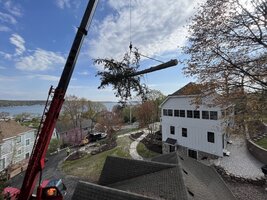
My crane OP likes me to sling them wide on horizontal picks.

It works out great. Saves bunch of time and saves me a shit load of pain.Omg, if we get to crane out this big black oak that we bid, I am gonna suggest that. That sounds efficient as fuck
I'm usually the guy cutting in this scenario. The big oak I posted about in the today thread was done this way. I set the first pick for the top, rappelled down, and made my cut. Almost all the rest were horizontal leaders, save one. I set a TIP where I could maneuver around for the remaining picks. That last pick of 30k lbs, both of us set 6 twenty foot eye slings with 2 shackles. 3 straps for each shackle. The guy setting straps was a bit slow. He's not privy to crane work but, it still was done within 3 hrs. If I recall, there were 8 or 9 total picks.
evo
Been here much more than a while
- Location
- My Island, WA
I don’t, haven’t done a crane job in years. That and the vast majority is conifer work. Most of the time we brush it out and pick wood.Do you have one person rigging & rappelling and another person cutting?
evo
Been here much more than a while
- Location
- My Island, WA
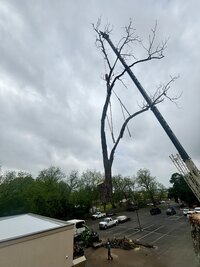
I had a bad experience with wide angle slings. A bigleaf maple lead busted out and was laying horizontal through the crown of the tree. Maybe 40’-50’ long. The longest slings we had were 15’ or about. The stem buckled as the operator was rotating after it cleared the tree. I was working the ground and dodging giant 3’ maple splinters in the parking lot.View attachment 93777
My crane OP likes me to sling them wide on horizontal picks.
flushcut
Been here much more than a while
- Location
- Delavan, WI
Duly noted.

Stumpsprouts
Been here much more than a while
- Location
- Asheville
Having the piece butt heavy will generally work out better than tip heavy. So I would ensure the tip is tied adequately far out in the piece, and often have the crane cable up slightly before I tie on the butt so that the tip has more tension. Where the ball is placed relative to COG has a lot to do with how it will behave as well. Each piece is its own unique challenge, isn’t it? If it’s a wide brushy pick I will add a third sling to keep it from rotating. Maybe you can describe your process a little more to help us get a sense.I have been miscalculating (tip heavy / light and butt the same) the dead eye slings when removing long parallel limbs. Maybe the sling angle too great? miscalculating center balance? Curious to rules of thumb too. Thx for help.

cody willard
Participating member
- Location
- Tulsa
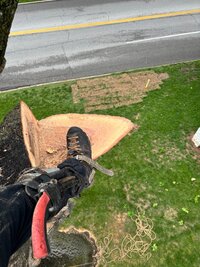
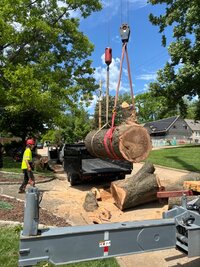
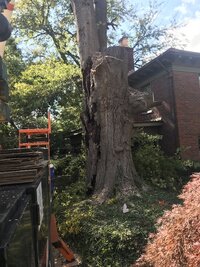
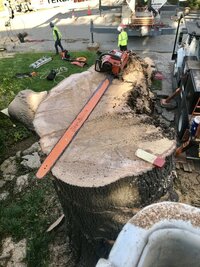
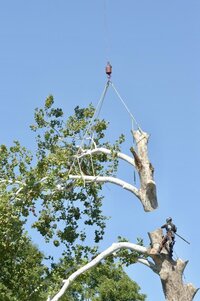
Self cuts are king for the horizontal picks. Obviously you want it balanced perfectly, but you can purposely rig it slightly butt heavy, and allow it to lift off the shelf.
You can also make an upward cut on the brush end, then a horizontal plunge cut to rip down a fat branch. After that, you can trigger it with the downward cut at the branch collar as pictured, (third to last picture).
You need Nick Taylors NT Slings and log Equalizer . Incredible adjustability.
Finding the balance point is key, but slightly butt heavy is better then brush heavy IMO.
You can also make an upward cut on the brush end, then a horizontal plunge cut to rip down a fat branch. After that, you can trigger it with the downward cut at the branch collar as pictured, (third to last picture).
You need Nick Taylors NT Slings and log Equalizer . Incredible adjustability.
Finding the balance point is key, but slightly butt heavy is better then brush heavy IMO.
Attachments

Last edited:

Daniel
Carpal tunnel level member
- Location
- Suburban Philadelphia (Wayne)

Jehinten
Been here much more than a while
- Location
- Evansville
Take an extra 5 mins on the job and after a piece is down, adjust the slings and re-lift.I have been miscalculating (tip heavy / light and butt the same) the dead eye slings when removing long parallel limbs. Maybe the sling angle too great? miscalculating center balance? Curious to rules of thumb too. Thx for help.
See where the slings should have been for a balanced pick and adjust for the next one.
Daniel
Carpal tunnel level member
- Location
- Suburban Philadelphia (Wayne)
good stuff...Self cuts are king for the horizontal picks. Obviously you want it balanced perfectly, but you can purposely rig it slightly butt heavy, and allow it to lift off the shelf.
You can also make an upward cut on the brush end, then a horizontal plunge cut to rip down a fat branch. After that, you can trigger it with the downward cut at the branch collar as pictured, (third to last picture).
You need Nick Taylors NT Slings and log Equalizer . Incredible adjustability.
Finding the balance point is key, but slightly butt heavy is better then brush heavy IMO.












New threads New posts
-
test
-

-
-
-
-
 Light 14 or 16" narrow kerf bar for 200t or 201t
- Started by southsoundtree
- Replies: 9
-








