Anyone else give-up on routine "friction-saver" usage?

I like the idea of a smaller retrieval line, but after learning about how the retrieval side could be used an an access line for an aerial rescue, I now use another climbing line as a retrieval

I’ve been skeptical of knot blocking carabiners, how has that been for you @oceans?
I should have been more clear when putting two different types of gear into the same post. I can see how it could be misconstrued. So, I’ll clear it up here...I do not knot block against a carabiner.

The Midline Anchor I described is for just that, mid line SRS Redirect or MRS Canopy Anchor. Do not knot block against a carabiner.

I was just mentioning the different types of Anchors I employ on the regular based on the title of the thread. I definitely will not ever give up routine friction saver usage.
 
So a comment from the cheap seats again . . . I'm doing a masssive gear clean during our +35/36 degC week of cloudless skies after getting a touch of heat stroke couple of weeks ago (no matter how careful I was - unacclimated I guess). Anyway, one really interesting thing I noticed in this clean fest is that my SRT ropes (base tied) which usually go over a couple of branches on the same whorl, these all had about an eight to ten-ish inch section of really ground-in sap, right about the length where they'd have gone over the branches (spruce or pine usually). I speculate that through the course of the climb/ work as I weight and unweight the rope, the rope gives up stretch it's acquired under load and does saw a bit back and forth on the branch. Never really looked at them before hitting the down button but I'll have to do this next couple of ups. MRS saws conifer limbs no end, so I at least use a leather branch saver if not something more spiffy from Teufelberger etc. But hadn't thought of SRT doing the same (on a smaller scale) cuz of rope stretch. Or is it the heat?
I have stiff sections of embedded pine pitch in several lines that have been used base anchored while pruning conifers. These sections will stop the bird on a RW or Rope Runner. Definitely want to use cambium protection of some sort for SRS redirects in conifers.
-AJ
 
Last edited:
Less about rope stretch more about the tree bending under the climber's load. Using a more static ascent line might cause more 'sawing'
Thought about this Tom and I don't think it was tree movement - these were still "large" straight stems for the most part and the SRT line was set over one or two branches on the same whorl right near the stem - using Richard's loop-hop on-listen before going up, there was nada movement in the tree that I could see. But I had sometimes about 100 - 140 ft of rope out when you counted up-over-then climbing leg (oh oh, is a strict diet indicated?).

On a side note, the last spruce I topped after limbing was straight as an arrow on an about 70 ft stem, but stayed that way, and seemed to sway from the roots somewhere when I watched it go and we tottered a bit. Felt creepy. No root rot, good solid stem wood and no indication of ground movement in the root plate before ascending and limbing. Guess it was just a different tree . . . . be safe out there. Ya never know.
(Removal 'cuz a deck contractor had ratched the crap outa this tree's roots with a bobcat, when putting in a new deck . . . maybe he cut more than we thought)
 
Thought about this Tom and I don't think it was tree movement - these were still "large" straight stems for the most part and the SRT line was set over one or two branches on the same whorl right near the stem - using Richard's loop-hop on-listen before going up, there was nada movement in the tree that I could see. But I had sometimes about 100 - 140 ft of rope out when you counted up-over-then climbing leg (oh oh, is a strict diet indicated?).

On a side note, the last spruce I topped after limbing was straight as an arrow on an about 70 ft stem, but stayed that way, and seemed to sway from the roots somewhere when I watched it go and we tottered a bit. Felt creepy. No root rot, good solid stem wood and no indication of ground movement in the root plate before ascending and limbing. Guess it was just a different tree . . . . be safe out there. Ya never know.
(Removal 'cuz a deck contractor had ratched the crap outa this tree's roots with a bobcat, when putting in a new deck . . . maybe he cut more than we thought)
Every time a climber loads up the rope during ascent or while working, the line digs a little more into upper conifer unions, even with the most static lines just a few millimeters of rope movement in the load and rebound cycle is going to dig down, if there is tree flex/movement even more so.
-AJ
 
Thought about this Tom and I don't think it was tree movement - these were still "large" straight stems for the most part and the SRT line was set over one or two branches on the same whorl right near the stem - using Richard's loop-hop on-listen before going up, there was nada movement in the tree that I could see. But I had sometimes about 100 - 140 ft of rope out when you counted up-over-then climbing leg (oh oh, is a strict diet indicated?).

On a side note, the last spruce I topped after limbing was straight as an arrow on an about 70 ft stem, but stayed that way, and seemed to sway from the roots somewhere when I watched it go and we tottered a bit. Felt creepy. No root rot, good solid stem wood and no indication of ground movement in the root plate before ascending and limbing. Guess it was just a different tree . . . . be safe out there. Ya never know.
(Removal 'cuz a deck contractor had ratched the crap outa this tree's roots with a bobcat, when putting in a new deck . . . maybe he cut more than we thought)

Not to divert but I’ve been casually thinking about this string of comments for about three weeks :b
I don’t climb “tall” tall trees often, we don’t have a ton around here. Was climbing an eastern cottonwood recently, got a massive TIP about 70ish feet up. It was a luxury lol. It was in between two houses with another tree to the right about 18(?) feet. The crotch was perpendicular to the neighboring tree. Tons of shit growth at the base of the tree so I decided to do one of those ”basal anchor across the yard” type deals. My rope went up through the crotch, turned right, went down to base of the other tree. Aside from hugging the tree with the twist up top, the rope was totally free I.e no lower trunk friction at all at ~45 degree angle. I’m still learning the physics of all this, but before I set the rope was thinking softening that angle decreased forces. I hop on the rope (Yale focus) and there was an insane amount of stretch comparatively. I’ve had climbs recently almost as high with minimal rope stretch. Tree flex would be mindblowing to me, my tip was massive. Was it really the amount of rope in the system? Anybody have input here? The twist up top adding some kind of undesirable force multiplier?
 
Not to divert but I’ve been casually thinking about this string of comments for about three weeks :b
I don’t climb “tall” tall trees often, we don’t have a ton around here. Was climbing an eastern cottonwood recently, got a massive TIP about 70ish feet up. It was a luxury lol. It was in between two houses with another tree to the right about 18(?) feet. The crotch was perpendicular to the neighboring tree. Tons of shit growth at the base of the tree so I decided to do one of those ”basal anchor across the yard” type deals. My rope went up through the crotch, turned right, went down to base of the other tree. Aside from hugging the tree with the twist up top, the rope was totally free I.e no lower trunk friction at all at ~45 degree angle. I’m still learning the physics of all this, but before I set the rope was thinking softening that angle decreased forces. I hop on the rope (Yale focus) and there was an insane amount of stretch comparatively. I’ve had climbs recently almost as high with minimal rope stretch. Tree flex would be mindblowing to me, my tip was massive. Was it really the amount of rope in the system? Anybody have input here? The twist up top adding some kind of undesirable force multiplier?
It sounds like you may have, with your climbing line, been leveraging the entire cottonwood in the direction of the tree you anchored your base too. There’s a lot of play there. I tend to avoid these very open ‘basal anchor across the yard’ types due to the increased leverage applied to the TIP. Better to be straight up and down. If there’s a tree pretty close by, of course that’s fair game... if not, either setup canopy, or set up basal at the base of cottonwood and switch while aloft.
 
Right on. I was gonna switch the basal anchor to the tree I was in but in this case trusted the TIP regardless so opted to move forward. Sometimes wording is everything - I was not considering the huge lever arm which would increase as I limb walk. Thanks.
 
Not to divert but I’ve been casually thinking about this string of comments for about three weeks :b
I don’t climb “tall” tall trees often, we don’t have a ton around here. Was climbing an eastern cottonwood recently, got a massive TIP about 70ish feet up. It was a luxury lol. It was in between two houses with another tree to the right about 18(?) feet. The crotch was perpendicular to the neighboring tree. Tons of shit growth at the base of the tree so I decided to do one of those ”basal anchor across the yard” type deals. My rope went up through the crotch, turned right, went down to base of the other tree. Aside from hugging the tree with the twist up top, the rope was totally free I.e no lower trunk friction at all at ~45 degree angle. I’m still learning the physics of all this, but before I set the rope was thinking softening that angle decreased forces. I hop on the rope (Yale focus) and there was an insane amount of stretch comparatively. I’ve had climbs recently almost as high with minimal rope stretch. Tree flex would be mindblowing to me, my tip was massive. Was it really the amount of rope in the system? Anybody have input here? The twist up top adding some kind of undesirable force multiplier?
You should try climbing with 300-400ft in your system.. No matter what rope you are climbing on you are gonna experience some rope stretch, and if you are using a line with even a moderate amount of elongation you are in for a fairy miserable climb (MRS or SRS.)
 
There is so much more involved within these two setups than that. With careful thought and understanding, each situation can provide benefits worth doing.
I have been ruminating on this. What would you consider a situation in which a basal anchor across the yard would have enough benefits worth doing?

I’m thinking of the times I have done this, and I can only remember one time that I felt it was really the best option. It was a large white pine prune, and I had a good enough shot to the canopy but if I had taken the anchor side of the line to the base of the pine, I would have put too much pressure on some smaller limbs and would have broken them out. So I was anchored to a dogwood on the other side of the yard for the ascent, then switched my anchor once I was aloft. I don’t think I’ve ever kept working in a tree start to finish with a basal anchor of an angle around 45. Maybe 15.
 
I have been ruminating on this. What would you consider a situation in which a basal anchor across the yard would have enough benefits worth doing?

I was climbing a tree where the main lead, and my tie in point, was about 10-15 feet leaned away from the base, and the branch below it, that i was removing, was stretching another 30ish feet further away from the base. Tree wasn't exceptionally strong or thick. Putting the base anchor to another tree opposite all this lean directed the force more toward the base of the tree I climbed, and rope was totally out of the work area.
 
I have been ruminating on this. What would you consider a situation in which a basal anchor across the yard would have enough benefits worth doing?
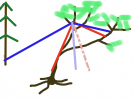
I did this once about three years ago when my neighbor asked me to get his kid's kite down from about 50 feet up a tall spindly alder (kite was a pricey one, a birthday present). The alder was leaning quite a bit and not a very big tree in diameter; no way would I have felt good hanging on it. But he had another tree across his back yard, opposite direction to the lean of the alder, and when I ran the basal tie to that, about 45 degrees, it seemed to take every bit of down pressure off the alder when I put my weight on the rope.
 
quick drawing, just showing how i visualize the change in the vector force .. red being simple base tie, blue showing how the angle moves closer to the line of the trunk as it opens up. in the case described the other tree was probably 50 feet away so the angle opened up quite a bit, more than as it looks here.


ropeangle.png
 
quick drawing, just showing how i visualize the change in the vector force .. red being simple base tie, blue showing how the angle moves closer to the line of the trunk as it opens up. in the case described the other tree was probably 50 feet away so the angle opened up quite a bit, more than as it looks here.


View attachment 77270
Right, I see that, thanks. With a key element being its lean away from the basal anchor on the left, correct?

I’m thinking about why I have avoided those situations. With a tree of that nature I usually set a tie back with a rig line and mechanical advantage. I can see this is a way to make your basal anchor act a bit like a tie back.
 
I have been ruminating on this...

LOL!

@dspacio did a good job with the explanation. It is something that I do often. I thinking it has been years since I used a canopy anchor for a primary ascent.

I am always searching for any way to stabilize the loading so that vectors are in compression and potential multipliers are at their lowest.
 
With a key element being its lean away from the basal anchor on the left, correct?
yes indeed. as I understand it, the force vector at any time, will be between the direction of your pull, and the other end of the anchor. ideally, this force is directed down in line with the trunk. the tree or branch lead will never collapse down its length, it's the snapping to the side that's our danger.

sometimes it doesn't matter, but when I am on a small lead, or a snappy (not bendy) kind of tree, I will arrange a redirect or the anchor itself, to direct that vector right down the trunk, especially considering in relation to any area I need to do significant work or go far out.
 
quick drawing, just showing how i visualize the change in the vector force .. red being simple base tie, blue showing how the angle moves closer to the line of the trunk as it opens up. in the case described the other tree was probably 50 feet away so the angle opened up quite a bit, more than as it looks here.


View attachment 77270
This is a good illustration of a way to improve how a climber can potentially load a tree. If given this scenario in the real world, I’d take the blue pill.

What I learned when researching for a presentation at expo a few years ago was how much of a role friction plays in the resulting vectors. Essentially, in real lapels application, the vector will rarely follow a geometrical bisect of the incoming and outgoing paths of rope.

I set up several RE Enforcers within the spans of a stationary climbing system. I began with a single redirect over a large union with a 180 rope angle and an Enforcer on the anchor leg and on my climbing side. This allowed me to set a baseline for forces imparted while climbing.and also see how my movement affected the anchor side.

I then added a second redirect and left the anchor side Enforcer in place while moving the second one to the new span of line between the anchor leg and climbing leg.

The data I got was almost mind blowing. I knew friction, degrees of deflection, union circumference, rope type, and several other factors played a role in what the tree experiences…I just had no idea how much. I’m not advocating doing so, but you can almost get to a point with enough redirects that you could base anchor off your lunch bag.

This research really expanded my understanding of the real world vectors, and truly helped me in choosing just how and where to anchor and redirect based on where I need to work in the tree.

Also, David is right in that vector force is slightly redundant, since a vector is the result of a force in a particular direction.

Essay complete. And just as a note, prior to C-19, I spoke with RE about my research and they generously sent me a couple more Enforcers to build a more elaborate system and expand the data. I will likely present again once I make time to run more tests and contact TCIA.

 
little trick, if your on a ropewrench

tie an alpine butterfly 2ft from the spliced eye in your rope, put a quickie around your rope and thru the butterfly, and a biner in the spliced eye, pull the side you want to climb on, so the quickie sinches up on the limb, and climb that STR till you reach your TIP, then hook the biner to your hitchclimber, take the wrench off, and undo the quickie
Treesap,

I'm a recreational tree climber. I learn so much on these forums, then go out and try them out. Your "trick" has me all excited for this afternoon's climb. That transfer from SRT to DRT has been a bit kludge in my situation. Thank you for the idea.
 

New threads New posts

Kask Stihl NORTHEASTERN Arborists Wesspur TreeStuff.com Teufelberger Westminster X-Rigging Teufelberger
Back
Top Bottom