









Anthracnose on valley oak?

Ahoy!
i'm looking at a young valley oak, 40 feet tall, growing in Oakland, CA. It is only getting bigger. Tips of twigs blighted throughout, drops leaves constantly in season. PITA. HO would treat it if he could, but I don't think treatment has a great chance of success due to the size of the tree and location location location. It's a somewhat dense living area, so I don't think he wants to hose fungicide all over the neighborhood. This tree is definitely out of habitat as they tend to live out in the parts of California that are both hotter and colder. Bay area weather is a little too mild in summer and winter.

I'm thinking anthracnose, can't figure out what else it would be. Any thoughts? Thanks in advance!
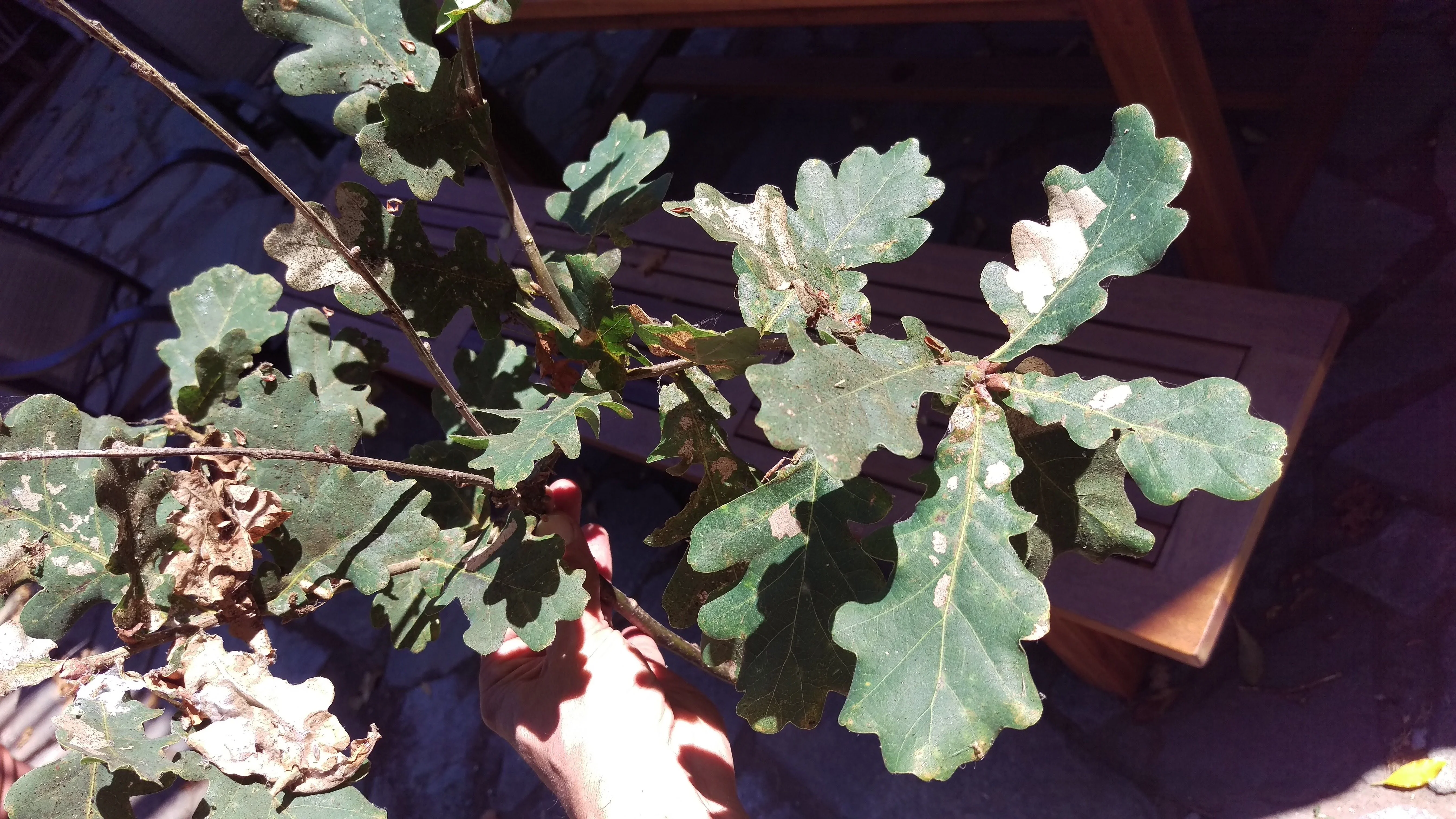
 
Not quite right for Taph. leaf blister. I thought window paning from sawfly or caterpillars.
Some defoliated stems look to potentially have a fungal issue.
Some honeydew and spotting on some leaves too.
Is oak Diplodia problematic out there?
 
It's close, i would need a closer look to see raised blisters and their underside. Could be though.
Peteyt is going to take a closer look I believe.
 
Hiho, I'm back, thanks so much for the suggestions.

I realize that my photo isn't the best now that i am not next to the tree. Wish I had a photo of whole tree for you. I'll get back over there. The sample I pulled is now fairly old and dry. Definitely some caterpillar activity, but it doesn't appear to be the problem agent at work. I do want to see who is in there, as I am trying to learn more about insect activity in our trees here.

Don't think Taphrinia, as I don't see blisters on underside.

Diplodia possible. We have it out here, but my impression is that is affects some individual branches and also has a tendency to invade injuries. It also affects whole branches (from the description) and I am not seeing that. This is an unpruned young tree, and the symptoms of terminal dieback appear throughout the tree, from the leaders to the low laterals. It is a "fairly" uniform distribution of dead terminals. I say "fairly" because I have actually spent little time with the tree, but it is definitley all over the tree. Most terminal buds are infected and new growth is coming from lateral buds. The HO says that it starts dropping leaves almost immediately after spring growth flush and continues throughout the growing season.

I'm looking also at "oak twig blight" or Cyptocline cinerescens. This has a more scattered distribtion and tends to affect the terminal shoots. It also, apparently, can operate in association with anthracnose and other fungi here in California.

I am seeing leaf tissue dying along the veins of the leaf, which is a feature of anthracnose here.

My sense is that it is a fungal issue of some sort, but I am still learning learning learning. thanks for your attention and guidance =-). The tree doesn't seem to mind much and is growing quickly, but I have concerns about when this tree is large and dieback starts to happen. This is going to be a big tree, and it isn't quite in the right place, so that's another problem. I think the HO would keep it if he could know that he could treat the agent effectively, but I have real doubts given the disease options I am looking at here. Neither he nor his neighbors have much tolerance for repeated fungicide spraying, especially if chances of success are middling. It would be very sad to remove and replace, but honestly I think that is what we are looking at.

But I'm still learning! THis tree is becoming a teacher to me. Only this one neighborhood in Oakland has these trees and they are naturalized in this locality. I don't see them anywhere else. I have always wondered what their deal is. I have it weakly ID'ed as a valley oak, but I"m starting to think it might be something else, need to get back over there and nail this down.

Many thanks! I'll keep reporting.
Pete
 
GTS: A field guide to insects and diseases of california oaks.
Looks to be a good reference for your library.
 
Last edited:
Great - Cornell book page 6 was a great lead, Guy. Thanks.

Same with the california Oak dieases guide - i had forgotten about that one, used to have it on my phone. It actually lumps anthracnose in with cryptocline and a few other fungal blights.

I've got Oaks in the Urban Landscape, but they don't go very into detail. the UC Davis extension site has been helpful as well.

I can't say that I have pinned down just what it happening, but all of the options available seem to be just as difficult to clear up. The HO said that the problem become pronounced starting about 5 years ago and has continued. That about lines up with our continued pattern of warm, wet springs around here. You should just see how bad the fire blight (I know that is a bacteria not a fungus, but it likes the wet warm quite a bit, too) is in the bay area has become in the past 5 years. There is literally nothing to do about it here, nobody even tries.

Inconclusive diagnosis on my end, but, gee whiz, I sure have learned a lot and will apply it to the future.

Thanks, Guy and JD
 
Glad to hear it Pete. Rainy consecutive springs can do weird things with foliar diseases. Past couple I've been seeing some leaf spot going after Japanese tree lilacs that Im unfamiliar with. Makes them look lousy and drop most leaves by summer. Theres always some kind of a tree bummer...
Take care, good luck
 
Yes, I tried sanitation pruning on some back when it got underway, but it was back in 2009, the year people didn't prune trees (recession). It really took off, whole streets of pyrus calleryana going down and nobody was spending any money. You can prune one tree but it just comes back from the neighbors. I've seen a few just die outright. Crazy. The drought hasn't helped them with their defenses. We were talking about this in a local pruning group talk with a respected plant pathologist - one of her colleagues had made a slurry of fire blight to spread on tools and was trying to infect the trees with the blight using pruning cuts. It didn't work. She thought it was all the bees doing. I now agree. New incidences on individual flower spurs. A tree will get 10, 20, more new outbreaks on teeny little spurs - it would be so expensive to prune them out and if you go 12 inches down you have a very funny looking tree.

That folks hate callerys and pyrus kawakamii doesn't help with anyone wanting to protect them. I have looked a little into injections for them, but haven't come across a tree that anyone really wanted to protect that much.

Back in my orcharding days in central CA coast we would prune out the blight to great effect (we didnt' have many pears), but in the urban forest/orchard, you can't control what the neighbors are doing. Similar story with coddling moth in the apples.

Parks and Rec guy in Piedmont said that their callery pears were blight-resistant and still got it. I have one client with a couple of blight-resistant orchard pears and they don't have the blight - it blows my mind every time I see them. They are like the only ones in the whole bay area without it!! I'm fascinated by the blight, though, lots of trees get it and keep right on trucking in a blighty sort of way.
 
Erwinia strikes often lead to Botryosphaeria canker moving in afterwards. Very common on apple and pear. Gotta gotta gotta prune out asap.

Have you priced Arborjet's OTC product? WAY too $$$$$
 
I'll keep an eye out for Botrosphaeria, that must be some of what I am seeing. That's a big problem for the wine grapes around here. Always more to learn. I don't have much of a handle yet on tree diseases, but I will eventually if I just keep paying attention and doing the work.

I figured the Arborjet was bucks, didn't check. good to know.
 

New threads New posts

Kask Stihl NORTHEASTERN Arborists Wesspur TreeStuff.com Teufelberger Westminster X-Rigging Teufelberger
Back
Top Bottom












